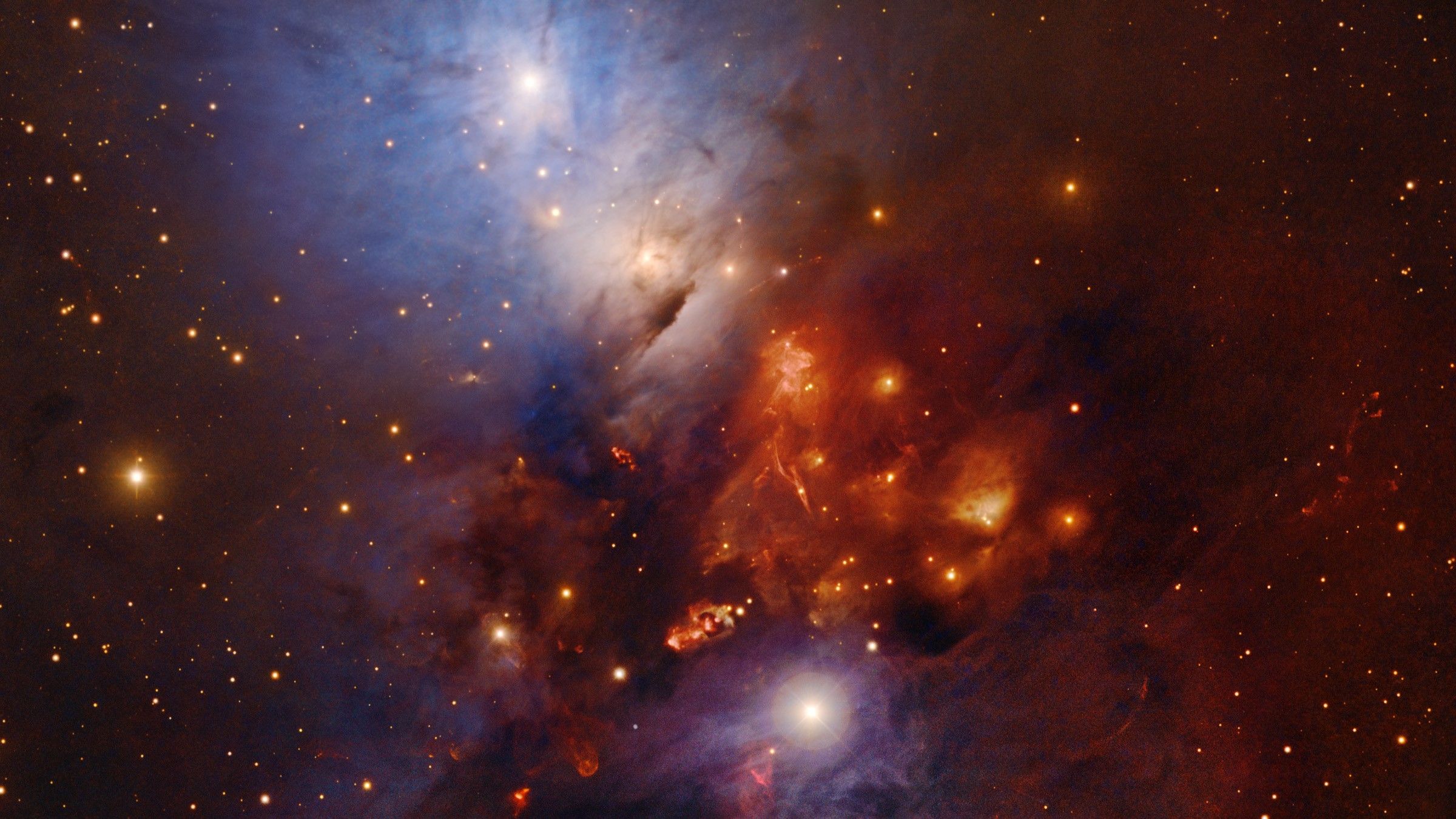
Stunning New Image Reveals Secrets of Star Birth in Dramatic Detail
A breathtaking new image of the SVS 13 star-forming region is rewriting our understanding of how stars are born. Researchers have, for the first time, directly observed a key process predicted by decades of theory: young stars accreting material and then violently ejecting it. This groundbreaking finding, published in Nature Astronomy, offers an unprecedented look into the chaotic early lives of stars.
The team captured this remarkable view using the Atacama Large Millimeter/submillimeter Array (ALMA) in Chile. This powerful radio telescope revealed a stunning array of over 400 ultra-thin, bow-shaped rings surrounding a jet emitted from a young star within SVS 13. These rings aren’t just beautiful; they’re historical records.
Decoding the Rings: A Star’s Life Story
each ring represents the aftermath of a powerful outburst from the star. Think of them like tree rings, marking the passage of time and important events. Remarkably, the youngest ring corresponds to a radiant outburst observed in the SVS 13 system back in the early 1990s.
This direct connection is a major breakthrough. It allows scientists to link a specific burst of activity to a measurable change in the star’s jet speed. Sudden increases in jet activity are believed to be triggered by large amounts of gas falling onto the young star.
“these images give us a completely new way of reading a young star’s history,” explains Gary Fuller,a professor at the University of Manchester. “Each group of rings is effectively a time-stamp of a past eruption.” This insight is crucial for understanding how young stars grow and how their surrounding planetary systems develop.
What This Means for Understanding star Formation
Here’s what this discovery tells us:
* Confirmation of a Long-Held Theory: this is the first direct observational evidence supporting the theoretical model of episodic accretion and ejection in young stars.
* A New Timeline for Stellar Evolution: The rings provide a detailed timeline of a star’s early activity, allowing researchers to study the frequency and intensity of outbursts.
* Insights into Planetary System Formation: Understanding how stars grow and eject material is vital for understanding how planets form within those disks of gas and dust.
This research opens up exciting new avenues for studying star formation. By analyzing these rings, scientists can unlock the secrets of how stars - and potentially, the planets around them – come to be.
For more captivating images of the cosmos, explore the space Photo of the Week archives.