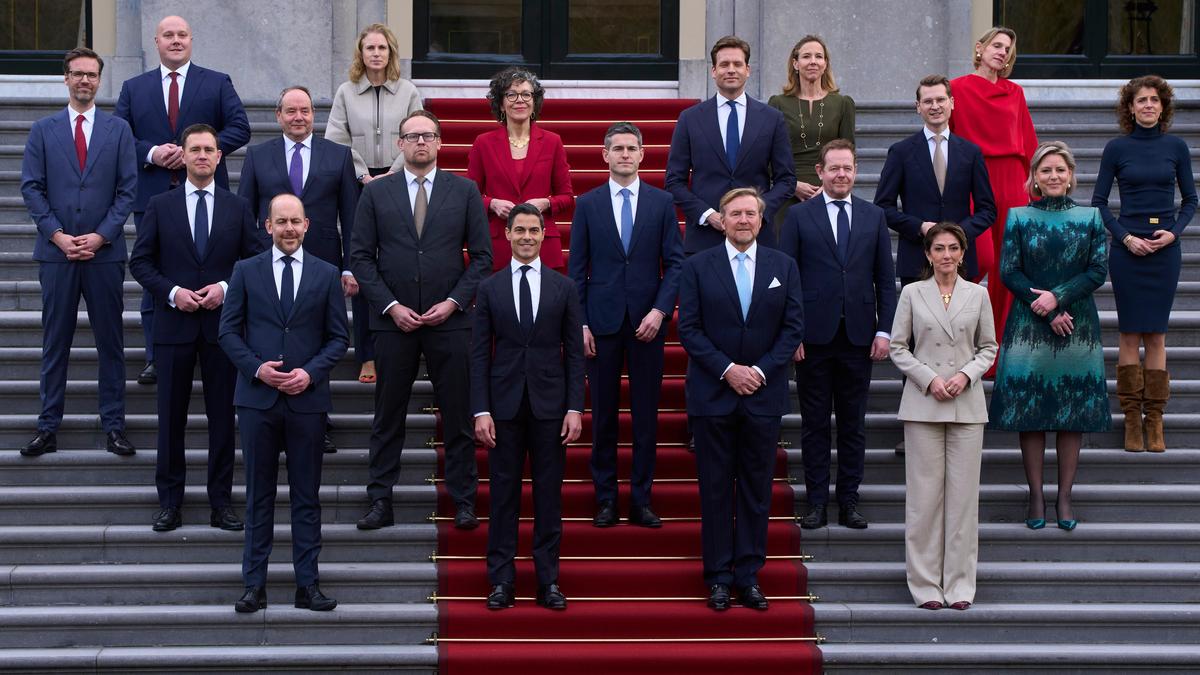
The Netherlands has a new leader. Today, February 23, 2026, King Willem-Alexander swore in Rob Jetten as the country’s youngest-ever Prime Minister, ushering in a new era for Dutch politics. The formation of this minority coalition government, comprised of the centrist Democrats 66 (D66), the Christian Democrats, and the People’s Party for Freedom and Democracy, marks a significant shift in the political landscape and presents unique challenges for the incoming administration. Jetten, at 38 years old, will need to demonstrate considerable political acumen to navigate a fragmented parliament and secure support for his legislative agenda.
The swearing-in ceremony took place in the ornate Orange Hall of the royal palace, located just outside The Hague. It concluded a lengthy 117-day period following national elections held last year. The new cabinet, posing for a traditional photograph on the palace steps alongside the King and Deputy Prime Minister Dilan Yeşilgöz-Zegerius, signaled a commitment to collaborative governance. However, the reality of governing with a minority in the 150-seat parliament – holding only 66 seats collectively – means that Jetten’s success will hinge on his ability to forge alliances and negotiate compromises with opposition parties.
A Delicate Balancing Act: The Challenges Facing the New Coalition
The formation of this three-party coalition represents a complex political negotiation. The Democrats 66, led by Jetten, secured the largest number of seats in the November 2025 elections, but fell short of a majority. The subsequent months were marked by intense discussions with potential partners, ultimately resulting in an agreement with the Christian Democrats and the People’s Party for Freedom and Democracy. As reported by the Associated Press, the new government faces the immediate task of addressing pressing issues such as the cost of living crisis, climate change, and immigration, all while maintaining a delicate balance between the differing ideologies of its constituent parties.
Rob Jetten’s political career has been marked by a rapid ascent. He has served as a Member of Parliament since 2017, and prior to becoming Prime Minister, held the positions of First Deputy Prime Minister and Minister for Climate and Energy Policy. According to his Wikipedia profile, Jetten was born on March 25, 1987, in Veghel, Netherlands, and holds degrees from Radboud University. His experience in climate policy will likely be central to the government’s agenda, as the Netherlands continues to grapple with the impacts of climate change and strives to meet its international commitments under the Paris Agreement.
Key Players in the New Administration
Alongside Prime Minister Jetten, Deputy Prime Minister Dilan Yeşilgöz-Zegerius will play a crucial role in the new government. Yeşilgöz-Zegerius, formerly the Minister of Justice and Security, leads the People’s Party for Freedom and Democracy. Her experience in law enforcement and security issues will be vital as the government addresses concerns related to public safety and immigration. The Christian Democrats are represented by Henri Bontenbal, who will likely focus on social and economic policies aligned with the party’s values.
The composition of the cabinet reflects a commitment to diversity, with a mix of experienced politicians and rising stars. However, the success of the coalition will depend not only on the individuals involved but also on their ability to work together effectively and build consensus across the political spectrum. The limited number of seats held by the coalition parties necessitates a collaborative approach, requiring constant negotiation and compromise with opposition lawmakers.
Navigating a Fragmented Parliament
The Dutch political landscape has become increasingly fragmented in recent years, with a proliferation of parties and a decline in traditional party loyalties. This trend has made it more difficult to form stable governing coalitions and has increased the importance of negotiation and compromise. The current situation presents a significant challenge for Prime Minister Jetten, who will need to build bridges with parties across the ideological spectrum to secure support for his legislative agenda.
Potential areas of contention include economic policy, immigration, and climate change. The opposition parties, including the far-right Party for Freedom led by Geert Wilders, are likely to scrutinize the government’s policies closely and will seek to exploit any weaknesses or divisions within the coalition. Jetten will need to demonstrate strong leadership and political skills to navigate these challenges and maintain the stability of his government.
The Road Ahead: Priorities and Challenges
The new Dutch government faces a number of pressing challenges in the coming months. Addressing the rising cost of living is a top priority, as many Dutch households are struggling with increasing energy prices and inflation. The government will also need to address the ongoing housing shortage, particularly in major cities, and invest in infrastructure to support economic growth.
Climate change remains a critical issue for the Netherlands, a low-lying country particularly vulnerable to the effects of rising sea levels. The government is committed to reducing greenhouse gas emissions and transitioning to a more sustainable economy, but this will require significant investment and policy changes. Immigration is another contentious issue, with differing views among the coalition partners and the opposition parties. The government will need to find a balance between welcoming skilled migrants and addressing concerns about integration and social cohesion.
the Netherlands currently holds the rotating presidency of the Council of the European Union. This adds another layer of complexity to Jetten’s responsibilities, requiring him to navigate both domestic and international challenges simultaneously. The presidency provides an opportunity for the Netherlands to shape the EU’s agenda on key issues, but also demands significant diplomatic effort and coordination with other member states.
Key Takeaways
- Rob Jetten, at 38, is the Netherlands’ youngest-ever Prime Minister.
- The new government is a minority coalition comprised of D66, the Christian Democrats, and the People’s Party for Freedom and Democracy.
- The coalition faces the challenge of governing with only 66 seats in the 150-seat parliament, requiring extensive negotiation with opposition parties.
- Key priorities for the government include addressing the cost of living crisis, climate change, and immigration.
- The Netherlands also holds the rotating presidency of the Council of the European Union, adding to the government’s responsibilities.
The coming weeks will be crucial for the new Dutch government as it seeks to establish its agenda and build support for its policies. The first cabinet meeting is scheduled for this afternoon, where ministers will begin to discuss their priorities and develop a plan of action. The success of the Jetten administration will depend on its ability to navigate a complex political landscape, forge alliances, and deliver tangible results for the Dutch people. The next major milestone will be the presentation of the government’s budget plan, expected in the spring, which will provide a clearer indication of its economic priorities and policy direction.
We encourage readers to share their thoughts and perspectives on the new Dutch government in the comments section below. Stay tuned to World Today Journal for continued coverage of this developing story and its implications for the Netherlands and the wider European Union.
Keep reading