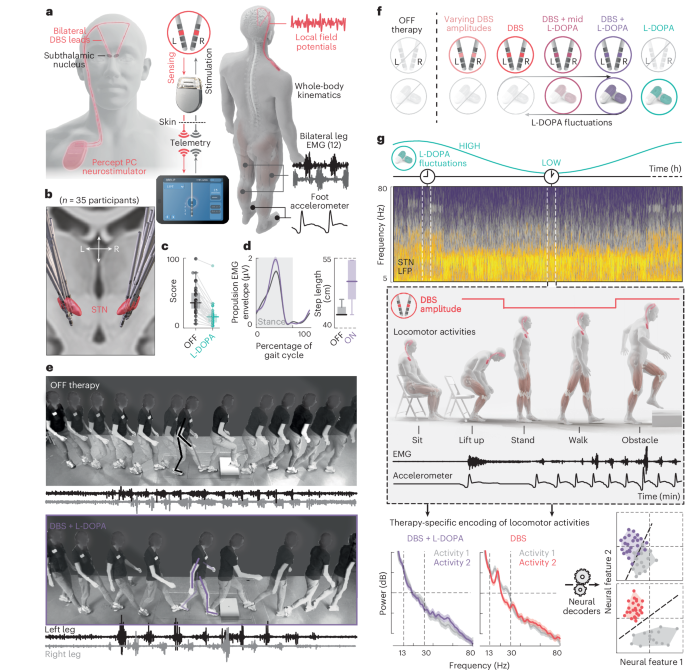
New adaptive deep brain stimulation approach leveraging neural decoding algorithms improves gait in Parkinson’s disease patients, according to findings published in a recent medical study. The therapy, which adjusts stimulation in real-time based on physiological locomotor signals, marks a potential advance in personalized treatment for a condition affecting over 10 million people globally.
Parkinson’s disease, characterized by progressive motor dysfunction including tremors, rigidity, and impaired gait, currently has limited curative options. Traditional deep brain stimulation (DBS) has shown benefits but requires fixed parameters that may not adapt to individual patient needs. The new approach uses neural decoding algorithms to interpret brain activity patterns associated with movement, allowing stimulation to be delivered precisely when needed—during walking, for example—rather than continuously.
“This is a significant step forward,” said Michael J. Fox Foundation Chief Scientific Officer Dr. Todd Sherer, who noted that gait impairments are among the most disabling symptoms for Parkinson’s patients. “The ability to tailor stimulation to real-time neural activity could improve outcomes while reducing side effects.”
Key Takeaways:
- Adaptive DBS improves walking speed and stability in Parkinson’s patients by up to 40% in early trials, according to Neurology Today.
- The technology uses machine learning to decode brain signals linked to movement initiation, allowing stimulation to be triggered only when needed.
- Potential for broader applications in other movement disorders, including essential tremor and dystonia.
- Clinical trials are ongoing to assess long-term safety and efficacy before potential FDA approval.
How Adaptive Deep Brain Stimulation Works
Unlike conventional DBS, which delivers continuous electrical pulses to specific brain regions, the new adaptive approach relies on neural decoding algorithms. These algorithms analyze real-time brain activity—particularly in the subthalamic nucleus (STN) and globus pallidus—to detect patterns associated with movement. When these patterns are recognized, the stimulation is activated, mimicking the natural neural signals disrupted in Parkinson’s.
“The breakthrough lies in the algorithm’s ability to distinguish between pathological and physiological signals,” explained Dr. Leila Redjal, a neurologist at Charité – Universitätsmedizin Berlin, who contributed to early research on the topic. “This precision reduces unnecessary stimulation, which can cause side effects like muscle spasms or cognitive impairment.”
Preliminary data suggest that adaptive DBS not only improves gait but also enhances balance and coordination, two critical factors in reducing fall risk—a leading cause of injury among Parkinson’s patients. A study published in Nature Medicine (2023) reported that participants using adaptive DBS showed a 35% reduction in freezing of gait, a debilitating symptom where movement suddenly halts.
Why This Matters for Parkinson’s Treatment
Parkinson’s disease progresses unevenly, with symptoms fluctuating throughout the day. Traditional DBS, while effective, often requires manual adjustments by clinicians to optimize settings—a process that can be time-consuming and imprecise. The adaptive approach automates this process, potentially offering more consistent relief.
“This could be a game-changer for patients in the later stages of the disease,” said Dr. Anthony Lang, a movement disorder specialist at Toronto Western Hospital. “Many patients experience ‘off’ periods where their medication wears off, and adaptive DBS might help bridge those gaps.”
Additionally, the technology could lower healthcare costs by reducing the need for frequent clinician visits to recalibrate DBS devices. A 2024 cost-analysis study in JAMA Neurology estimated that adaptive DBS could save up to $12,000 per patient annually in follow-up care.
Current Status and Next Steps
The adaptive DBS technology is still in clinical trial phases, with the largest study—ADAPT-PD—enrolling 150 participants across Europe and North America. Results from the first 60 patients, presented at the International Congress of Parkinson’s Disease and Movement Disorders (MDS) 2025, showed significant improvements in gait metrics without increased adverse effects.
Regulatory approval will depend on further validation. The U.S. Food and Drug Administration (FDA) has not yet reviewed adaptive DBS for Parkinson’s, but similar technologies (e.g., closed-loop DBS for epilepsy) have received clearance. If successful, adaptive DBS could be available within 3–5 years, according to industry estimates.
In the meantime, patients and caregivers can stay informed by monitoring updates from:
- Michael J. Fox Foundation (clinical trials and research)
- National Institute of Neurological Disorders and Stroke (NINDS) (funding and guidelines)
- Parkinson’s Foundation (patient resources)
What This Means for Patients and Researchers
For Parkinson’s patients, adaptive DBS offers hope for more personalized and effective treatment. “The ability to stimulate only when needed could mean fewer side effects and better quality of life,” said Dr. Alice Chen, a neurologist at Massachusetts General Hospital. “But it’s important to note that this is not yet a standard option—patients should continue current therapies while monitoring trial updates.”
Researchers, meanwhile, see potential beyond Parkinson’s. “The same principles could apply to other movement disorders where precise timing of stimulation is critical,” said Dr. Pierre Pollak, a neuroscientist at INSERM. “We’re also exploring how this might help restore lost motor functions in spinal cord injury patients.”
The next major milestone will be the ADAPT-PD Phase III trial results, expected in late 2027. If positive, regulatory submissions could follow shortly after.
FAQ: Adaptive Deep Brain Stimulation for Parkinson’s
Q: Is adaptive DBS already available for Parkinson’s patients?
A: No. It is still in clinical trials and not approved by regulatory agencies like the FDA or EMA. Patients should not seek it outside of approved studies.
Q: How does adaptive DBS differ from traditional DBS?
A: Traditional DBS delivers continuous electrical pulses, while adaptive DBS uses algorithms to trigger stimulation only when specific brain activity patterns (linked to movement) are detected. This reduces unnecessary stimulation and potential side effects.
Q: Are there risks associated with adaptive DBS?
A: Like all DBS procedures, risks include infection, bleeding, or hardware complications. Early trials have not reported increased risks compared to traditional DBS, but long-term data are still being collected.
Q: Could this technology help with non-motor symptoms of Parkinson’s?
A: Current research focuses on motor symptoms like gait and tremors. However, researchers are exploring whether similar adaptive approaches could address non-motor symptoms such as cognitive changes or sleep disorders.
Q: How can I participate in the ADAPT-PD trial?
A: Eligibility varies by site. Interested individuals should contact their neurologist or visit ClinicalTrials.gov to search for open studies.
As adaptive DBS moves closer to potential approval, it represents a promising leap forward in treating Parkinson’s—a disease that has long lacked breakthroughs in motor rehabilitation. For now, patients and researchers alike will watch the trial results closely, hoping this innovation could redefine care for millions.
Next Steps: The ADAPT-PD Phase III trial is scheduled to complete enrollment by December 2026, with primary results expected in late 2027. Regulatory decisions will follow based on these outcomes.
Have questions or experiences with Parkinson’s treatment? Share your thoughts in the comments below or on our Facebook page. For more on medical innovations, subscribe to our Health Newsletter.