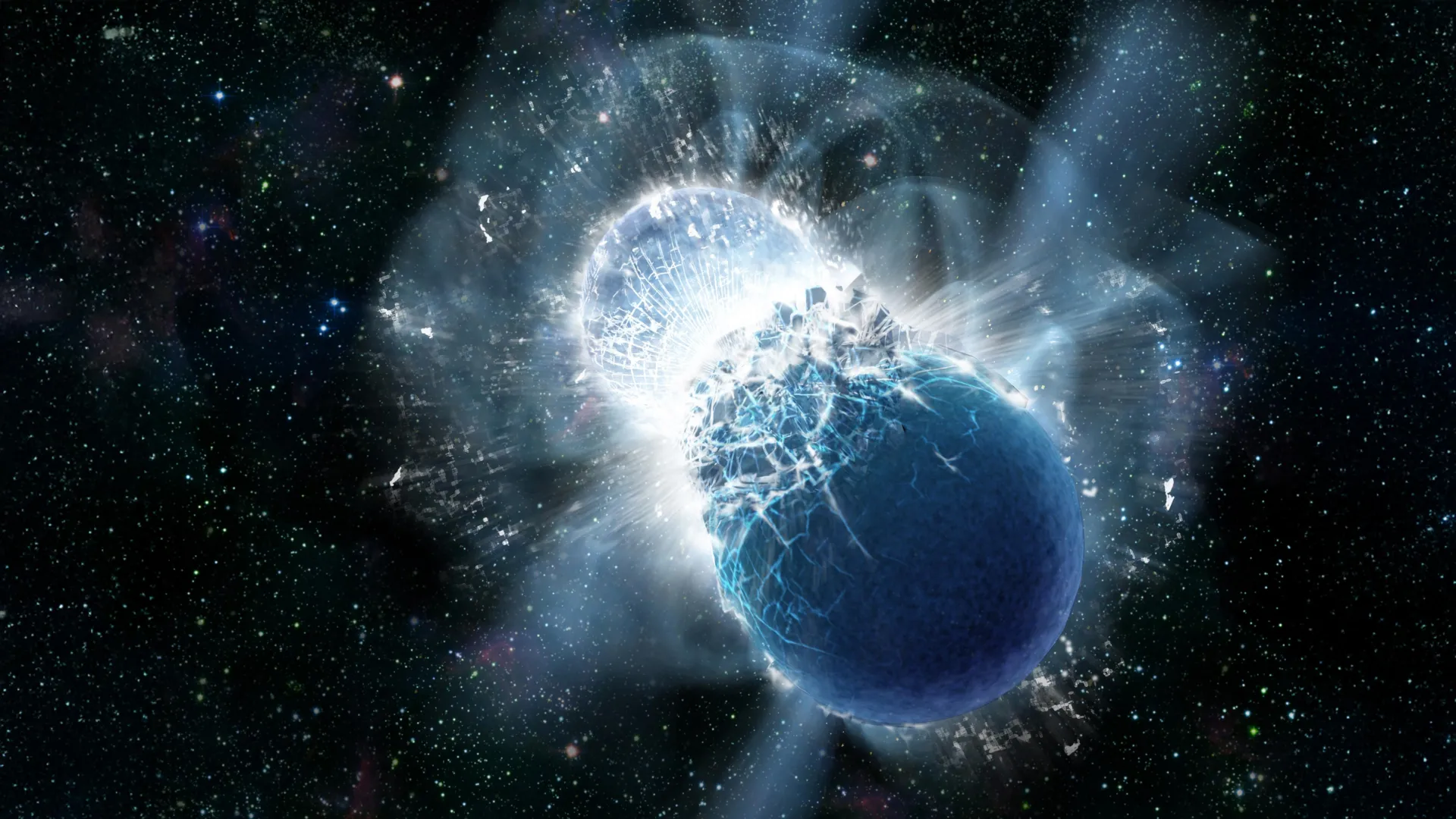
Researchers have developed a new artificial intelligence simulation that significantly accelerates the modeling of neutron star mergers, providing a more efficient way to understand how these cosmic events forge the universe’s heaviest elements. By streamlining the complex physics calculations required to track the creation of elements like gold and platinum, this tool enables scientists to better bridge the gap between astronomical observations and terrestrial laboratory experiments.
The Physics of Heavy Element Synthesis
Neutron star mergers—the cataclysmic collisions of two ultra-dense stellar remnants—are considered the primary sites for the r-process, or rapid neutron-capture process. This astrophysical mechanism is responsible for synthesizing roughly half of the elements heavier than iron. According to research published by the Los Alamos National Laboratory, simulating these environments is notoriously computationally expensive because it requires tracking a vast number of nuclear interactions over varying timescales.

Traditional simulations often struggle to balance the precision of nuclear physics with the fluid dynamics of a multi-second stellar explosion. The introduction of machine learning models allows researchers to emulate the output of these complex simulations at a fraction of the computational cost.
Bridging Space Observations and Earth-Based Labs
One of the primary challenges in nuclear astrophysics is connecting light-based data from deep space with precise measurements taken in laboratories on Earth. When a neutron star merger occurs, it emits gravitational waves and an electromagnetic counterpart known as a kilonova. Analyzing these signals requires comparing them against extensive libraries of theoretical models.

By using AI to generate these models faster, scientists can perform more comprehensive “parameter sweeps,” testing how different mass ratios or magnetic field strengths affect the final abundance of heavy elements. This capability is crucial for interpreting data from observatories like the Laser Interferometer Gravitational-Wave Observatory (LIGO). As noted in recent studies, the ability to rapidly match observational data to simulation results is a prerequisite for identifying the specific nuclear signatures of these mergers.
Advancing Predictive Power in Astrophysics
The application of AI in this field does not replace traditional numerical relativity, but rather complements it by acting as a fast surrogate. While a full-scale simulation might take weeks or months to compute on a supercomputer, a trained neural network can provide accurate predictions in milliseconds. This efficiency is particularly valuable when researchers need to account for uncertainties in nuclear physics data, such as the decay rates of exotic, neutron-rich isotopes.
Current research efforts are focused on refining these surrogate models to ensure they remain accurate across the extreme temperatures and densities found in a merging system. The integration of these tools into standard data analysis pipelines is expected to improve the accuracy of kilonova light-curve predictions. According to updates from the DOE Nuclear Physics program, these improvements are essential for interpreting the next generation of multi-messenger astronomy data.
Future Directions in Cosmic Modeling
The next phase of this research involves incorporating more nuanced physics, such as neutrino transport and magnetic field evolution, into the AI-accelerated frameworks. As observational facilities become more sensitive, the demand for high-fidelity, rapidly computed models will only increase. Scientists are currently working to ensure that these AI tools can generalize across different types of neutron star equations of state, which describe the internal structure of the stars themselves.
The scientific community anticipates further updates on these simulation techniques as new data from gravitational wave detectors becomes available during upcoming observation runs. Readers interested in the latest developments in nuclear astrophysics and computational modeling can monitor updates through the American Physical Society and institutional research portals. We welcome your thoughts on how artificial intelligence is shaping the future of space exploration—please share your insights in the comments below.