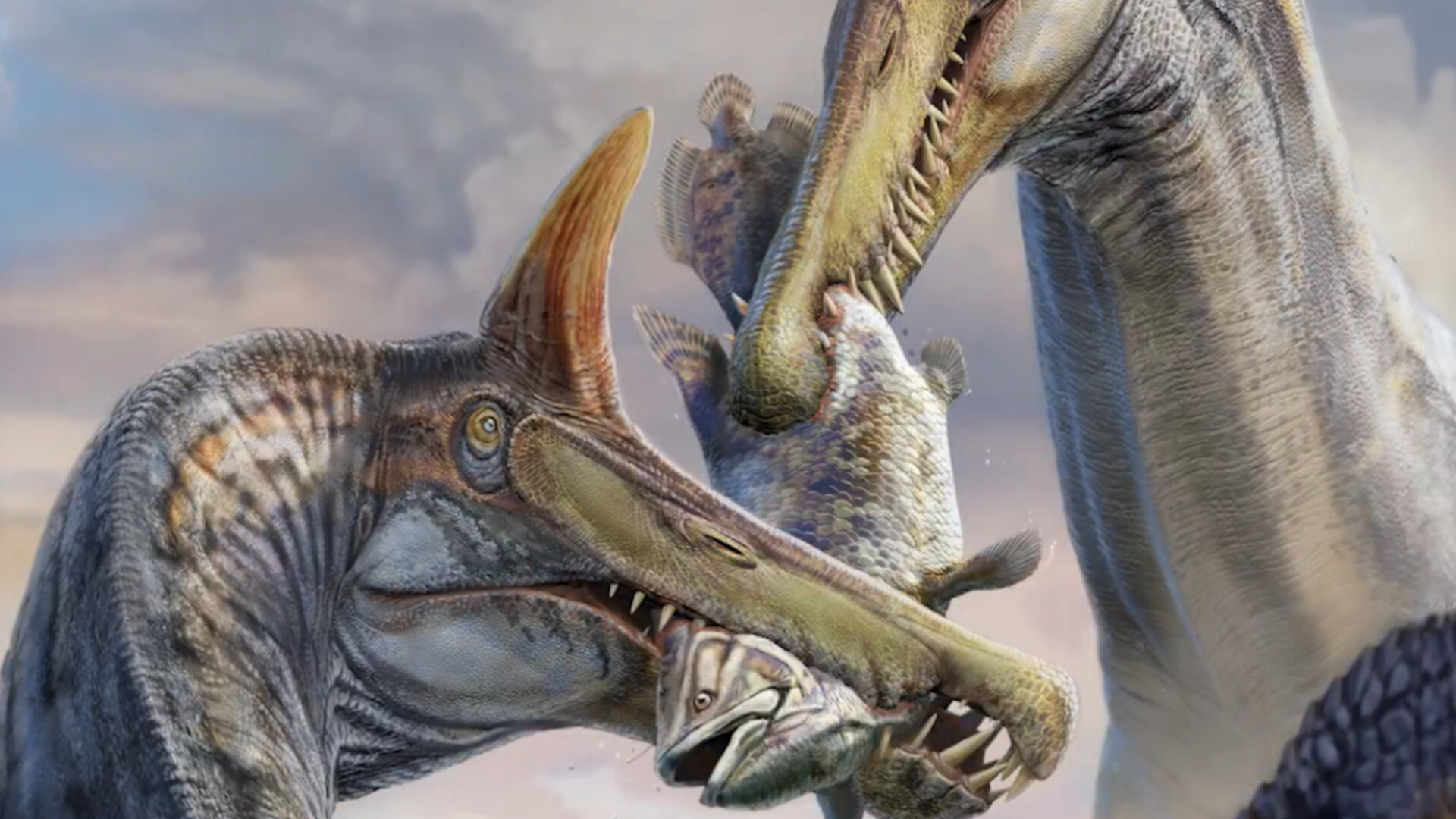
New Spinosaurus Species Discovered, Revealing Unique Crest and Semi-Aquatic Lifestyle
The Spinosaurus, a dinosaur instantly recognizable for its massive size and distinctive sail, has long captivated paleontologists and the public alike. Often depicted as a fearsome, bipedal predator rivaling even the Tyrannosaurus Rex – a portrayal popularized in films like Jurassic Park III – the Spinosaurus’s true form and behavior have been the subject of ongoing debate. Questions surrounding its degree of aquatic adaptation, hunting strategies, and whether it primarily walked on two or four legs have fueled scientific discussion for decades. Now, a groundbreaking discovery announced on February 19, 2026, is adding a significant new chapter to the Spinosaurus saga: the official naming of a new species, Spinosaurus mirabilis, detailed in a recently published article in the journal Science.
Spinosaurus mirabilis represents only the second officially recognized species within the Spinosaurus genus, the first being Spinosaurus egypticus, initially discovered in 1915. Tragically, the original fossils of Spinosaurus egypticus were destroyed during the bombings of Munich in World War II, making the discovery of Spinosaurus mirabilis all the more significant. This new find provides crucial insights into the evolutionary history and diversity of this enigmatic dinosaur.
A Distinctive Crest Sets Spinosaurus mirabilis Apart
Perhaps the most striking feature of Spinosaurus mirabilis is its uniquely shaped crest. Described as scimitar-shaped, this structure has never before been observed in any known theropod dinosaur. Paleoartist Daniel Navarro was the first to visually represent this distinctive feature in detailed illustrations accompanying the scientific publication. The crest’s purpose remains a subject of ongoing research, but scientists hypothesize it may have played a role in display, species recognition, or even thermoregulation.
An Aquatic Lifestyle and North African Habitat
Initial studies suggest that Spinosaurus mirabilis exhibited a lifestyle more akin to a heron than a crocodile, spending much of its time in shallow waters and hunting far from the open sea. The dinosaur roamed what is now North Africa approximately 95 million years ago, during the Cretaceous period. Estimates place its length around 13 meters (approximately 43 feet) and its weight between 6 and 7 tons. Its jaws were uniquely adapted, functioning like a “cage” to trap fish, indicating a primarily piscivorous diet. Fossil evidence also reveals the presence of other dinosaurs in the same region, including sauropods – long-necked herbivores – suggesting a complex ecosystem.
The Discovery and Future of Spinosaurus Research
The journey to identify Spinosaurus mirabilis began in 2019 when paleontologist Paul Sereno first unearthed Spinosaurus fossils in the Sahara Desert. Returning in 2022 with a team of 29 paleontologists from five different countries, Sereno led an intensive excavation effort. The findings were officially announced on February 19, 2026. Currently, the fossils are housed in Chicago, but plans are underway to repatriate them to Niger, where Sereno intends to establish two museums and a paleontological institute. This initiative aims to foster local scientific capacity and preserve Niger’s rich paleontological heritage.
Implications for Understanding Spinosaurus Evolution
The discovery of Spinosaurus mirabilis is not merely the addition of another species to the dinosaur family tree; it’s a pivotal moment in understanding the evolution of Spinosaurus itself. The unique crest and skeletal features of this new species provide valuable data points for reconstructing the evolutionary relationships within the genus. Researchers are now able to refine hypotheses about the degree of adaptation to aquatic environments and the ecological role Spinosaurus played in its ancient ecosystem. The ongoing debate about whether Spinosaurus was primarily bipedal or quadrupedal may also be informed by further analysis of Spinosaurus mirabilis’s skeletal structure.
The Spinosaurus has always been a controversial dinosaur, its image shifting with new discoveries and interpretations. The popular depiction of a massive, aggressive predator, as seen in Jurassic Park III, has been challenged by paleontologists who emphasize its likely semi-aquatic lifestyle and specialized feeding habits. The unveiling of Spinosaurus mirabilis adds another layer of complexity to this fascinating creature, prompting a reevaluation of existing theories and opening new avenues for research.
The repatriation of the fossils to Niger, as planned by Paul Sereno, is a significant step towards ensuring that the scientific benefits of this discovery are shared with the local community. The establishment of museums and a paleontological institute will provide opportunities for education, research, and economic development in the region. This commitment to collaboration and knowledge-sharing underscores the importance of international cooperation in paleontological research.
As research continues, we can expect further insights into the life and times of Spinosaurus mirabilis and its place in the prehistoric world. The ongoing analysis of the fossils, combined with advanced imaging techniques and computational modeling, will undoubtedly reveal even more secrets about this remarkable dinosaur. The next major update from the research team is anticipated in late 2027, when a comprehensive analysis of the skull morphology is expected to be published.
The discovery of Spinosaurus mirabilis serves as a powerful reminder of the vastness of prehistoric life and the ongoing process of scientific discovery. It highlights the importance of continued paleontological exploration and the dedication of researchers who strive to unravel the mysteries of our planet’s past. What are your thoughts on this incredible find? Share your comments and insights below.
Keep reading