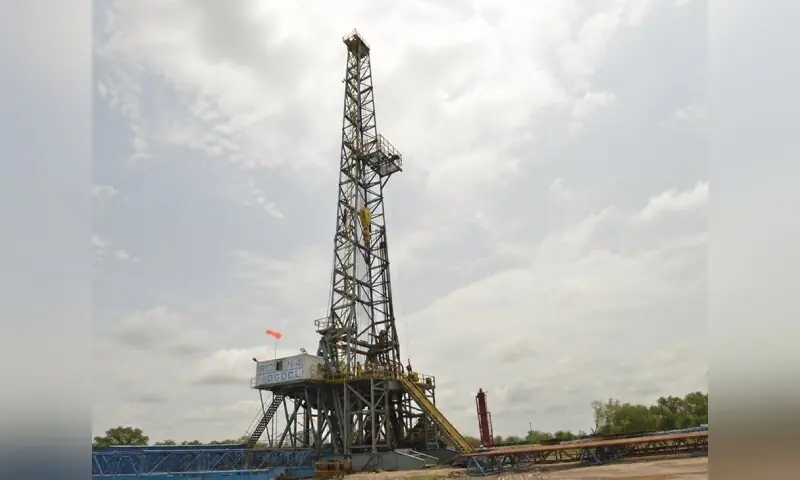
The Oil and Gas Development Company Limited (OGDCL), Pakistan’s state-owned energy giant, has announced a significant hydrocarbon discovery at its exploratory well, Bobi Deep-1, situated in the Sanghar district of Sindh. This development is being viewed as a critical step toward bolstering the nation’s domestic energy output and reducing a long-standing dependence on costly fuel imports.
The latest OGDCL oil and gas discovery was confirmed following successful testing of the Massive Sand interval within the Lower Goru Formation. According to the company’s official statement, the well yielded 2,000 barrels of oil per day (bpd) and 1.1 million standard cubic feet of gas per day (mmscfd). These figures were achieved through a cased-hole Drill Stem Test (DST), a standard industry procedure used to evaluate the pressure and permeability of a geological formation before committing to permanent infrastructure.
For a nation like Pakistan, which frequently grapples with balance-of-payment challenges linked to energy procurement, such finds are more than just corporate milestones. They represent a tangible effort to enhance national energy security. The OGDCL remains the country’s largest producer of hydrocarbons, and this latest success follows a string of efforts to revitalize older blocks and explore deeper, more complex geological plays.
Overcoming Subsurface Complexity Through Innovation
The path to the Bobi Deep-1 discovery was not without significant operational hurdles. The project had previously faced severe subsurface challenges that necessitated a temporary suspension of drilling activities. Rather than abandoning the site, the OGDCL engineering team opted for a technical pivot, utilizing advanced geophysical modeling and collaborative research. This approach highlights the growing trend of industry-academia cooperation in the region.
The company collaborated with the Centre for Pure and Applied Geology at the University of Sindh, Jamshoro, to refine their understanding of the local formation. By integrating advanced seismic data with field evaluations, the team successfully de-risked the prospect. This collaboration underscores a shift toward leveraging local technical expertise to solve geological puzzles that might otherwise remain untapped. The successful redeployment of the drilling rig to reach the target depth serves as a testament to these engineering safeguards and specialized civil works.
According to the Oil and Gas Development Company Limited (OGDCL), this discovery has opened a new exploration window in the Sanghar district. By proving the potential of the Massive Sand play, the company has effectively de-risked surrounding prospects, creating a roadmap for future reserve additions. This is a critical development for stakeholders, as it increases the economic viability of the broader Bobi and Dhamraki Mining Lease area.
Strategic Impact on Pakistan’s Energy Landscape
The timing of this discovery is notable. In April 2024, the OGDCL made headlines by initiating commercial production from what was described as one of the country’s most promising single-well projects. These incremental gains are vital for the Pakistani economy. The energy sector, which is heavily monitored by the Directorate General of Petroleum Concessions (DGPC), remains the primary engine for industrial growth and household electricity stability.
The Sinjhoro Block, where the OGDCL recently saw a revival of production at the Chak#2-2 well, serves as a prime example of successful joint-venture management. The block structure—featuring OGDCL as the operator with a 62.5% working interest, alongside Government Holdings (Pvt) Ltd (22.5%) and Orient Petroleum Inc. (15%)—provides a model for how the state can share both the risk and the rewards of exploration with private partners. This collaborative framework is expected to remain the standard as the government seeks to attract further investment into its upstream sector.
Key Takeaways for Stakeholders
- Production Potential: The Bobi Deep-1 well is currently testing at 2,000 bpd of oil and 1.1 mmscfd of gas.
- Technical Strategy: The use of advanced geophysical modeling and local academic collaboration allowed the company to overcome subsurface drilling challenges.
- Regional De-risking: The success in the Massive Sand interval validates the potential for further exploration in the Sanghar district.
- National Energy Goal: The project aligns with broader goals to reduce reliance on imported energy and augment domestic reserves.
Looking Ahead: What Comes Next?
As the OGDCL moves toward transitioning the Bobi Deep-1 well from an exploratory phase to permanent commercial production, the company is expected to release further updates regarding the integration of this output into the national grid. Investors and industry analysts will be closely monitoring the upcoming quarterly financial filings to assess the long-term impact of these production increases on the company’s bottom line.
The government of Pakistan continues to encourage exploration and production (E&P) activities through various regulatory incentives. For the latest official bulletins and production data, stakeholders are encouraged to monitor the Ministry of Energy (Petroleum Division) website for ongoing policy updates and licensing rounds. The success at Sanghar serves as a reminder that with the right combination of indigenous innovation and technical rigor, there remains significant untapped potential within the country’s sedimentary basins.
What are your thoughts on the role of industry-academia collaboration in domestic resource exploration? Share your insights in the comments section below, and stay tuned to World Today Journal for further updates on Pakistan’s energy sector developments.
Worth a look