
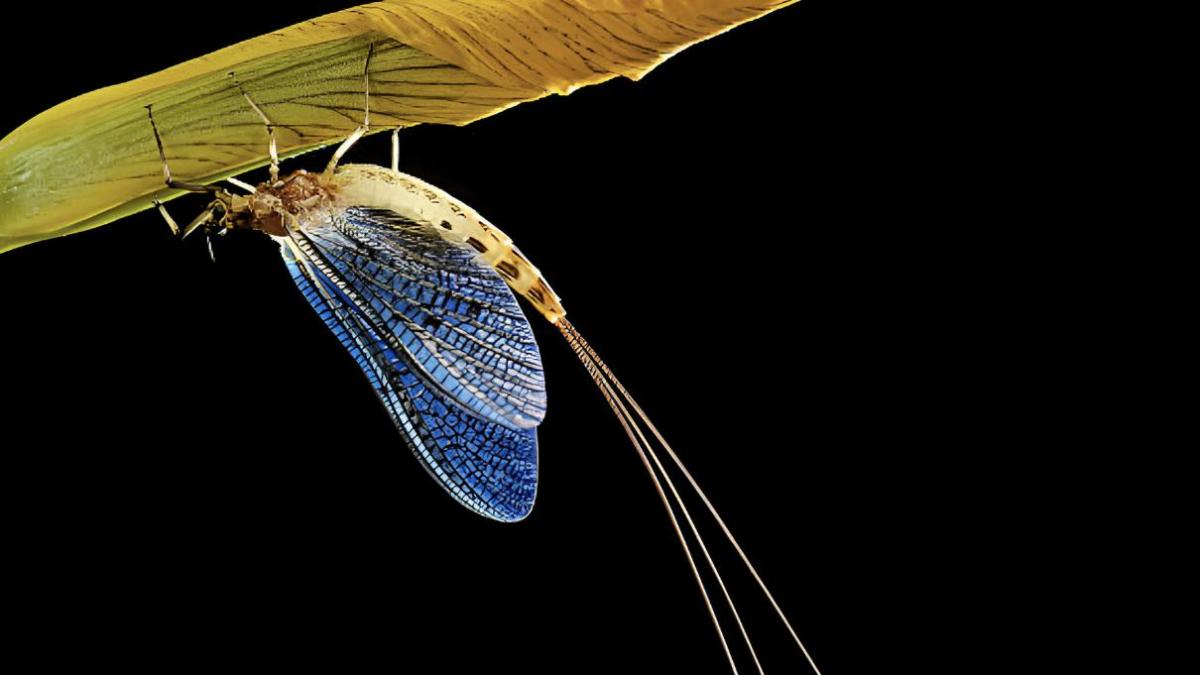
On warm spring evenings along the banks of the River Thames in London, a mesmerizing aerial display takes place. Thousands of mayflies engage in a synchronized, vertical choreography—climbing steeply into the air, flipping over, and drifting back down in a skydiving posture. For generations, this bizarre flight pattern has puzzled naturalists and biologists, remaining one of the most enduring mysteries of the insect world.
The mayfly is a creature of extremes. While its adult life is famously ephemeral, lasting only a few days, its lineage is ancient. These winged insects emerged roughly 300 million years ago, establishing their presence on Earth long before the first dinosaurs walked the planet. Despite the vast stretches of geological time, the mayfly’s basic biological design and its peculiar mating dance have remained virtually unchanged.
Now, a collaborative effort between researchers at the University of Oxford and Imperial College London has finally unlocked the secret of this prehistoric ritual. By utilizing advanced 3D filming and flight-path analysis, the team has determined that the vertical flight pattern is not a random quirk of nature, but a sophisticated biological tool used for gender identification within massive, chaotic swarms.
As a technology editor, I find this discovery particularly compelling because it highlights the intersection of computational analysis and evolutionary biology. The solution to a 300-million-year-old riddle didn’t come from traditional observation alone, but from the application of high-resolution spatial tracking that allowed scientists to “see” the swarm from a mathematical perspective.
The Technology of the Hunt: 3D Flight Reconstruction
To understand the mayfly’s movements, researchers could not rely on standard two-dimensional video. In a swarm of thousands, insects overlap and obscure one another, making it nearly impossible to track the trajectory of a single individual. To solve this, Samuel Fabian, a research fellow at the University of Oxford, and his colleagues at Imperial College London deployed specialized 3D filming equipment in the London borough of Richmond.

The team captured high-speed footage of the common mayfly, which was then processed through software designed to reconstruct three-dimensional flight paths. This process, known as 3D trajectory analysis, allows researchers to isolate individual insects and map their exact movements in X, Y, and Z coordinates. By analyzing these paths, the scientists could differentiate between the erratic movements of the swarm and the specific, repetitive vertical loops performed by the males.
This computational approach revealed a level of precision in the “dance” that was previously invisible. The data showed that the males follow a strict vertical ascent followed by a controlled descent. By quantifying these movements, the researchers could finally test hypotheses about why the insects were spending so much energy on such a specific pattern.
Decoding the Dance: A Tool for Gender Identification
The central question was whether the dance served a purpose in mating or if it was a byproduct of the insect’s physiology. The findings, published in the Journal of Experimental Biology, reveal that the vertical flight pattern is essential for the males to navigate the swarm.
In the dense clouds of insects that gather over the Thames, visibility is low and the environment is chaotic. The research indicates that male mayflies rely on this specific up-and-down movement to distinguish other males from potential female mates. Because the vertical loop is a characteristic behavior of the males, any insect that does not participate in this specific pattern stands out as a likely female.
Essentially, the dance acts as a biological filter. By performing the loop, males signal their identity to others. When they encounter an individual that is not performing the vertical climb and flip, they can identify it as a female and initiate mating. This mechanism ensures that in a swarm of thousands, males do not waste precious time and energy attempting to mate with other males.
An Evolutionary Legacy Older Than Dinosaurs
The most striking aspect of this discovery is the sheer longevity of the behavior. Mayflies are among the oldest winged insects known to science, with a fossil record stretching back approximately 300 million years. The fact that they have retained this specific flight behavior for hundreds of millions of years suggests that it is an incredibly efficient survival strategy.
The stability of the mayfly’s design is a rarity in evolutionary biology. While other species have undergone radical transformations to adapt to changing environments, the mayfly’s method of finding a mate has remained constant since before the Permian period. This suggests that the “dance” solved the problem of mate location so effectively that there was no evolutionary pressure to change it.
This biological persistence is even reflected in human culture. The short-lived nature of the mayfly has been a metaphor for the fragility of life for millennia, appearing in ancient texts such as the Epic of Gilgamesh, one of the oldest pieces of literature in existence. While humans have long noted the insect’s brief life, we are only now understanding the sophisticated logic behind its lifelong ritual.
Why This Discovery Matters for Modern Biology
While the study of mayflies may seem like a niche pursuit, the implications of this research extend into broader fields of entomology and behavioral ecology. Understanding how insects use movement as a communication tool helps scientists model how other species interact within complex environments.

the study underscores the importance of biodiversity. Mayflies are currently facing declines in regions like Britain, often serving as bioindicators for water quality. Because their larvae require clean water to survive, a drop in mayfly populations often signals environmental degradation in local river systems. By understanding the mating behaviors that ensure their survival, researchers can better understand the vulnerabilities of the species.
From a technical standpoint, the use of 3D reconstruction to solve biological mysteries opens the door for more sophisticated studies of animal behavior. The same tools used in Richmond could be applied to understand the swarming patterns of bees, the migration of birds, or the schooling of fish, turning the “chaos” of nature into readable data.
The work of Samuel Fabian and the team at Imperial College London reminds us that even the most common sights in nature—like a swarm of insects over a river—can hide complex mathematical and evolutionary secrets. It only takes the right technological lens to bring those secrets into focus.
As researchers continue to monitor mayfly populations and their behaviors, the next step will likely involve analyzing how environmental changes and pollution are affecting these ancient mating rituals. Whether climate change or water pollution disrupts the timing or success of the “dance” remains a critical area for future study.
Do you think advanced technology like 3D reconstruction will eventually solve all the mysteries of animal behavior? Share your thoughts in the comments below or share this article with a fellow nature or tech enthusiast.