
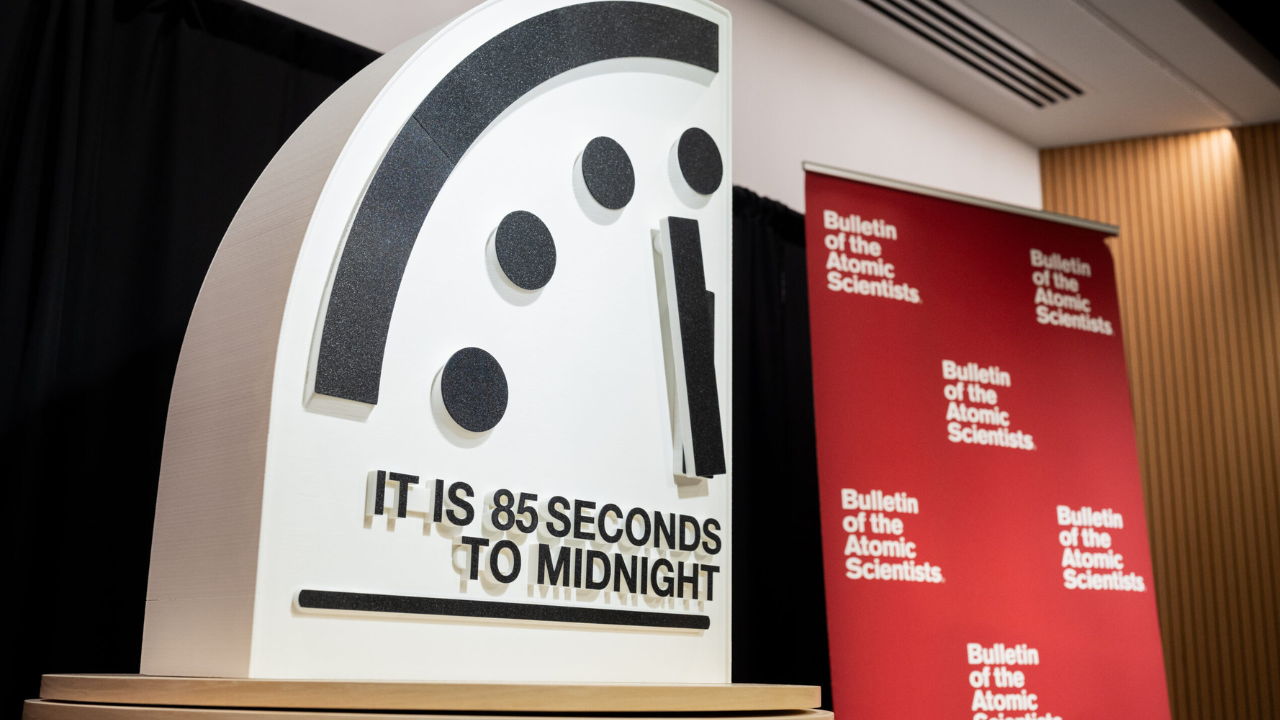
On January 27, 2026, the Bulletin of the Atomic Scientists set its Doomsday Clock to 85 seconds to midnight, marking the closest the symbolic timepiece has ever come to representing global catastrophe since its inception in 1947. This adjustment reflects heightened concerns over nuclear arms control erosion, emerging technological risks, and geopolitical instability among the world’s nuclear-armed states.
The Science and Security Board of the Bulletin cited multiple converging threats in its announcement, including the expiration of the New START Treaty between the United States and Russia without a successor agreement, ongoing modernization of nuclear arsenals by all nine nuclear powers, and growing risks associated with artificial intelligence and climate change. The move underscores what experts describe as a renewed era of nuclear competition rather than reduction.
According to the Bulletin’s statement, the decision was made after evaluating deteriorating conditions in international security, particularly the breakdown of long-standing arms control frameworks. The New START Treaty, which had limited deployed strategic nuclear warheads to 1,550 for each nation, expired on February 5, 2026, and was not replaced, removing a key constraint on U.S. And Russian nuclear forces. Together, these two countries possess approximately 86 percent of the world’s estimated 12,321 nuclear weapons.
Hans Kristensen, director of the Nuclear Information Project at the Federation of American Scientists, noted in interviews that the trend is unmistakable: “The era of reductions in the number of nuclear weapons in the world is coming to an end. Instead, we see a clear trend of growing nuclear arsenals, sharpened nuclear rhetoric, and the abandonment of arms control agreements.” His assessment aligns with data showing increased investment in nuclear modernization programs across multiple nations.
The United States is currently engaged in a $1.7 trillion nuclear modernization effort initiated under previous administrations and continued under President Donald Trump, who has publicly supported upgrading the nuclear triad. This program includes development of new intercontinental ballistic missiles, submarine-launched ballistic missiles, and air-delivered warheads. Similar upgrades are underway in Russia, China, the United Kingdom, France, India, Pakistan, Israel, and North Korea, with China’s arsenal growth described as the fastest among nuclear states.
Beyond nuclear risks, the Bulletin’s 2026 statement explicitly highlighted artificial intelligence as a contributing factor to global instability, calling for international guidelines on its use in military and decision-making systems. Climate change was also cited as a threat multiplier, exacerbating resource competition and potentially increasing the likelihood of conflict. The Board emphasized that these dangers are interconnected and require coordinated multilateral responses.
The Doomsday Clock has been adjusted 27 times since 1947, reflecting shifts in perceived global danger. Its furthest setting from midnight was 17 minutes in 1991, following the end of the Cold War. The 2026 adjustment to 85 seconds marks a significant shift toward greater perceived risk, surpassing even the peak of Cold War tensions in the 1950s and 1980s when the clock reached as close as 2 minutes to midnight.
The Bulletin of the Atomic Scientists was founded in 1945 by Albert Einstein, J. Robert Oppenheimer, and University of Chicago scientists who helped develop the first atomic weapons. The Doomsday Clock was introduced two years later as a metaphor for humanity’s vulnerability to self-inflicted destruction, initially focused solely on nuclear threat but later expanded to include climate change and disruptive technologies.
Global reactions to the 2026 setting included renewed calls from disarmament advocates for diplomatic engagement to revive arms control negotiations. Organizations such as the International Campaign to Abolish Nuclear Weapons (ICAN) and Citizens for Global Solutions urged nuclear-armed states to return to the negotiating table, implement transparency measures, and pursue verifiable reductions in stockpiles.
As of April 2026, no formal talks have been announced to replace New START, though backchannel discussions are reportedly ongoing between U.S. And Russian officials through neutral intermediaries. The next major opportunity for progress may come during the review cycle of the Treaty on the Non-Proliferation of Nuclear Weapons (NPT), with its upcoming preparatory committee meeting scheduled for later in 2026.
Readers seeking official updates on nuclear arms control can follow statements from the U.S. Department of State’s Bureau of Arms Control, Verification and Compliance, or the Russian Ministry of Foreign Affairs’ Department for Nonproliferation and Arms Control. The Bulletin of the Atomic Scientists continues to publish analysis and clock updates on its website, thebulletin.org.
Stay informed, share this article to help others understand the stakes, and join the conversation in the comments below.