
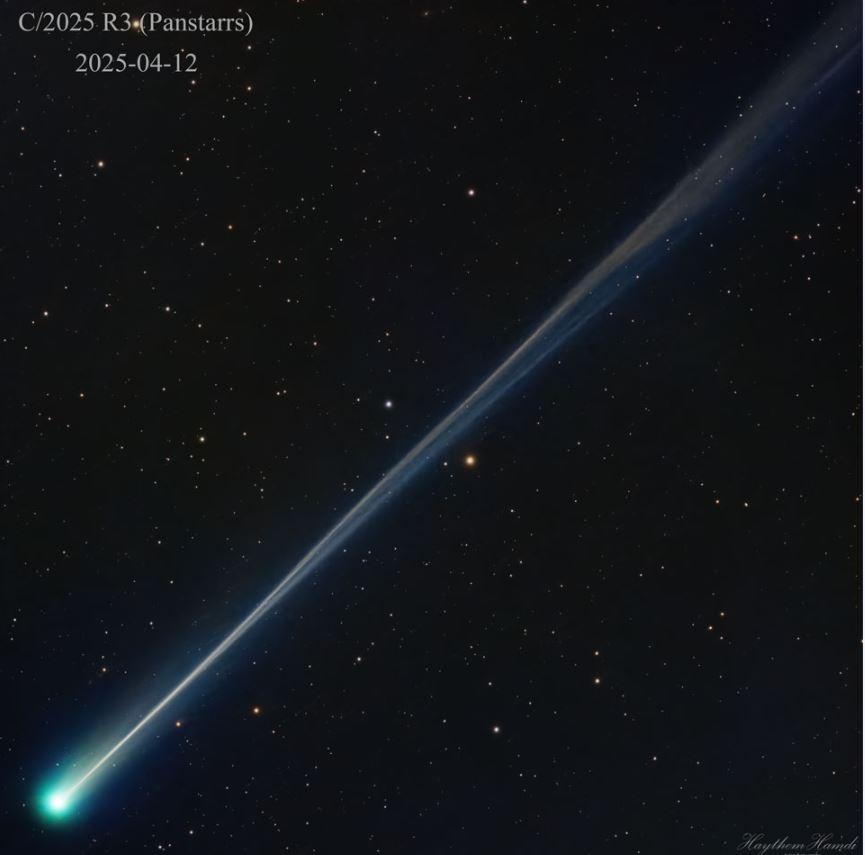
Stargazers and astronomy enthusiasts are preparing for a rare celestial event as PanSTARRS comet C/2025 R3 approaches its closest point to the sun, offering a window for observation that could be a once-in-a-lifetime experience for many.
Discovered in September 2025, this long-period comet has shown an unusually rapid increase in brightness, evolving from a faint 20th-magnitude object to one that may be visible to the naked eye under ideal conditions. For those in the Northern Hemisphere, particularly in Japan and surrounding regions, the prime viewing window is currently open, peaking between mid-April and April 22, 2026.
The comet, officially designated as C/2025 R3 (PANSTARRS), was first detected on September 8, 2025, by the Pan-STARRS 2 telescope located at the summit of Haleakalā on Maui, Hawaii according to Wikipedia. Although it began its journey toward the inner solar system as a dim speck, its acceleration in luminosity has captured the attention of the global scientific community.
As of April 16, 2026, the comet is reaching its peak visibility. Observers are encouraged to look toward the eastern horizon during the pre-dawn hours, where the object is expected to reach a magnitude of approximately 3 to 4 per the National Astronomical Observatory of Japan (NAOJ).
The Orbital Path and the 170,000-Year Cycle
What makes C/2025 R3 particularly significant is its staggering orbital period. Based on astronomical calculations for its elliptical orbit, the comet has an estimated orbital period of approximately 175,000 years as detailed in its orbital elements. This means that any sighting of the comet now is effectively a “prehistoric” encounter, as it will not return to our neighborhood for many millennia.
The comet is currently navigating its perihelion—the point in its orbit where it is closest to the sun. According to the NAOJ, the comet is scheduled to pass its perihelion on April 20, 2026, at approximately 7:00 AM JST (April 19 at 22:00 UTC) . At this moment, it will be approximately 0.5 au (about 75 million kilometers) from the sun.
Following its perihelion passage, the comet’s trajectory is expected to shift. Data indicates that while it is currently on an elliptical orbit, it may transition into a hyperbolic orbit after passing the sun, potentially becoming a non-periodic comet that will exit the solar system entirely .
How to Observe the PanSTARRS Comet
For the average observer, the comet’s low position in the sky presents some challenges. Because it remains low on the horizon, atmospheric haze can make naked-eye observation difficult. Yet, those in dark-sky locations with a clear, crisp horizon have the best chance of seeing a faint, blurry glow.
To maximize the chances of a successful sighting, astronomers recommend the following guidelines:
- Timing: The best window is roughly 60 minutes before sunrise.
- Location: Look toward the low eastern sky. An open area with no buildings or trees blocking the horizon is essential.
- Equipment: While a magnitude 3 or 4 object can be seen with the naked eye in very dark skies, binoculars are highly recommended to bring the comet into clear view .
- Navigation: Observers can use the “Great Square of Pegasus” as a landmark; the comet is moving from Pegasus toward the constellation Pisces .
For photographers, properly configured cameras may be able to capture the comet’s tail, which has already been documented in images taken during its approach in March .
Quick Reference: Key Dates and Data
| Event | Date/Time | Detail |
|---|---|---|
| Discovery | September 8, 2025 | Detected by Pan-STARRS 2 in Hawaii |
| Peak Visibility (Japan) | April 15–20, 2026 | Best viewing window in the eastern dawn sky |
| Perihelion (Closest to Sun) | April 20, 2026 (7:00 AM JST) | Approx. 0.5 au from the sun |
| Closest Approach to Earth | April 26, 2026 (6:00 PM JST) | Poor visibility due to proximity to the sun |
Why This Comet Matters to Science
The rapid brightening of C/2025 R3—moving from magnitude 20 to magnitude 8 by late March—is an area of interest for astronomers. Such a steep increase in luminosity suggests a highly active nucleus as it heats up upon approaching the sun. Comets are essentially “dirty snowballs” containing primordial materials from the birth of the solar system; studying their composition helps scientists understand the early conditions of our cosmic neighborhood.

The transition from a long-period elliptical orbit to a potentially hyperbolic one also provides a case study in gravitational dynamics. The influence of the sun’s gravity and the potential interaction with other planetary bodies can alter a comet’s path, turning a returning visitor into a permanent exile from the solar system .
As the comet continues its journey past the sun and eventually away from Earth, the window for observation will close rapidly. While it reaches its closest point to Earth on April 26, 2026, this date is considered unsuitable for observation because the comet’s position will be too close to the sun’s glare .
The next confirmed checkpoint for this celestial visitor is its perihelion passage on April 20, 2026. Astronomers will be monitoring the comet’s structural integrity during this peak heating phase to witness if the nucleus survives or fragments.
Do you have photos of the PanSTARRS comet or tips for other observers? Share your experiences and images in the comments below.