
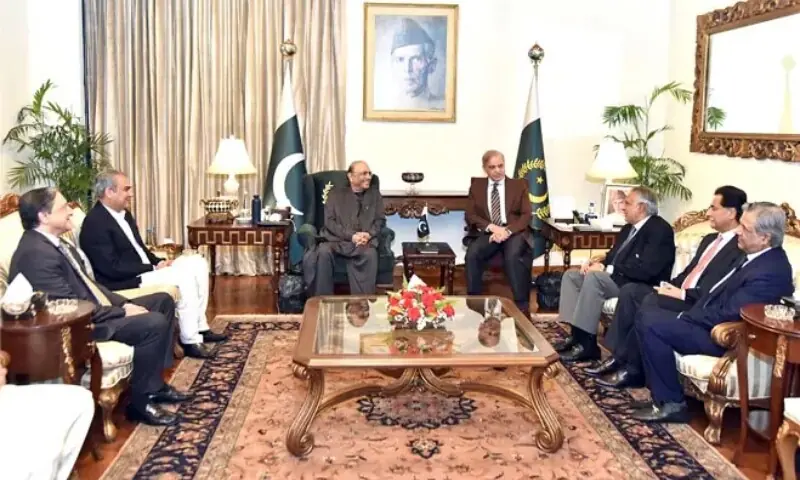
Prime Minister Shehbaz Sharif and President Asif Ali Zardari held a high-level meeting in Islamabad this week, a gathering that has sparked intense speculation across Pakistan’s political landscape. While official summaries of the meeting focused on routine governance and national stability, the discussions took place against a backdrop of persistent rumors regarding a potential move to roll back the 18th Amendment to the Constitution of Pakistan.
The 18th Amendment rollback Pakistan debate represents one of the most sensitive fault lines in the country’s democratic framework. Any attempt to reverse the landmark 2010 legislation would not only trigger a constitutional crisis but could potentially alienate the provincial governments, particularly in Sindh and Khyber Pakhtunkhwa, who view the amendment as the bedrock of their administrative and financial autonomy.
For the current coalition government, the tension is twofold: the need for fiscal consolidation at the federal level and the political necessity of maintaining harmony between the Pakistan Peoples Party (PPP), the architects of the amendment, and the Pakistan Muslim League-Nawaz (PML-N). As the country navigates a precarious economic recovery, the question of whether the federal government possesses enough power—and funds—to manage national crises has returned to the forefront of political discourse.
The Significance of the 18th Amendment
To understand why the rumors of a rollback are so explosive, one must first understand the scale of the 18th Amendment. Passed by a rare cross-party consensus in 2010, the amendment fundamentally altered the balance of power in Pakistan. Its primary achievement was the devolution of authority from the federal government to the provinces, effectively ending the era of highly centralized governance that had characterized much of Pakistan’s history.

Under the Constitution of Pakistan, the 18th Amendment abolished the “Concurrent List,” which had previously allowed both the federal and provincial governments to legislate on certain matters. By removing this list, powers over health, education, and environment were transferred entirely to the provinces. This shift was designed to ensure that local needs were met by local governments, rather than by bureaucrats in Islamabad.
Beyond administrative devolution, the amendment also stripped the President of the unilateral power to dissolve the National Assembly. This move was a direct response to decades of military-backed presidencies that had frequently dismissed elected governments, thereby stabilizing the parliamentary process and strengthening the role of the Prime Minister.
The Fiscal Friction: Why Rollback is Being Discussed
The drive to revisit the 18th Amendment is rarely about ideology and almost always about money. At the heart of the conflict is the National Finance Commission (NFC) Award, the mechanism used to distribute tax revenues between the federal government and the four provinces.
Since the 18th Amendment, the federal government’s share of the divisible pool of taxes has shrunk, while the provinces’ shares have increased. Critics of the current system argue that the federal government is left with too few resources to handle “non-divisible” burdens, such as debt servicing, national defense, and foreign affairs. This fiscal squeeze becomes particularly acute during economic downturns or when the state is under pressure from international lenders to reduce its deficit.
Proponents of a partial rollback argue that the federal government needs more “fiscal space” to manage the national economy. They suggest that some powers—and the accompanying funds—should be returned to the center to ensure that the state can maintain basic stability and meet its international obligations. However, provincial leaders view this argument as a thinly veiled attempt to reclaim control over resources that legally belong to the regions.
Political Stakes for Zardari and Sharif
The meeting between President Zardari and Prime Minister Sharif is particularly symbolic because of the roles their respective parties played in the amendment’s history. The PPP, led by the Zardari family, views the 18th Amendment as its crowning legislative achievement. For the PPP, the amendment is not just a legal document but a promise of provincial rights and a safeguard against autocracy.

For Prime Minister Shehbaz Sharif and the PML-N, the priority is often efficient administration and economic stability. While the PML-N has historically been more comfortable with a strong center, they are currently tethered to the PPP in a governing coalition. Any move to curtail the 18th Amendment without the explicit and enthusiastic support of the PPP would likely collapse the government.
The rumors of a rollback likely stem from internal discussions about “adjustments” rather than a total reversal. Political analysts suggest that the government may be exploring ways to optimize the NFC Award or introduce new federal levies without formally amending the Constitution—a “soft rollback” that avoids the political firestorm of a formal legislative battle.
Who is Affected by a Potential Rollback?
- Provincial Governments: Would lose direct control over budgets for health and education, potentially slowing down local development projects.
- The Federal Treasury: Would potentially see an increase in available funds to pay off national debts and fund federal infrastructure.
- The General Public: Could see a shift in service delivery. while the center might manage larger projects better, local grievances might go unaddressed without provincial autonomy.
- Political Stability: A move against the 18th Amendment could reignite ethnic and regional tensions, particularly in Balochistan and Sindh.
The Path Forward: Constitutional Crisis or Compromise?
The road to amending the Constitution of Pakistan is intentionally difficult. Any change to the 18th Amendment would require a two-thirds majority in both the National Assembly and the Senate. Given the current fragmentation of the parliament, achieving such a majority would require a level of consensus that currently does not exist.
the judiciary often plays a critical role in these disputes. The Supreme Court of Pakistan has historically been protective of constitutional frameworks that ensure democratic continuity. Any attempt to roll back the amendment could be challenged in court as a violation of the “Basic Structure” of the Constitution.

The most likely outcome of the Sharif-Zardari meetings is a public denial of any intention to roll back the amendment, coupled with private negotiations on how to manage the federal budget more effectively. By framing the issue as “fiscal management” rather than “constitutional reversal,” the government can attempt to appease both the treasury and the provinces.
| Feature | Pre-2010 (Centralized) | Post-2010 (Devolved) |
|---|---|---|
| Healthcare/Education | Shared (Concurrent List) | Provincial Responsibility |
| Presidential Power | Could dissolve Parliament | Limited role in dissolution |
| Tax Distribution | Center-heavy distribution | Increased Provincial Share (NFC) |
| Legislative Scope | Strong Federal Overlap | Clearer Provincial Jurisdiction |
Key Takeaways
- The Meeting: PM Shehbaz Sharif and President Zardari met amid rumors of a move to centralize power by revisiting the 18th Amendment.
- The Conflict: The federal government faces a fiscal crisis, while provinces refuse to surrender the autonomy granted in 2010.
- The Risk: Rolling back the amendment could destabilize the ruling coalition and trigger regional unrest.
- The Reality: A formal rollback is unlikely due to the requirement of a two-thirds parliamentary majority and strong opposition from the PPP.
As Islamabad continues to grapple with its economic challenges, the tension between federal efficiency and provincial autonomy remains a defining struggle of the Pakistani state. Whether the government chooses the path of constitutional amendment or fiscal innovation will determine the stability of the federation for years to come.
The next critical checkpoint will be the upcoming parliamentary session, where members of the opposition and provincial representatives are expected to seek official clarification on the government’s stance regarding constitutional changes.
We want to hear from you. Do you believe the federal government needs more power to stabilize the economy, or is provincial autonomy more critical for long-term stability? Share your thoughts in the comments below or share this article on social media to join the conversation.