
The intersection of high-stakes geopolitics and cutting-edge artificial intelligence has found a volatile focal point in the ongoing conflict with Iran. Although the U.S. Government has praised the operational efficiency of Palantir Technologies’ AI capabilities, the company’s market valuation has faced significant headwinds, with its stock declining 15% this week as the conflict continues to drag on.
At the center of this tension is the Maven Smart System, an evolution of the Pentagon’s Project Maven. This AI-driven platform has become a cornerstone of “Operation Epic Fury,” the joint U.S.-Israeli campaign that began on February 28, 2026. According to reports, the system has helped facilitate more than 11,000 strikes on Iranian targets, including nuclear facilities, military sites, and leadership targets via International Business Times.
For investors, the disconnect is stark: the software is performing at an unprecedented scale in a real-world combat environment, yet the financial markets are reacting to the prolonged nature of the hostilities and the associated risks. The Maven platform is being described as a primary driver in compressing the “kill chain”—the process of identifying, prioritizing, and engaging a target—from a timeline of days down to mere minutes via The Register.
The Mechanics of the Maven Smart System
The Maven Smart System functions as a massive data fusion engine. It integrates disparate streams of intelligence, including satellite imagery, signals intelligence, and drone footage, to provide actionable insights for military commanders. This capability allows the Department of Defense to move away from fragmented systems; Cameron Stanley, the chief digital and artificial intelligence officer for the DoD, noted that the military has transitioned from using eight or nine separate systems to a single integrated platform to action targets via The Register.
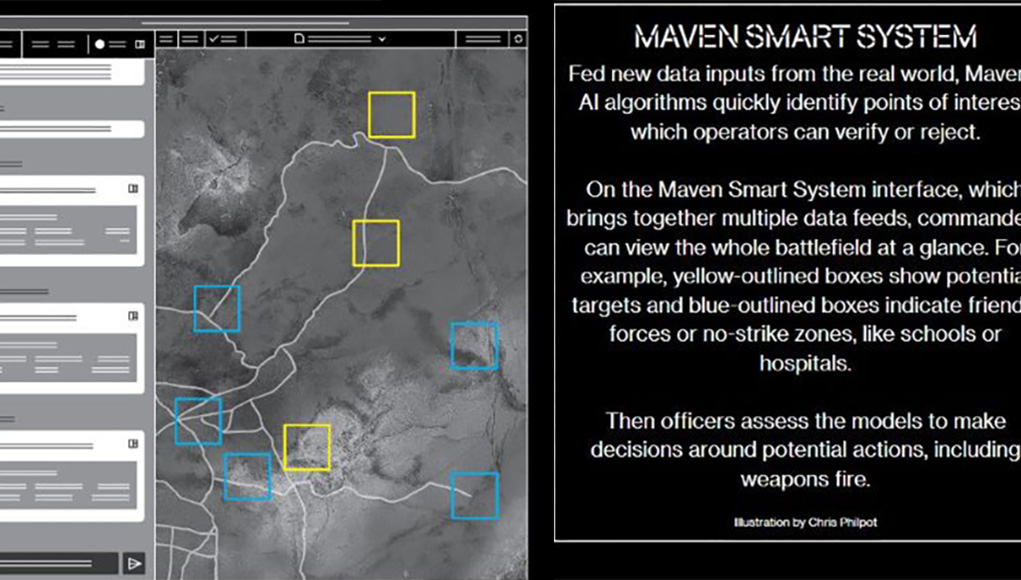
The scale of the AI’s impact was evident in the opening hours of Operation Epic Fury. The system reportedly helped generate recommendations for hundreds of targets within the first 24 hours of the operation, maintaining a pace of thousands more in the following weeks via International Business Times. This level of automation has led some analysts to characterize the Iran war as the world’s first large-scale example of artificial intelligence directing military operations in real time via NDTV.
Operational Efficiency vs. Ethical Concerns
While the Pentagon has lauded the speed and precision provided by Palantir’s tech, the deployment has not been without controversy. The ability to compress the kill chain has drawn sharp criticism regarding the risks to civilian populations. In response to these concerns, Palantir executives have emphasized that the software does not make autonomous lethal decisions.
Louis Mosley, Palantir’s head for the UK and Europe, stated in an interview with the BBC that the responsibility for life-and-death decisions remains exclusively with military commanders, asserting, “AI platforms like Maven have been instrumental to the management of the conflict, but responsibility always remains with the military organization” via International Business Times.
Market Volatility Amidst Military Success
Despite the technical success of the Maven Smart System and public praise from U.S. Officials, Palantir’s stock has plummeted 15% this week. This downturn suggests a complex relationship between wartime utility and market sentiment. While the company’s role as a primary contractor for the Pentagon is solidified, the “dragging on” of the conflict may be introducing uncertainties regarding long-term contract stability, geopolitical volatility, or the ethical backlash associated with AI-driven warfare.
During the AIPCON event, Palantir’s chief commercial officer, Ted Mabrey, highlighted that the company’s technology is “in the fight” for its customers, referencing both Operation Epic Fury and other naval applications like ShipOS via The Register. However, the market’s reaction indicates that operational victory does not always translate immediately into share price appreciation, especially when the conflict’s duration remains unpredictable.
The Evolution of Project Maven
To understand the current deployment, one must look at the origins of Project Maven. The initiative began in 2016, driven by commanders seeking a “third offset”—a strategic advantage that would allow the U.S. Military to maintain an overwhelming edge over adversaries via The Register. Initially launched in 2017, the project focused on using AI to analyze drone video footage for counterterrorism operations before evolving into the comprehensive Maven Smart System currently utilized in Iran.
| Metric/Detail | Information |
|---|---|
| Start Date | February 28, 2026 |
| Total Strikes (approx.) | 11,000+ |
| Primary AI Tool | Palantir Maven Smart System |
| Key Impact | Kill chain compressed from days to minutes |
| Target Types | Nuclear facilities, military sites, leadership |
As the conflict continues, the global business community will be watching whether Palantir can stabilize its stock price by translating its battlefield dominance into sustainable, long-term commercial growth. The current situation serves as a case study in the “AI arms race,” where the ability to process data faster than an opponent becomes the primary metric of success, even as the financial markets grapple with the implications.
There are currently no further scheduled public briefings from U.S. Central Command regarding the specific software iterations of the Maven system, though military updates on Operation Epic Fury are expected as the campaign progresses.
We invite our readers to share their perspectives on the ethics of AI in military targeting in the comments below.
Related reading