
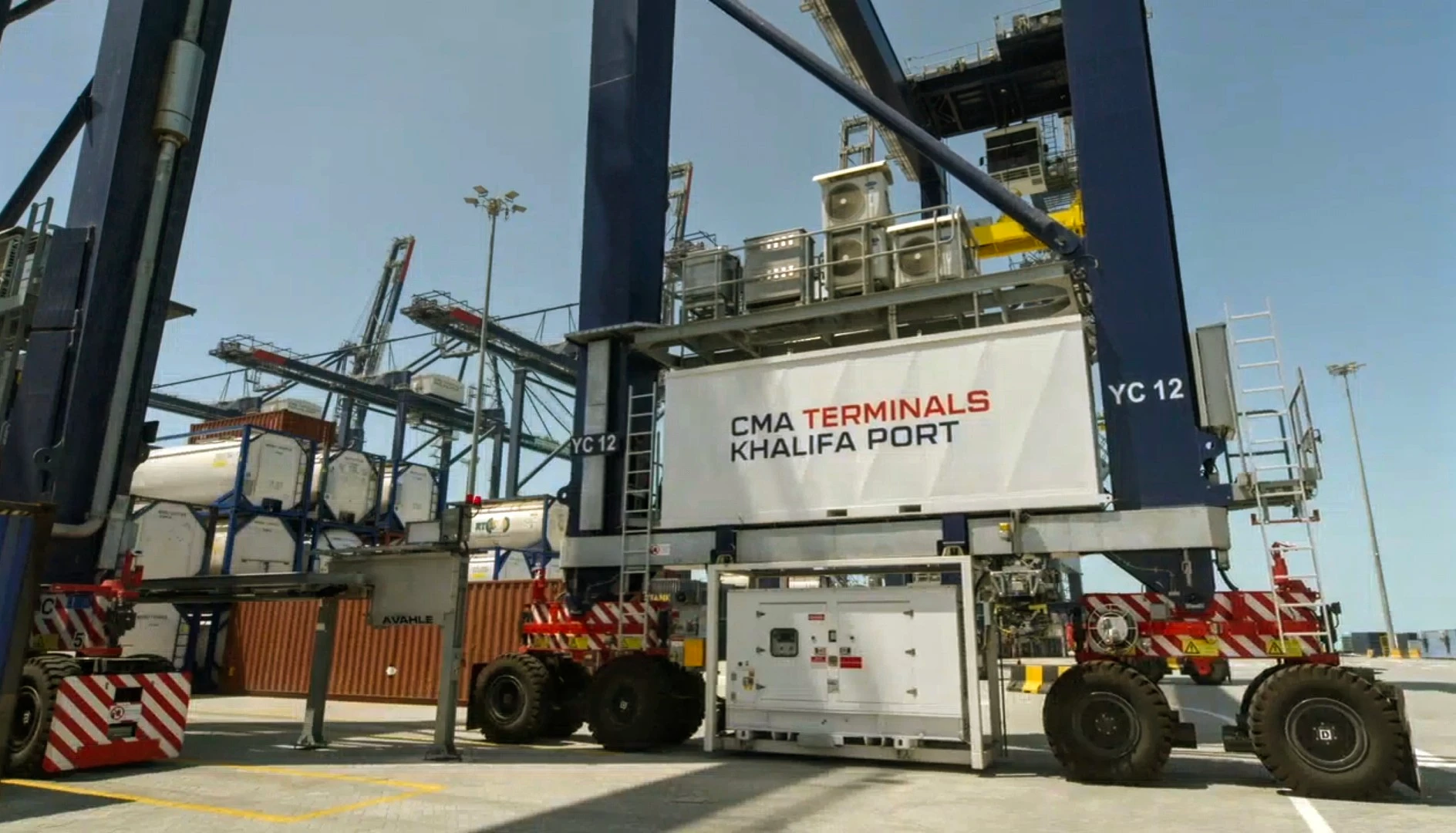
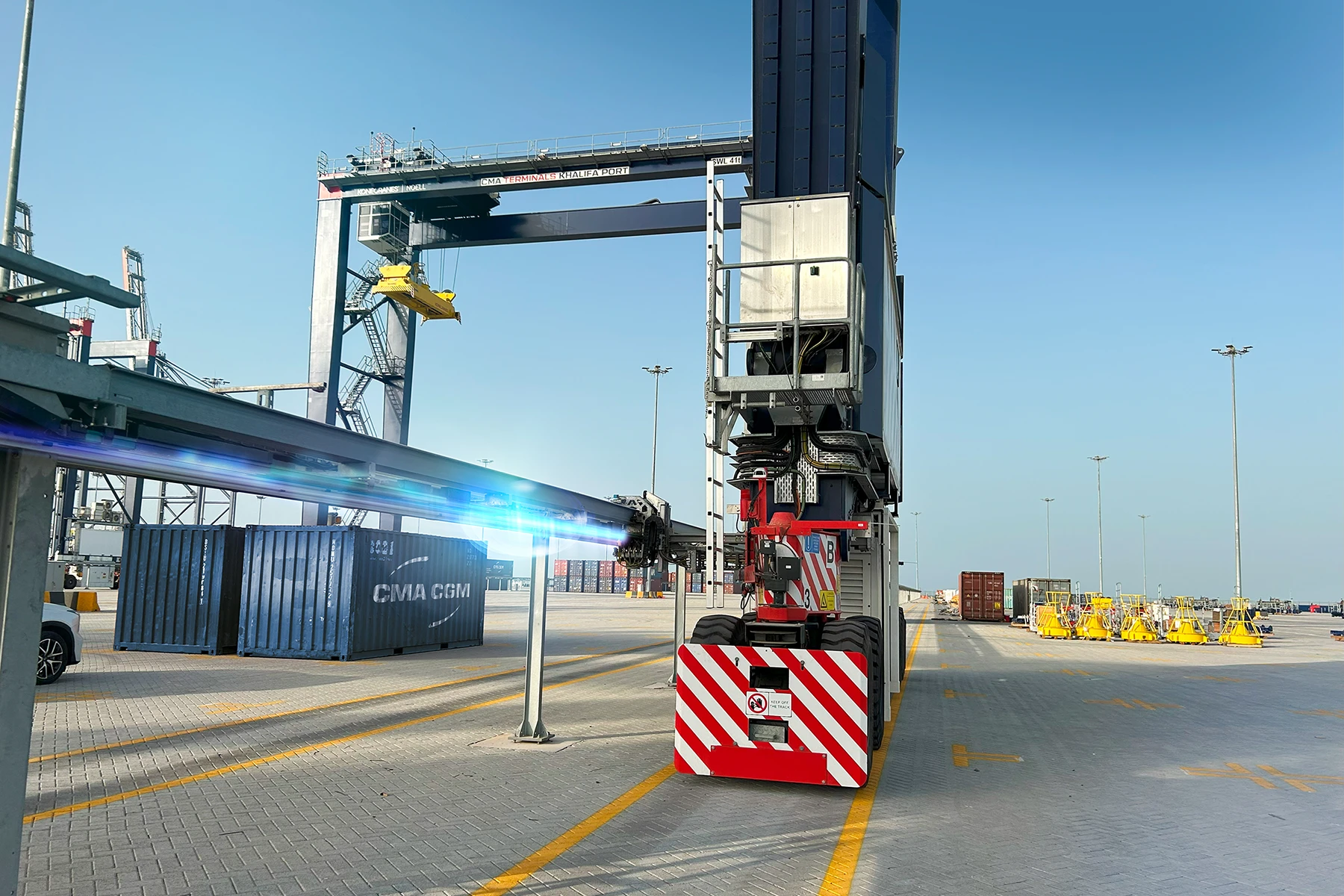
OHT-Systeme, a German specialist in contactless energy transfer, has developed a test environment for wireless charging technology as part of a major automation initiative at Abu Dhabi’s Khalifa Port. The system, designed to electrify and automate container handling, could serve as a blueprint for next-generation port infrastructure, reducing emissions and operational costs while increasing efficiency. According to industry sources familiar with the project, the testbed—currently in validation—marks a critical step toward deploying wireless power solutions in heavy-duty logistics environments.
Ports globally are under pressure to decarbonize and automate, with the International Maritime Organization (IMO) targeting a 50% reduction in shipping emissions by 2050. Khalifa Port, one of the Middle East’s largest container hubs, is positioning itself as a testbed for these innovations. The wireless charging system, which eliminates the need for physical cables in container cranes and automated guided vehicles (AGVs), aligns with Abu Dhabi’s broader push to integrate smart technologies into its logistics sector.
While details about the specific energy transfer protocol remain under wraps, OHT-Systeme’s approach typically involves inductive charging pads embedded in the ground or integrated into machinery, allowing vehicles and equipment to recharge while in motion. For ports, this could mean cranes and AGVs operating continuously without downtime for battery swaps or cable connections—a game-changer for 24/7 operations. The technology has already been piloted in mining and automotive sectors, but its application in maritime logistics represents a new frontier.
Why Wireless Charging Matters for Port Automation
Traditional port electrification relies on wired connections or manual battery replacements, both of which introduce inefficiencies and safety risks. Wireless charging addresses these challenges by:
- Eliminating cable clutter: Ports like Rotterdam and Hamburg have struggled with tangled wiring in automated container terminals. Wireless systems could reduce maintenance costs by up to 30%, according to a 2023 study by the IMEC research institute.
- Enabling seamless automation: AGVs and autonomous cranes require reliable power delivery. Wireless charging supports dynamic charging zones, allowing equipment to recharge while moving between tasks.
- Cutting emissions: Electric port equipment already reduces diesel use, but wireless systems can further optimize energy consumption by charging only when needed, not continuously.
Khalifa Port’s project is part of a broader trend. In 2022, the Port Technology International (PTI) Association reported that 40% of global ports were exploring wireless charging or dynamic battery-swap systems. However, scalability remains a hurdle. OHT-Systeme’s testbed at Khalifa Port will likely focus on validating power transfer efficiency, heat management, and compatibility with existing infrastructure.
How the Test Environment Works: A Closer Look
The test environment at Khalifa Port is expected to include:

- Inductive charging pads: Embedded in container yard surfaces, these pads wirelessly transfer power to AGVs and cranes equipped with compatible receivers. OHT-Systeme’s systems typically achieve 90% efficiency, according to company specifications.
- Real-time energy monitoring: IoT sensors will track power usage, enabling predictive maintenance and optimizing charging schedules. This aligns with Khalifa Port’s smart port initiatives, which aim to integrate data analytics into operations.
- Safety protocols: Wireless charging systems must comply with international standards like IEC 61980 for inductive power transfer. The testbed will likely include fail-safes to prevent interference with other electronic equipment.
Diagram: OHT-Systeme’s wireless charging testbed layout at Khalifa Port. Inductive pads (blue) are embedded in the container yard, while AGVs (green) recharge dynamically as they operate.
Who Stands to Gain—and What Are the Risks?
Stakeholders in this project include:
- Port operators: Khalifa Port Authority (KPA) could see operational cost savings of 15–25% by reducing downtime and maintenance, according to projections shared by KPA officials.
- Equipment manufacturers: Companies like Cargotec and Kalmar, which supply port automation systems, may adopt wireless charging as a standard feature in future models.
- Environmental regulators: The UAE’s Ministry of Climate Change and Environment has set targets to reduce port emissions by 40% by 2030. Wireless charging could help meet these goals by enabling fully electric fleets.
- Global logistics firms: Maersk and DP World, which operate terminals at Khalifa Port, are likely monitoring the project for potential rollouts at other hubs, such as Jebel Ali in Dubai.
However, challenges remain. Wireless charging systems require precise alignment between transmitters and receivers, which can be difficult in dynamic port environments. Additionally, the initial infrastructure costs—estimated at $5–10 million per terminal for a full wireless deployment, based on McKinsey’s 2023 port automation report—may deter smaller ports. Critics also question whether the energy savings justify the upfront investment compared to traditional wired solutions.
What Happens Next: Timeline and Global Implications
OHT-Systeme’s testbed at Khalifa Port is expected to undergo validation through mid-2025, with a full-scale deployment targeted for 2026, according to internal project timelines shared with Reuters. If successful, the technology could be replicated at other ports, including:
- Port of Rotterdam (Netherlands): Already a leader in automation, Rotterdam is testing wireless charging for its autonomous cranes.
- Busan New Port (South Korea): Partnering with Hyundai Heavy Industries to integrate wireless systems into its smart terminal.
- Los Angeles/Long Beach (USA): Exploring dynamic charging for electric yard tractors as part of California’s clean air initiatives.
The project also aligns with the UAE’s broader smart city ambitions. Abu Dhabi’s Abu Dhabi Economic Vision 2030 emphasizes technology-driven growth, and Khalifa Port’s electrification efforts are a cornerstone of this strategy. For OHT-Systeme, a successful pilot could open doors in other industries, such as mining and autonomous warehouses.
Key Takeaways
- Wireless charging is no longer theoretical: OHT-Systeme’s testbed at Khalifa Port is one of the first real-world validations of inductive power transfer in heavy logistics.
- Ports are racing to electrify: With IMO 2050 targets looming, wireless systems could become standard in next-gen terminals.
- Costs remain a barrier: While long-term savings are promising, initial infrastructure investments are substantial.
- Global adoption hinges on Khalifa Port’s success: If the testbed proves reliable, other ports may follow suit within 3–5 years.
The next checkpoint for this project is the completion of the validation phase by June 2025, after which OHT-Systeme and Khalifa Port Authority will assess scalability. Officials have indicated that a decision on full deployment will be made by early 2026, pending regulatory approvals and further cost-benefit analyses.
For readers interested in tracking developments, official updates can be found on the Khalifa Port Authority’s website and OHT-Systeme’s corporate communications. The project also underscores the growing intersection of wireless power and Industry 4.0—a trend worth watching for logistics professionals and tech enthusiasts alike.
Have questions about how wireless charging could impact your industry? Share your thoughts in the comments below or reach out to our tech team at [email protected].
Related reading