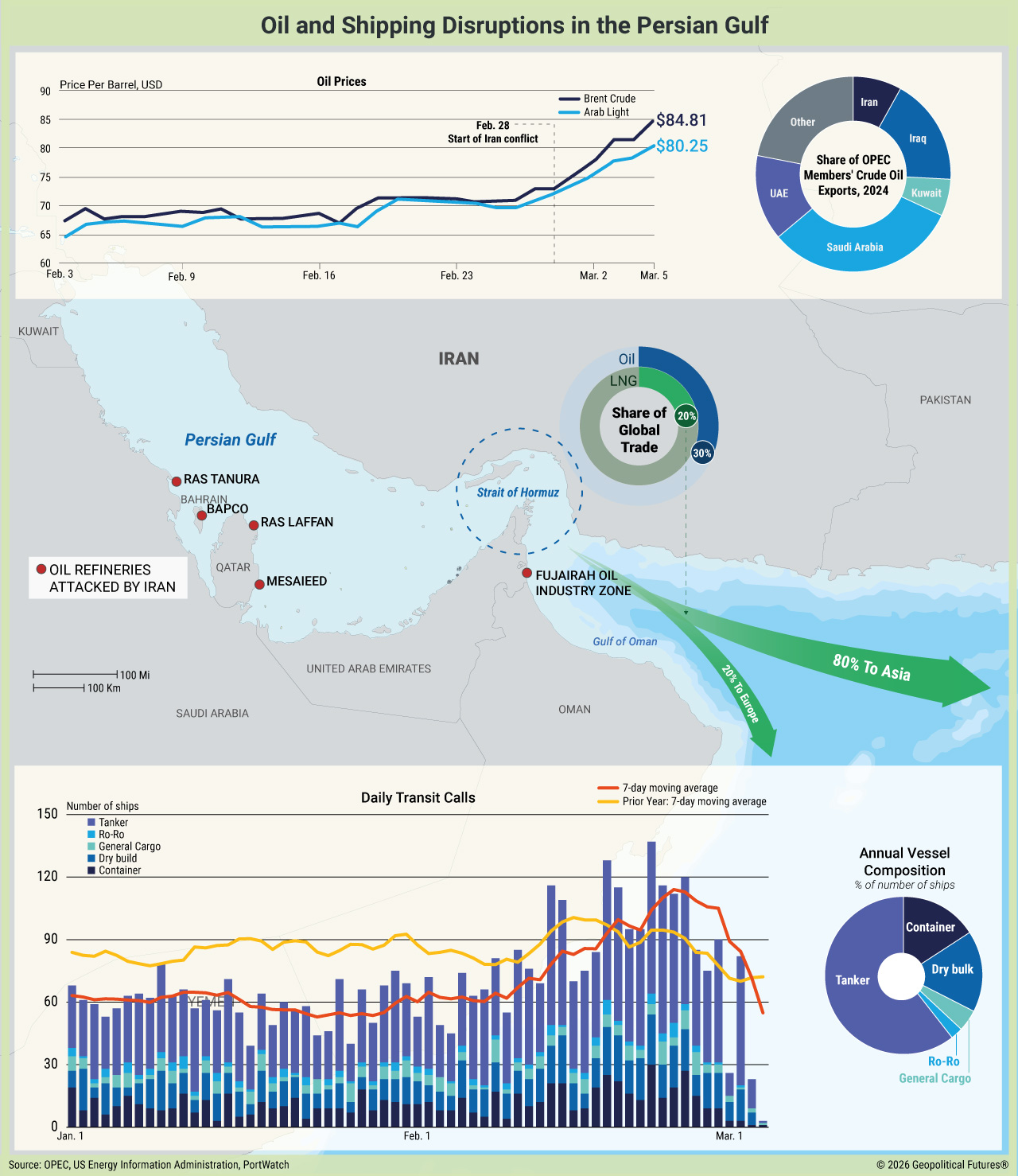
Persian Gulf oil producers are navigating a period of heightened market uncertainty as persistent logistical bottlenecks and security concerns—including the threat of naval mines—complicate the transit of global energy supplies. While crude exports from the region have maintained relative stability, government energy agencies and private shipping firms are increasingly prioritizing the development of alternative export routes to mitigate risks associated with the Strait of Hormuz, the world’s most critical maritime chokepoint.
The geopolitical instability in the Middle East has forced a reassessment of energy security protocols. According to the U.S. Energy Information Administration (EIA), the Strait of Hormuz sees an average daily flow of approximately 21 million barrels of petroleum liquids, representing about 21% of global petroleum consumption. Any disruption to this transit corridor poses an immediate risk to global price stability, prompting regional producers to accelerate investments in infrastructure that bypasses the narrow waterway entirely.
Infrastructure Shifts and the Search for Secure Transit
To reduce reliance on the Strait of Hormuz, key regional players are expanding pipeline capacities designed to carry crude oil directly to the Red Sea or the Arabian Sea. The United Arab Emirates, for instance, has long utilized the Habshan-Fujairah pipeline, which allows for the export of oil from the Gulf of Oman, effectively bypassing the chokepoint. Market analysts observe that the utilization rates of these existing bypass routes have become a primary indicator of regional risk appetite.

However, the transition to alternative routes is neither immediate nor inexpensive. The International Energy Agency (IEA) notes that while infrastructure investments are rising, the sheer volume of production from Gulf states necessitates a multi-modal approach to logistics. Shipping companies continue to face rising insurance premiums as underwriters account for the potential for maritime incidents, including the presence of naval mines or drone-based interference, which remain a persistent concern for commercial vessels operating in the Persian Gulf.
The Impact of Maritime Security on Global Energy Markets
Security in the Persian Gulf remains a volatile variable that influences daily trading prices. The U.K. Maritime Trade Operations (UKMTO) consistently issues advisories to commercial shipping, urging heightened vigilance due to the threat of unexploded ordnance and regional military activity. These advisories serve as a baseline for the shipping industry, often leading to temporary route deviations that increase transit times and fuel costs for tanker operators.

The interplay between security threats and market supply creates a feedback loop. When tensions rise, tanker operators often demand higher premiums or refuse to enter high-risk zones, which can tighten supply and drive up benchmark prices. For instance, the divergence of tanker traffic away from the Red Sea—a route often used to connect with European markets—has forced vessels to take longer routes around the Cape of Good Hope, adding days to transit schedules and increasing the cost of delivered barrels.
Managing Deep Uncertainty in Production Planning
Regional producers are managing this deep uncertainty by diversifying their storage capabilities and strengthening diplomatic ties to ensure freedom of navigation. Official statements from the Organization of the Petroleum Exporting Countries (OPEC) emphasize that while the group remains committed to market stability, the logistical challenges remain largely outside the control of individual oil companies. The focus has shifted toward building “resilience in logistics,” which includes coordinating with international naval coalitions to protect critical shipping lanes.
For investors and energy consumers, the primary concern remains the predictability of supply. As of mid-2024, the market remains characterized by a “risk premium” baked into the price of Brent and WTI crude. This premium fluctuates based on real-time reports of maritime incidents or diplomatic breakthroughs. The ability of producers to maintain output levels despite these logistical hurdles remains a testament to the sophistication of the regional energy supply chain, though it does not eliminate the underlying systemic risks.
Future Outlook and Monitoring Procedures
The next major checkpoint for market observers will be the upcoming quarterly updates from national oil companies regarding export volume targets and pipeline expansion milestones. Stakeholders are advised to monitor the Maritime Executive and official government bulletins for updates on naval transit protocols and security advisories, which provide the most accurate assessment of current operational risks.
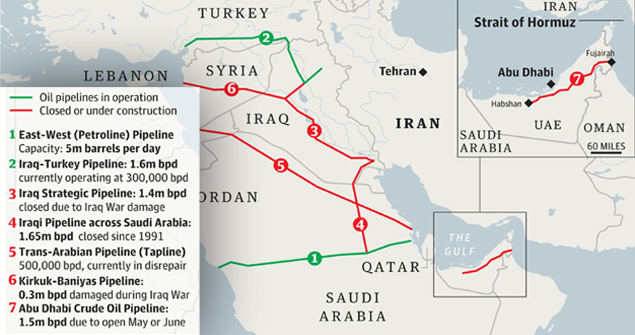
As the situation develops, transparency from regional producers regarding their logistical contingency plans will be essential for calming market volatility. Readers interested in the latest data on energy flows and regional stability are encouraged to follow official updates from energy ministries and international maritime safety organizations. Please share your thoughts or questions regarding the impact of these logistical shifts on global energy security in the comments section below.
Keep reading