
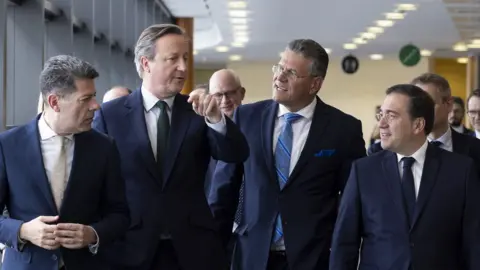
Fabian Picardo, the Chief Minister of Gibraltar, has reiterated his defense of the post-Brexit agreement between the European Union and the United Kingdom as a critical safeguard for the territory’s economic and social stability, describing it as a “vaccine” against frontier-related disruptions.
Speaking in recent international forums, Picardo emphasized that the agreement prevents a scenario of economic collapse for Gibraltar, particularly due to its reliance on thousands of cross-border workers from the Campo de Gibraltar region in southern Spain. He warned that without the framework established by the deal, the daily influx of workers essential to sectors like financial services and online gaming would have been severely jeopardized.
The Chief Minister as well used the opportunity to assign political responsibility for the Brexit outcome, directly blaming both moderate and far-right political forces in the UK for creating the conditions that made the agreement necessary. According to Picardo, these groups were the primary drivers behind the 2016 referendum result, which initially threatened Gibraltar’s close ties with both the UK and the EU.
In contrast, he highlighted the role of progressive and left-leaning political actors in negotiating a solution that preserves mobility and trade fluidity. Picardo likened the post-agreement movement of people and goods across the Gibraltar frontier to the seamless border arrangements seen between European nations such as Belgium and Luxembourg, suggesting this model ensures continuity for local businesses and residents.
His remarks were made during a gathering of progressive politicians in Barcelona, where he stressed that the agreement acts as a stabilizing mechanism not only for Gibraltar but also for the wider surrounding area, preventing social and economic disruption in the Campo de Gibraltar.
The treatment of the agreement as a defensive measure reflects ongoing concerns about the long-term implications of Brexit for territories with deep economic interdependence across former internal EU borders. Picardo’s framing positions the deal not as a permanent solution but as a vital buffer against renewed instability.
As of the latest available information, no major revisions to the EU-UK Trade and Cooperation Agreement, which governs Gibraltar’s post-Brexit relationship, have been formally proposed or implemented. The framework remains in effect, with both sides committed to its operation through joint institutional mechanisms.
For ongoing updates on the implementation of the agreement and its impact on Gibraltar and the Campo de Gibraltar region, readers are encouraged to consult official communications from the Government of Gibraltar and the European Commission’s Directorate-General for Trade.
We invite our global audience to share their perspectives on how border agreements like this one shape regional stability in post-Brexit Europe. Join the conversation by commenting below and sharing this article with others interested in European affairs and cross-border cooperation.