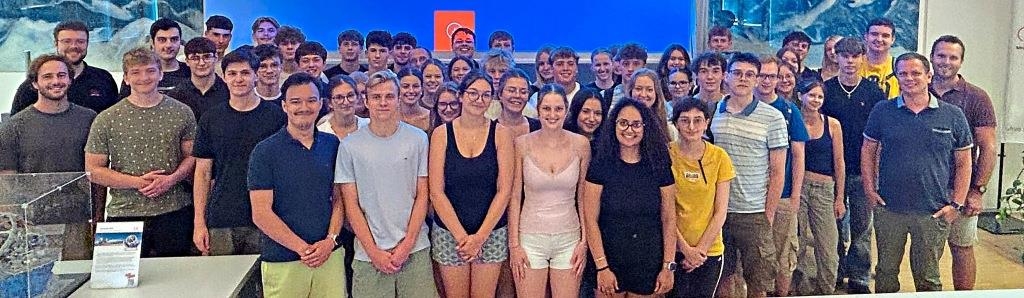
Physics students from the 12th grade at Pocking Gymnasium recently experienced world-class technology on their doorstep by visiting Micro-Epsilon, a high-tech measurement systems manufacturer based in Lower Bavaria. According to regional educational reports, the excursion offered senior students a direct look at precision measurement technology, sensor systems, and industrial automation development.
For students preparing for their final Abitur physics examinations, bridging abstract textbook formulas with industrial engineering provides vital context. Micro-Epsilon, recognized globally for non-contact measurement sensors and infrared temperature measurement devices, regularly hosts regional school groups to foster interest in STEM fields. Engineering teams at the firm walked students through laboratories where advanced laser scanners and optical measuring devices undergo rigorous testing before deployment in automotive, aerospace, and electronics manufacturing worldwide.
High-tech manufacturing hubs across rural and semi-urban districts in southern Germany increasingly partner with local secondary schools to address skilled labor shortages in engineering. Educational initiatives championed by regional chambers of commerce and institutions like Pocking Gymnasium emphasize hands-on technical literacy. During the visit, staff demonstrated how optical displacement sensors operate using laser triangulation principles—a core topic in the Bavarian physics curriculum for senior secondary grades.
Inside Industrial Measurement Technology
The curriculum connection became tangible as engineers explained the practical physics behind industrial sensors. Students examined how millimeter-wave radar and confocal chromatic sensors measure surface roughness down to the sub-micron level. Such industrial applications require a deep understanding of wave optics, electromagnetism, and signal processing.
Company representatives detailed the research and development pipeline, showing how raw sensor data translates into machine-readable output for quality control systems on automated production lines. Technicians outlined the challenges of designing sensors capable of withstanding extreme industrial environments, including high temperatures and continuous vibration.
Regional educational coordinators note that direct industry exposure helps students make informed career choices regarding university degree programs in mechanical engineering, mechatronics, and applied physics. Local manufacturing enterprises benefit from cultivating talent pools directly within their immediate communities.
STEM Education and Regional Industry Collaboration
Pocking Gymnasium has maintained active partnerships with local industrial partners to enrich its science curriculum. Teachers accompanying the 12th-grade physics cohort emphasized that seeing physical principles applied in commercial manufacturing environments reinforces classroom theory far more effectively than standard laboratory experiments alone.
Micro-Epsilon operates multiple facilities in the region, employing hundreds of engineers, technicians, and specialized apprentices. Company training managers presented dual-study educational models available to graduating seniors, combining practical corporate training with academic engineering programs at regional universities.
Educational authorities and industrial associations encourage similar cooperative programs across Europe to bridge the gap between secondary education and advanced technology sectors. Future site visits and collaborative workshops between Pocking Gymnasium and local engineering firms are planned for upcoming academic semesters.
Keep reading