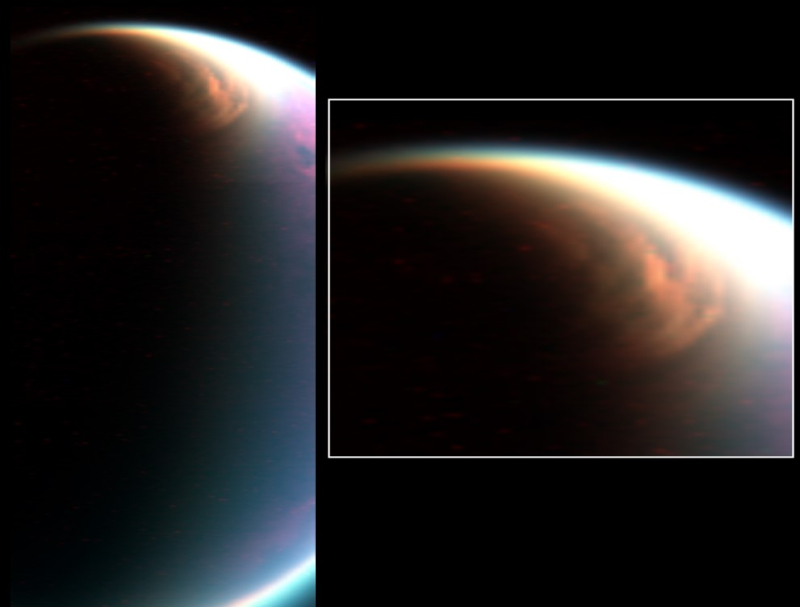
Titan’s Polar Clouds: A Window into Saturn’s Largest Moon’s Complex Atmosphere
Saturn’s largest moon, Titan, continues to fascinate scientists with its Earth-like features – rivers, lakes, and a dense atmosphere – despite being vastly different in temperature and composition. Recent research, published in Nature Communications in December 2025, has provided the first complete seasonal model of Titan’s stratospheric polar clouds, offering insights into the moon’s atmospheric evolution and paving the way for future exploration with missions like Dragonfly. These clouds, composed of exotic ices, aren’t just visually striking; they play a crucial role in the complex chemical processes occurring within Titan’s atmosphere and potentially influencing its surface features.
For over four decades, since their initial discovery by the Voyager probe in 1980, these polar clouds have presented a puzzle to researchers. Observations from Earth-based telescopes and the Cassini mission (2004-2017) revealed their cyclical nature, but the precise mechanisms driving their formation and seasonal changes remained elusive. The new model, developed by a team of French scientists from the Observatoire de Paris – PSL, the University of Reims Champagne-Ardenne, and Sorbonne Université, finally provides a comprehensive explanation for these observations. Understanding these clouds is vital for predicting future atmospheric conditions and interpreting data gathered by upcoming missions.
Formation and Evolution of Titan’s Unique Clouds
The formation of Titan’s polar clouds is a seasonal process, beginning in the autumn. This process is driven by a combination of rapid atmospheric cooling and an enrichment of organic compounds within the stratospheric polar vortex. This vortex, a swirling mass of air similar to a hurricane, concentrates these compounds, creating the conditions necessary for cloud formation. Unlike water-based clouds on Earth, Titan’s clouds are composed of ices of benzene and hydrogen cyanide. The Observatoire de Paris details how these clouds initially form at very high altitudes, around 336 kilometers (approximately 209 miles) above the surface.
As the seasons progress, these clouds don’t remain static. They gradually descend to lower layers of the atmosphere, undergoing chemical changes along the way. This descent and evolution are key to understanding their eventual disappearance in the spring. The changing composition and altitude of the clouds influence the distribution of organic molecules throughout Titan’s atmosphere, potentially impacting the formation of haze layers and the chemical processes occurring on the surface. The descent of these clouds also contributes to the deposition of organic compounds onto Titan’s surface, potentially influencing the composition of its lakes and landscapes.
The Role of Polar Clouds in Titan’s Atmospheric Chemistry
Polar stratospheric clouds (PSCs), as they are known in Earth’s atmosphere, play a significant role in ozone depletion. Research from the Université de Toulouse highlights how PSCs enhance ozone destruction by activating stable chlorine and bromine reservoirs into reactive radicals, and prolonging ozone depletion by removing nitric acid and water from the stratosphere through sedimentation. While Titan’s atmospheric chemistry differs from Earth’s, the principle of chemical activation within these clouds is likely similar, influencing the distribution of key compounds like methane and ethane.
On Titan, the clouds are not directly involved in ozone depletion (as Titan doesn’t have a significant ozone layer), but they are crucial in the broader context of organic chemistry. The ice crystals within the clouds provide surfaces for chemical reactions to occur, converting simple molecules into more complex organic compounds. These compounds then fall to the surface, contributing to the formation of Titan’s lakes and seas, which are primarily composed of liquid methane and ethane. The process of cloud formation, descent, and eventual dissipation effectively redistributes organic material throughout Titan’s atmosphere and onto its surface.
Predicting Future Cloud Formation and the Dragonfly Mission
The new climate model developed by the French team isn’t just a retrospective explanation of past observations; it also allows for predictions about future cloud activity. Scientists now anticipate the formation of a new polar cloud in Titan’s northern hemisphere towards the finish of 2027. This prediction provides a valuable opportunity for astronomers to focus their observations and gather data to validate the model’s accuracy. The ability to accurately predict cloud formation is crucial for maximizing the scientific return of future missions.
The upcoming Dragonfly mission, scheduled to launch in 2027 and arrive at Titan in 2034, will be a game-changer in our understanding of this enigmatic moon. NASA’s Dragonfly mission is a rotorcraft lander that will explore Titan’s surface, sampling its organic-rich environment and searching for potential signs of prebiotic chemistry. The insights gained from the cloud model will be invaluable in interpreting the data collected by Dragonfly, helping scientists understand the connection between the atmosphere, clouds, and surface composition. The model provides a predictive framework for interpreting Dragonfly’s observations, allowing researchers to anticipate the types of organic molecules and compounds they might encounter.
Understanding the Long-Term Impact on Titan’s Surface
Beyond the immediate implications for the Dragonfly mission, the research suggests that these polar clouds could play a significant long-term role in shaping Titan’s surface. The deposition of organic compounds through precipitation from these clouds could contribute to the formation and evolution of Titan’s lakes and seas, altering their composition over time. This process could also influence the formation of dunes and other surface features, creating a dynamic and evolving landscape.
The study highlights the interconnectedness of Titan’s atmospheric and surface processes. The clouds aren’t isolated phenomena; they are integral parts of a complex system that governs the distribution of organic material and the evolution of the moon’s environment. Further research will be needed to fully understand the long-term consequences of cloud activity on Titan’s surface, but the current findings provide a crucial foundation for future investigations.
Key Takeaways
- Titan’s polar clouds are formed in autumn due to atmospheric cooling and organic compound enrichment.
- These clouds are composed of ice crystals of benzene and hydrogen cyanide, unlike Earth’s water-based clouds.
- The clouds descend through the atmosphere, evolving chemically and eventually disappearing in the spring.
- Scientists predict a new polar cloud will form in Titan’s northern hemisphere by the end of 2027.
- Understanding these clouds is critical for interpreting data from the upcoming Dragonfly mission.
As we approach the launch of the Dragonfly mission, the detailed understanding of Titan’s polar clouds provided by this new research will be invaluable. The mission promises to unlock further secrets of this fascinating moon, and the insights gained from studying these clouds will undoubtedly play a key role in unraveling the mysteries of Titan’s atmosphere and its potential for harboring prebiotic chemistry. Stay tuned for further updates as the Dragonfly mission progresses and new discoveries are made.
Keep reading