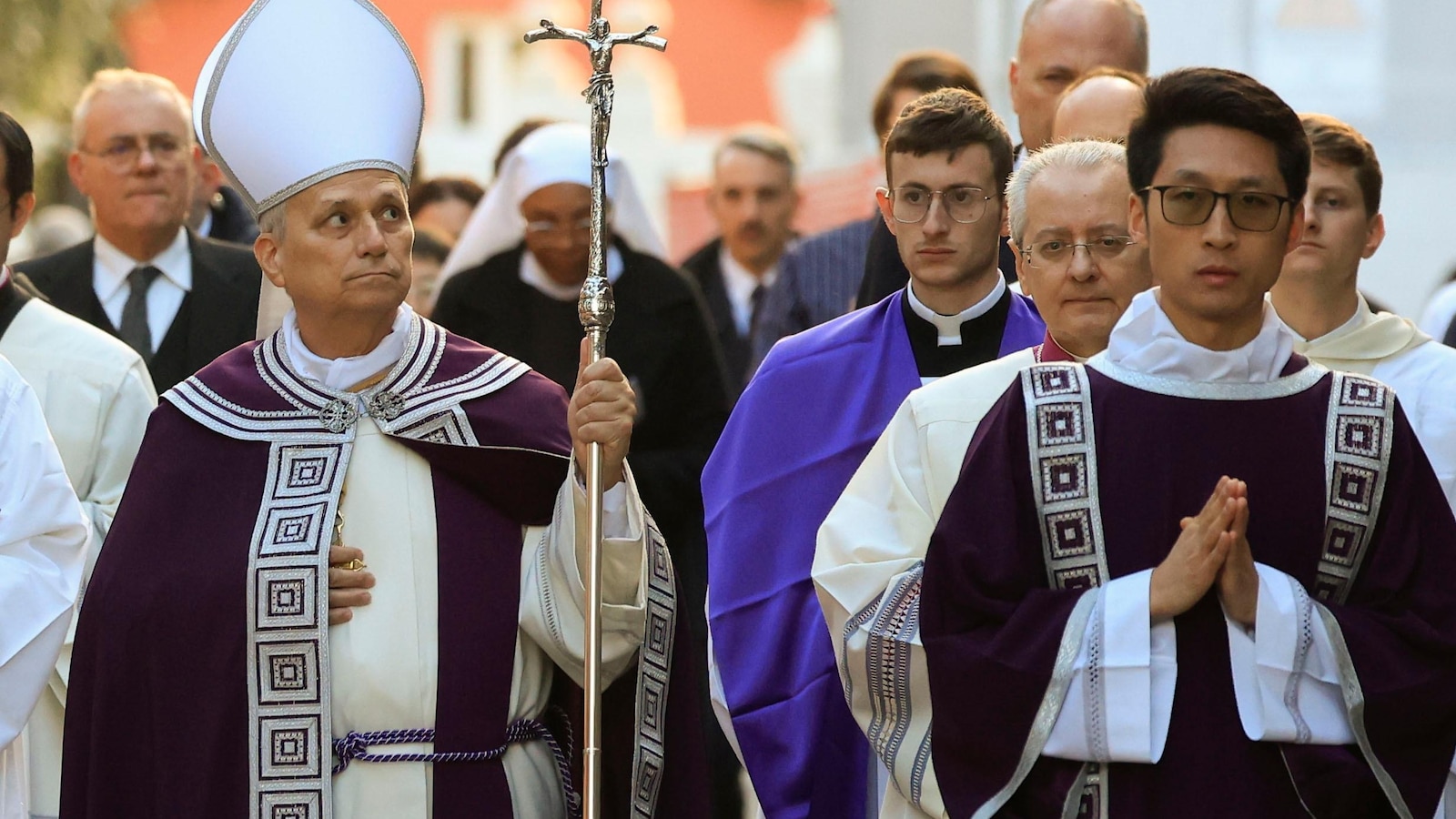
Rome, Italy – Pope Leo XIV marked the beginning of Lent with a somber Ash Wednesday address, lamenting what he described as the “ashes of international law and justice” scattered across the globe by ongoing conflicts. The pontiff’s remarks, delivered during a traditional procession and Mass, underscored a growing concern within the Vatican regarding the erosion of established international norms and the devastating human cost of war. This year’s observance carries particular weight as conflicts continue to rage in Ukraine, the Middle East, and elsewhere, challenging the foundations of a post-World War II order.
The service, a revival of practices largely delegated by Pope Francis in his later years, saw Pope Leo XIV walk with a procession of clergy from the Church of Sant’Anselmo on the Aventine Hill to the Basilica of Santa Sabina on the Janiculum Hill. There, he presided over Mass and dispensed ashes to cardinals, a symbolic act of repentance and a reminder of human mortality. Ash Wednesday initiates Lent, a 40-day period of fasting, prayer, and self-reflection for Catholics, culminating in the observances of Good Friday and Easter.
In his homily, Pope Leo XIV offered a profound meditation on the nature of sin and its consequences, stating that the ashes received by Christians represent “the weight of a world that is ablaze, of entire cities destroyed by war.” He expanded on this imagery, connecting the physical ashes to a broader sense of loss – the breakdown of legal frameworks, the destruction of ecosystems, the erosion of critical thinking, and a diminishing reverence for the sacredness of life. The Pope’s words reflect a deepening anxiety within the Catholic Church regarding the state of global affairs and the increasing disregard for international humanitarian law.
A World ‘Ablaze’: The Pope’s Critique of International Order
Pope Leo XIV has consistently voiced concerns about the weakening of the international legal order, particularly in the wake of Russia’s invasion of Ukraine. He has condemned the violation of national sovereignty and the disregard for international treaties, arguing that such actions undermine the principles of peaceful coexistence. The Vatican has repeatedly called for a negotiated resolution to the conflict in Ukraine, emphasizing the demand for dialogue and respect for international law. The ongoing war has resulted in a significant humanitarian crisis, with millions of Ukrainians displaced and countless lives lost, a situation the Pope has described as “tragic and unacceptable.”
Beyond Ukraine, the Pope’s critique extends to other instances where he perceives a disregard for international norms. He has previously spoken out against the U.S. Military incursion into Venezuela, expressing concern over external interference in the internal affairs of sovereign nations. This stance reflects a broader commitment to multilateralism and a cautious approach to unilateral actions, even when ostensibly aimed at promoting democracy or human rights. The Vatican’s position underscores its belief that international disputes should be resolved through diplomacy and adherence to established legal frameworks.
The Pope’s concerns aren’t limited to geopolitical conflicts. He also highlighted the “ashes of entire ecosystems,” drawing attention to the environmental consequences of human activity and the urgent need for sustainable practices. This aligns with the Vatican’s increasing focus on environmental stewardship, as articulated in Pope Francis’ encyclical Laudato Si’, which calls for a radical ecological conversion. The destruction of natural resources, the Pope argues, is not only an environmental tragedy but also a moral failing, as it deprives future generations of their rightful inheritance.
The Holy See and the Gaza Conflict
Just this week, the Holy See reaffirmed its commitment to a multilateral approach to international crises by announcing it would not participate in the Trump Administration’s Board of Peace for Gaza. Cardinal Pietro Parolin, the Vatican’s Secretary of State, explained that the United Nations is the appropriate forum for monitoring the fragile ceasefire agreement and overseeing the rebuilding of Gaza. This decision underscores the Vatican’s preference for established international institutions and its skepticism towards unilateral initiatives. The Holy See has consistently called for a two-state solution to the Israeli-Palestinian conflict, based on mutual recognition and respect for the legitimate rights of both peoples.
The situation in Gaza remains deeply concerning, with ongoing humanitarian challenges and a precarious security situation. The United Nations Relief and Works Agency for Palestine Refugees in the Near East (UNRWA) continues to provide essential assistance to Palestinian refugees in Gaza, but its operations are hampered by funding shortages and access restrictions. The Vatican has repeatedly appealed for increased humanitarian aid to Gaza and for a renewed commitment to finding a lasting political solution to the conflict. According to UNRWA, as of February 2026, over 2.2 million Palestinians in Gaza are reliant on humanitarian assistance.
Lent: A Time for Reflection and Repentance
Ash Wednesday marks the beginning of Lent, a period of spiritual preparation for Easter. Traditionally, Lent is observed through prayer, fasting, and almsgiving – acts of devotion intended to deepen one’s relationship with God and to express solidarity with those in need. The 40-day period commemorates the 40 days Jesus spent in the desert, fasting and praying, before beginning his public ministry. For Catholics, Lent is a time for self-examination, repentance, and renewal.
The practice of receiving ashes on Ash Wednesday is a visible sign of repentance and a reminder of human mortality. The ashes are traditionally made from burned palm branches from the previous year’s Palm Sunday celebration, symbolizing the transience of life and the need for spiritual transformation. The priest or minister applies the ashes to the forehead of the recipient, often accompanied by the words, “Remember that you are dust, and to dust you shall return.” This somber reminder encourages believers to focus on the things that truly matter – faith, love, and service to others.
Beyond individual practices, Lent is also a time for communal reflection and action. Many Catholic parishes organize Lenten programs, such as Bible studies, prayer groups, and charitable initiatives. These activities provide opportunities for parishioners to deepen their faith, support their communities, and live out the Gospel message of love and compassion. The Lenten season culminates in the celebration of Easter, the most vital feast in the Christian calendar, commemorating the resurrection of Jesus Christ and the promise of eternal life.
Pope Leo XIV’s message on Ash Wednesday serves as a powerful call to conscience, urging individuals and nations to confront the challenges facing the world with humility, compassion, and a renewed commitment to justice and peace. His words remind us that true repentance requires not only personal reflection but also a collective effort to build a more just and sustainable world for all. The Vatican is expected to release further statements on international conflicts and humanitarian crises throughout the Lenten season.
The next major event on the Vatican calendar is the Pope’s planned address to the United Nations General Assembly in September 2026, where he is expected to elaborate on his vision for a more just and peaceful world order. Readers are encouraged to share their thoughts on the Pope’s message and the challenges facing the international community in the comments section below.
Keep reading