
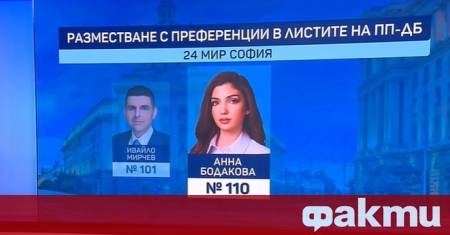
As Bulgaria counts the final hours before official results are released from the April 19 parliamentary elections, preferential voting has once again reshaped candidate lists across multiple parties, particularly in the capital Sofia. Preliminary data shows that personal votes for individual candidates have significantly altered the pre-determined party rankings, setting the stage for potential shifts in parliamentary representation once mandates are allocated.
The phenomenon of preferential voting – where voters can express support for specific candidates within a party list – has proven especially influential in Sofia’s multi-member constituencies (МИР). According to verified reports from the election, former President Rumen Radev, running under the “Progressive Bulgaria” coalition, received 22,741 preferential votes in Burgas and 21,541 in Sofia’s 25th МИР, far outpacing other leading candidates in those regions. His nearest rival in the 25th МИР, GERB leader Boyko Borisov, secured just 7,063 preferential votes in the same district.
In Sofia’s 23rd МИР, Aleksandar Bogdanov of the “Yes, Bulgaria!” party emerged as a standout performer in preferential voting, amassing 13,528 votes – enough to move him from fifth to a projected second place on his party’s list. This surge would secure him a parliamentary seat, pushing other candidates down the ranking. Elisaveta Belobradova followed closely with 9,864 preferential votes in the same constituency, positioning her for a third seat, while Nikolay Denkov received 9,640 votes, placing him in contention for a fourth mandate if the party wins enough seats.
Meanwhile, in the 24th МИР, Anna Bodakova of the “We Continue the Change – Democratic Bulgaria” (PP-DB) coalition became the most preferred candidate across all parties in that district, although exact vote totals for her performance were not specified in the available verified sources. Ivaylo Mirchev, leader of the PP-DB list in Sofia’s 24th МИР, received 6,692 preferential votes, reflecting strong personal support despite not topping the list.
These results underscore how preferential voting continues to challenge traditional party hierarchies in Bulgaria’s electoral system. Unlike closed-list systems, Bulgaria’s open-list proportional representation allows voters to influence not only which parties gain seats but also which individuals within those parties are elected. In past elections, this mechanism has frequently led to high-profile candidates being demoted or promoted based solely on personal appeal, independent of party leadership preferences.
The impact extends beyond individual careers. Parties must now calculate not only their overall vote share but also how many candidates from each list will clear the threshold for election based on preferential tallies. For instance, analysts from the Bulgarian news outlet “24 Chasa” projected that PP-DB is likely to win six mandates in Sofia’s 23rd МИР, meaning the top six candidates on their adjusted list – shaped by preferential votes – would enter parliament.
As of the latest verified updates, election officials are still processing ballots, with final results expected within hours. The Central Election Commission has not yet released a definitive timeline, but historical patterns suggest that preferential vote counts are typically finalized alongside seat allocation calculations, which follow the initial tabulation of party-list votes.
For voters seeking real-time updates, the Central Election Commission’s official website provides live results as they are verified, and published. Political analysts note that while preferential voting increases voter influence over individual candidacies, it also complicates coalition forecasting, as elected representatives may owe their positions more to personal popularity than to party directives.
With the count entering its final stages, all eyes remain on how these preference-driven reshufflings will affect the balance of power in the upcoming National Assembly. Whether the shifts will lead to new parliamentary alliances or reinforce existing blocs remains to be seen once all ballots are officially tallied and mandates distributed.
Stay tuned to World Today Journal for continuing coverage of Bulgaria’s election aftermath, including official statements from party leaders and expert analysis of what the results mean for governance in the months ahead.
Share your thoughts on how preferential voting is shaping Bulgaria’s political landscape in the comments below, and help spread informed discussion by sharing this article with your network.