
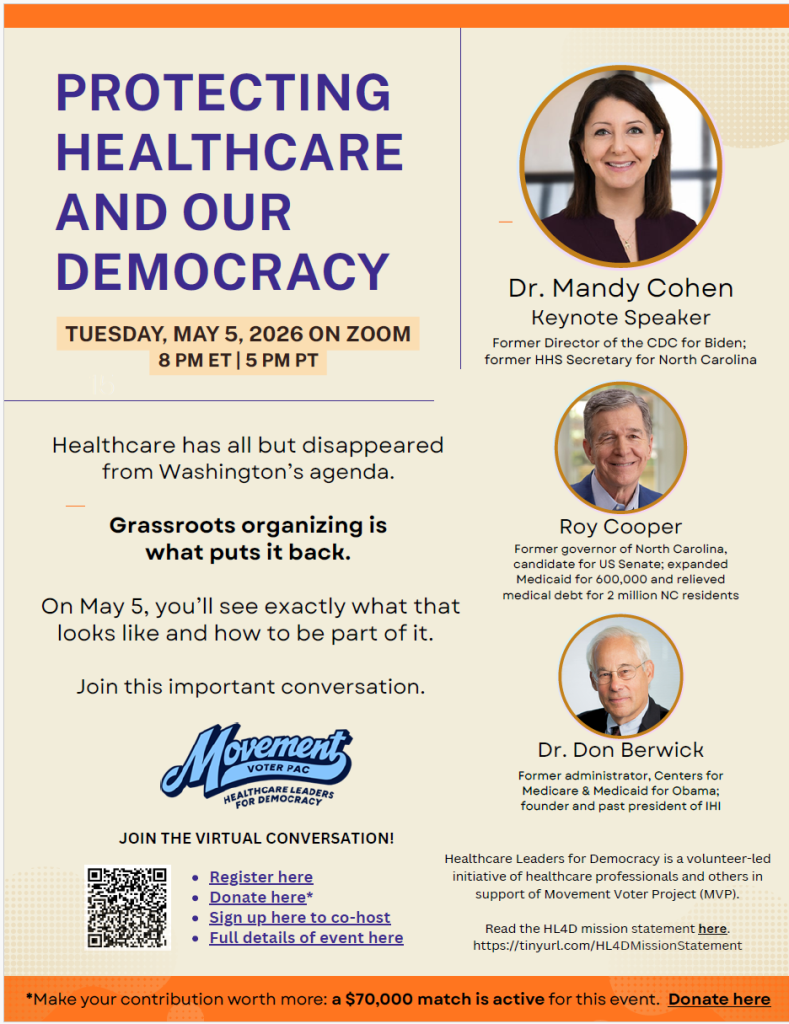
The stability of a nation’s public health infrastructure is inextricably linked to the strength of its democratic institutions. This fundamental truth was the central theme of a high-level discussion held on May 5, 2026, which brought together prominent figures from the worlds of medicine, public health, and governance. The conversation, titled “Protecting Healthcare and Our Democracy,” examined how the erosion of civic engagement and the volatility of political landscapes can directly impact the ability of health systems to serve their populations effectively.
The event featured a rare convergence of leadership, including former Director of the Centers for Disease Control and Prevention (CDC) Mandy Cohen, former North Carolina Governor Roy Cooper, and Dr. Donald Berwick, the founder and former president of the Institute for Healthcare Improvement (IHI). By bridging the gap between clinical expertise and political administration, the participants highlighted a growing consensus: that the health of a citizenry cannot be fully secured without the protection of the democratic processes that govern health policy, funding, and equity.
Central to the evening’s objectives was a significant fundraising effort to support the Movement Voter Project. The initiative, which seeks to bolster democracy through grassroots investments, benefited from a $70,000 matching fund during the event. This financial mobilization underscores a critical realization among modern leaders: that defending the right to participate in local and national governance is a vital component of maintaining a functional and responsive healthcare system.
A Convergence of Health and Policy Leadership
The panel brought together three distinct but overlapping perspectives on how institutional stability influences human well-being. Each speaker represents a different pillar of the infrastructure required to maintain public health: federal agency leadership, state-level executive governance, and the systemic reform of healthcare delivery.
Mandy Cohen, who served as the Director of the Centers for Disease Control and Prevention, provided insights into the federal necessity of scientific integrity and public trust. During her tenure, the importance of clear, non-partisan communication became a cornerstone of managing large-scale health crises. The discussion touched upon how political polarization can impede the dissemination of critical health information, thereby undermining the efficacy of public health interventions.

Representing the state-level perspective, former North Carolina Governor Roy Cooper addressed the practicalities of implementing health policy at the local level. In North Carolina, the intersection of legislative decisions and public health access—particularly regarding Medicaid expansion and rural healthcare stability—has been a defining feature of the state’s political landscape. Cooper’s participation emphasized that the ability of a governor to protect the health of their constituents is often contingent upon the legislative and democratic frameworks within which they operate.
Adding a systemic dimension to the conversation, Dr. Donald Berwick brought his extensive experience in healthcare quality and patient safety to the forefront. As the founder of the Institute for Healthcare Improvement, Berwick has long advocated for systems that prioritize human dignity and equitable care. His perspective highlighted how democratic decay can lead to the degradation of healthcare quality, as accountability mechanisms within medical institutions are often tied to the broader social and political health of the community.
The Role of Grassroots Engagement: The Movement Voter Project
A significant portion of the discussion was dedicated to the necessity of local-level organization. The Movement Voter Project serves as a primary vehicle for this mission, focusing on making grassroots investments to organize and support democracy at the local level. This approach recognizes that while national policy sets the tone, the actual implementation of democratic safeguards—and by extension, health protections—often begins in local municipalities and community organizations.
The $70,000 matching fund utilized during the May 5 event was specifically designed to empower these local efforts. By directing resources toward grassroots organizing, the project aims to ensure that the voices of community members are heard in the decision-making processes that affect their local clinics, hospitals, and public health departments. This bottom-up approach is viewed as a necessary counterweight to the centralized political tensions that often paralyze national health policy.
Co-hosted by Matthew Holt, the event framed voter participation not merely as a civic duty, but as a public health imperative. The logic is straightforward: when citizens are engaged and empowered to vote, they are better positioned to demand accountability from health officials, advocate for equitable resource distribution, and protect the scientific institutions that safeguard their lives.
Why Healthcare Stability Depends on Democratic Strength
The dialogue between Cohen, Cooper, and Berwick underscored several key reasons why the protection of democracy is a prerequisite for the protection of healthcare. This connection can be analyzed through three primary lenses: policy continuity, resource allocation, and the maintenance of public trust.
- Policy Continuity and Predictability: Effective public health planning requires long-term strategies that transcend election cycles. When democratic institutions are unstable, or when political transitions result in the sudden dismantling of established health programs, the ability to manage chronic disease, prepare for pandemics, and maintain immunization schedules is severely compromised.
- Equitable Resource Allocation: The distribution of healthcare funding—ranging from federal grants to state-level Medicaid budgets—is a political process. A robust democracy ensures that these decisions are made through transparent, representative channels, preventing the marginalization of vulnerable populations who rely most heavily on public health infrastructure.
- The Preservation of Scientific Authority: Public health relies on the authority of experts and the integrity of data. In a healthy democracy, scientific findings are used to inform policy rather than being suppressed for political expediency. Protecting the independence of agencies like the CDC is essential to ensuring that health guidance remains grounded in evidence rather than ideology.
The participants suggested that the “social determinants of health”—the conditions in which people are born, grow, live, and work—are deeply influenced by the political environment. Political instability can lead to economic volatility, social fragmentation, and the erosion of community support systems, all of which are known drivers of poor health outcomes.
Key Takeaways: The Link Between Civic Health and Physical Health
The conversation concluded with several critical themes that serve as a roadmap for future advocacy and policy work. These takeaways emphasize that the fight for healthcare access and the fight for democratic integrity are, in many ways, the same struggle.
| Theme | Impact on Healthcare | Democratic Requirement |
|---|---|---|
| Institutional Trust | Higher compliance with health guidance and vaccination programs. | Transparent, non-partisan governance and communication. |
| Resource Equity | Consistent funding for underserved and rural communities. | Representative voting and local grassroots organizing. |
| Policy Stability | Long-term planning for pandemic preparedness and chronic care. | Protection of democratic norms and predictable legal frameworks. |
the event served as a call to action for both health professionals and civic leaders. It highlighted that clinical excellence and medical innovation are necessary but insufficient if the political and social structures supporting them are crumbling. To truly protect the health of a global population, one must also protect the democratic mechanisms that allow for accountability, equity, and scientific truth.
As healthcare systems continue to navigate the complexities of a post-pandemic world, the lessons from this discussion remain vital. The intersection of health and democracy is not a theoretical concept; It’s a lived reality that determines the life expectancy, well-being, and fundamental rights of billions of people worldwide.
For further updates on public health policy and its intersection with global governance, please monitor official statements from the CDC and the Institute for Healthcare Improvement.
What are your thoughts on the link between civic engagement and public health? Share this article and join the conversation in the comments below.