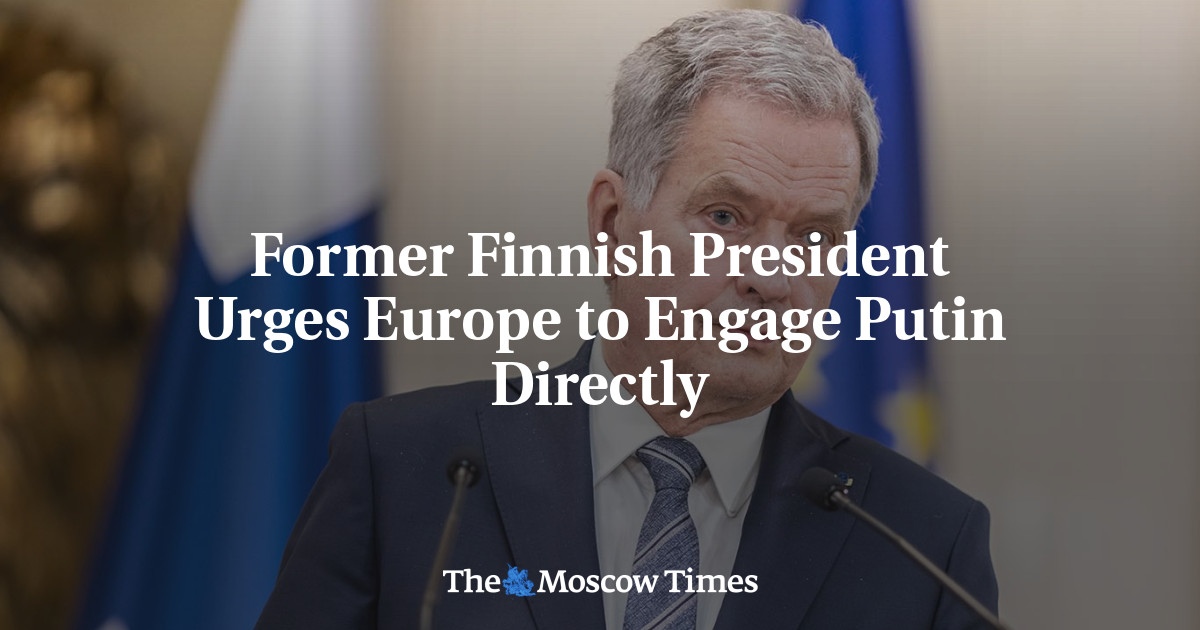
The debate Over Dialog: Should the EU Talk to Putin to End the Ukraine War?
The question of whether the European Union should directly engage with Russian President Vladimir Putin to negotiate an end to the war in Ukraine is sparking intense debate. Recent comments from Finland’s former president, Sauli Niinistö, have reignited this discussion, challenging the current EU stance of largely avoiding direct communication with the Kremlin. But is direct dialogue the key to peace,or would it legitimize aggression? Let’s delve into the arguments,the finnish outlook,and the potential implications.
Niinistö’s Call for Communication
Niinistö argues the EU’s refusal to speak with Putin is counterproductive,especially given that figures like former U.S. President Donald Trump maintain open lines of communication with the Russian leader. He pointedly noted the EU’s reliance on secondary sources to learn about these conversations, stating, “I still see something rather absurd in the situation where Europeans declare that they won’t talk to the war criminal Putin, yet Trump talks to him and than we go and listen to find out what they discussed.”
His concern? That crucial negotiations might occur over Europe’s head. Niinistö believes the EU should proactively engage in these discussions itself,mirroring the approach taken by the U.S. He served as Finland’s president from 2012 to 2024, guiding the nation through a pivotal shift towards NATO membership following Russia’s full-scale invasion of Ukraine.
The Finnish Government’s Response
while Niinistö’s experience carries weight, the current Finnish government remains cautious. Foreign Minister Elina Valtonen has publicly stated that now is not the time for direct talks with Putin. She emphasized that genuine peace negotiations aren’t currently on the table,and dialogue for its own sake isn’t a worthwhile goal.
Prime Minister Petteri orpo and Defense Minister antti Häkkänen echoed this sentiment. they stressed the importance of a unified European front, asserting that any future contact with Russia must be carefully coordinated across the EU. “We’re stronger when we speak with one voice,” Orpo explained.
A Shift in Perspective? President stubb’s Vision
interestingly,current Finnish President Alexander Stubb has signaled a potential willingness to consider a future thaw in relations. Earlier this year, he suggested Helsinki should “mentally prepare” to restore ties with Russia once the war in Ukraine concludes. The Kremlin responded positively, expressing openness to “mutually beneficial and respectful” relations should Finland desire them. This suggests a potential long-term strategy of keeping channels open, even amidst current conflict.
Why This Debate Matters: The Core Arguments
The debate over engaging with Putin boils down to several key arguments:
* Legitimacy vs. Necessity: Critics argue that talking to Putin legitimizes his actions and rewards aggression. Proponents counter that dialogue is necessary to explore potential off-ramps and prevent further escalation.
* Information Control: direct communication allows the EU to gather firsthand information and avoid relying on potentially biased intermediaries.
* Unified Front: A coordinated European approach is seen as crucial to maximizing leverage and presenting a united message to Russia.
* Long-Term Strategy: Some believe maintaining channels for future communication, even during conflict, is vital for eventual reconciliation and stability.
What Does This Mean for You?
As the war in Ukraine continues, understanding the nuances of this debate is crucial. The path to peace is complex, and there are no easy answers.The question isn’t simply if the EU should talk to Putin, but how, when, and under what conditions.
The evolving Finnish perspective - from overseeing NATO accession to cautiously considering future relations – highlights the shifting geopolitical landscape. It’s a reminder that long-term strategy requires adaptability and a willingness to reassess assumptions.
Evergreen Insights: The History of Dialogue in Conflict Resolution
Throughout history, dialogue has played a critical role in resolving conflicts, even with seemingly intractable adversaries. From the Cold War negotiations between the U.S. and the Soviet Union to the Camp David Accords between Israel and Egypt, direct communication has often been a necessary, though challenging, step towards peace. Though,it’s critically important to remember that dialogue is most effective when coupled with strong diplomatic pressure,clear red lines,and a commitment to upholding international law. Simply talking