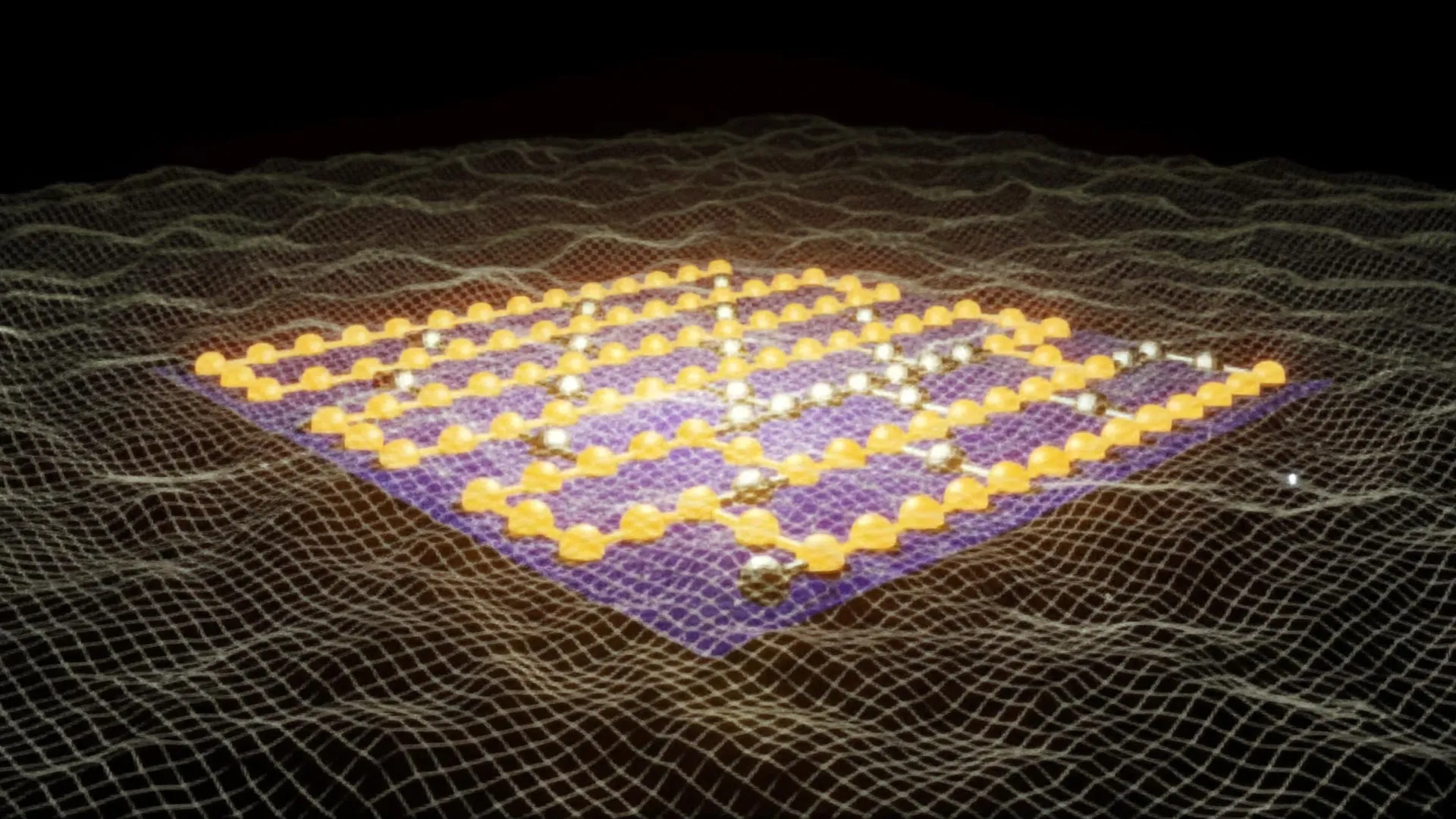
Quantum Simulation: Unlocking the Secrets of Matter Under Extreme Conditions
Scientists relentlessly probe the universe’s most basic behaviors by studying matter under extreme conditions – think the moments after the Big Bang or within the cores of collapsing stars. While the Standard Model of particle physics provides the theoretical framework, simulating thes scenarios presents a monumental challenge. Classical supercomputers struggle with the complexity of these systems, especially when dealing with rapidly changing environments or incredibly dense matter. Quantum computing emerges as a powerful alternative, offering the potential to represent and simulate these phenomena with unprecedented efficiency.
Recent breakthroughs have centered on a critical hurdle in quantum simulation: reliably preparing the initial quantum state. Researchers have now achieved a significant milestone, developing scalable quantum circuits capable of recreating the starting conditions of particle collisions, mirroring those generated in powerful particle accelerators. This work specifically focuses on the strong interactions described by the Standard Model, opening new avenues for exploring the building blocks of reality.
How Scalable Quantum Circuits Work
The team’s approach involved a two-pronged strategy. First,they utilized classical computers to design the necessary circuits for smaller,manageable systems. Crucially, these designs weren’t isolated solutions; they possessed a scalable structure. This allowed researchers to extrapolate and build far larger simulations directly on a quantum computer,leveraging the power of quantum mechanics to tackle previously intractable problems. Using IBM’s cutting-edge quantum hardware, they successfully simulated key features of nuclear physics utilizing over 100 qubits – a landmark achievement in the field.
These scalable quantum algorithms unlock simulations previously beyond our reach. The technique isn’t limited to particle collisions; it can model the vacuum state before a collision, systems with remarkably high densities, and even beams of hadrons. The expectation is that future quantum simulations, built upon this foundation, will surpass the capabilities of even the most powerful classical computers.
Implications for Fundamental physics
the potential impact of this research extends to some of the most pressing open questions in physics. Quantum simulations powered by these new circuits coudl provide insights into:
* Matter-Antimatter Asymmetry: Why is there so much more matter than antimatter in the universe?
* Heavy Element Creation: How are heavy elements forged within the explosive environments of supernovae?
* Ultra-High Density Matter: What happens to matter when compressed to densities far exceeding those found in atomic nuclei?
Beyond these core questions, the techniques developed are broadly applicable. They could also aid in modeling exotic materials exhibiting unusual quantum properties, perhaps leading to breakthroughs in materials science.
From Validation to Large-Scale Simulation
The team didn’t simply leap into large-scale simulations. A rigorous validation process was employed. They first tested individual circuit components on small systems using classical computing tools, ensuring systematic enhancement and accuracy. Only after confirming the reliability of these components did they scale up the circuits to handle over 100 qubits and deploy them on IBM’s quantum devices.
The resulting data allowed scientists to extract properties of the vacuum state with remarkable precision - achieving accuracy within a few percent. Furthermore, they successfully generated and simulated the evolution of hadron pulses, tracking their propagation over time. These advancements signal a future where quantum computers can perform full dynamical simulations of matter under extreme conditions, pushing the boundaries of what’s computationally possible.
Frequently Asked Questions About Quantum Simulation of High-Density Physics
1. What is quantum simulation and why is it needed for studying extreme conditions?
Quantum simulation utilizes the principles of quantum mechanics to model physical systems that are too complex for classical computers. Classical computers struggle with the exponential growth in computational demands when simulating quantum systems, especially those found in extreme conditions like particle collisions or the cores of neutron stars. Quantum computers, leveraging phenomena like superposition and entanglement, offer a fundamentally different approach capable of tackling this complexity.
2.How does this research advance scalable quantum algorithms for nuclear physics?
Previous quantum simulations were often limited by the size of the system they could handle. This research introduces circuits with a scalable structure, meaning they can be expanded to simulate larger and more complex systems without a prohibitive increase in computational cost. This scalability is achieved by identifying patterns – symmetries and differing length scales - within the physical systems being modeled, allowing for efficient circuit design.
3. What role did IBM’s quantum hardware play in this quantum computing breakthrough?
IBM’s quantum computers provided the necessary platform to execute the large-scale simulations. The team utilized over 100 qubits on IBM’s hardware, demonstrating the feasibility of simulating key features of nuclear physics at a scale previously unattainable. Access to this advanced hardware was crucial for validating the algorithms and extracting meaningful data.
4.Can quantum simulations definitively answer questions like the matter-antimatter asymmetry?
While quantum simulations won’t provide immediate, definitive answers, they offer a powerful new tool for exploring the underlying physics. By accurately modeling the conditions relevant to these questions, simulations can help refine theoretical models, identify potential mechanisms, and guide future experimental efforts. They provide a crucial bridge between theory and observation.
**5. How does this research
Keep reading