
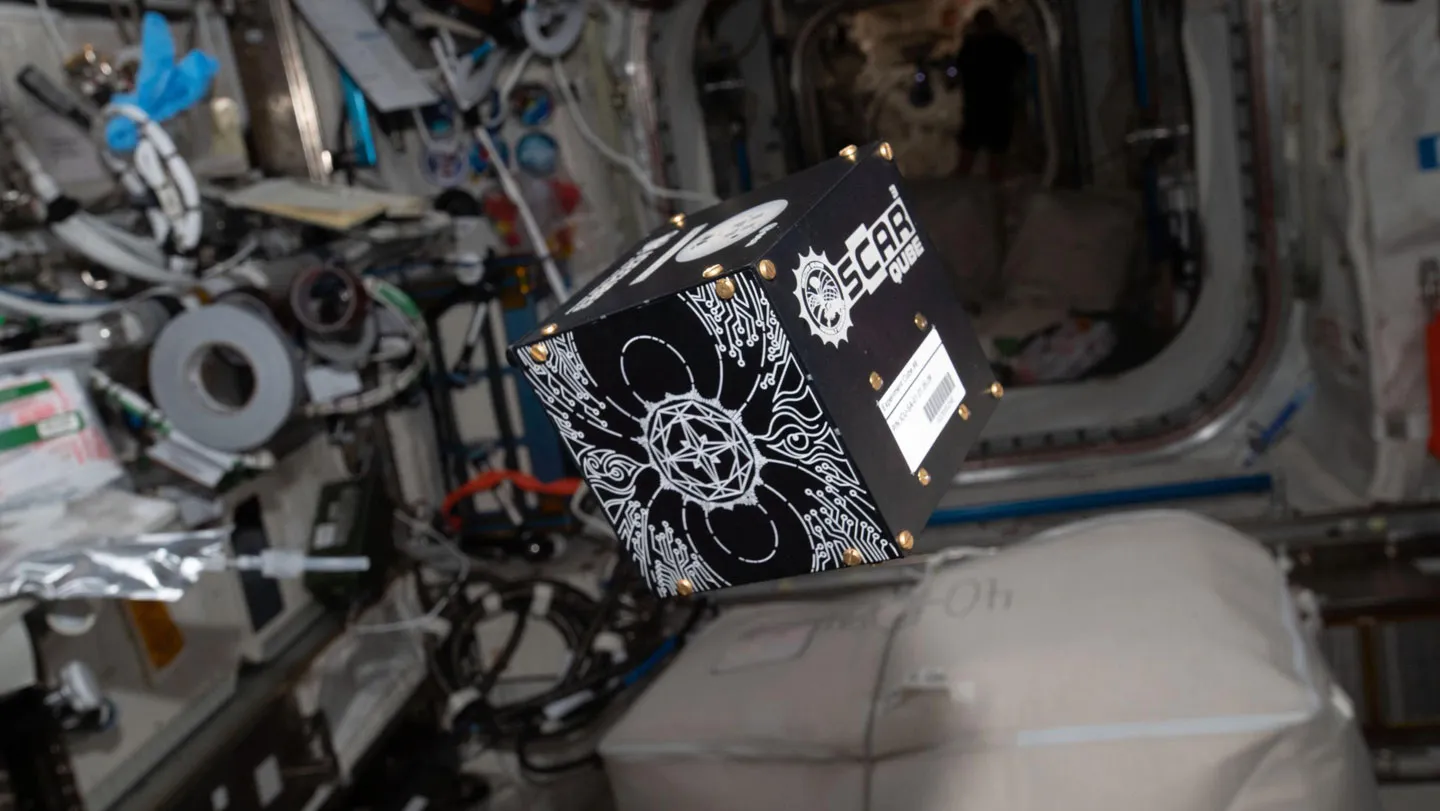
High above the Earth, aboard the International Space Station (ISS), a device no larger than a grapefruit is rewriting the rules of how we measure the invisible forces of our planet. The OSCAR-QUBE, a compact quantum magnetometer, has successfully demonstrated that the extreme precision of quantum sensing can be miniaturized and deployed in the harsh environment of space to map Earth’s magnetic field with unprecedented clarity.
For decades, mapping the geomagnetic field required massive, power-hungry instruments that often struggled to balance sensitivity with size. The introduction of the OSCAR-QUBE represents a paradigm shift, utilizing the unique properties of synthetic diamonds to detect minute fluctuations in magnetism. This breakthrough is not merely a win for astrophysics; it signals a coming revolution in how we navigate the globe and, perhaps more significantly, how we diagnose human disease.
As a physician and health journalist, I find the implications of this “diamond-based” sensing particularly compelling. While the current mission focuses on the cosmos, the same quantum architecture is paving the way for non-invasive medical imaging that could one day replace the cumbersome, liquid-helium-cooled machines currently used to map the human brain.
The Science of the “Diamond Defect”: How NV Centers Work
At the heart of the OSCAR-QUBE is a technology known as Nitrogen-Vacancy (NV) centers. To understand this, one must imagine the rigid, perfect lattice of a diamond. In a synthetic diamond used for quantum sensing, a carbon atom is intentionally replaced by a nitrogen atom, leaving an adjacent spot in the lattice empty—a “vacancy.”
This specific defect creates a quantum state that is incredibly sensitive to external magnetic fields. When a laser is pointed at the diamond, the NV center emits a glow (fluorescence). The intensity of this light changes depending on the strength and direction of the surrounding magnetic field. By measuring these changes in light, the OSCAR-QUBE can calculate the magnetic field of the Earth with extreme precision without needing the massive cooling systems required by traditional sensors.
Traditional magnetometers often rely on SQUIDs (Superconducting Quantum Interference Devices), which require temperatures near absolute zero to function. The diamond-based approach allows for high sensitivity at much higher temperatures, making the devices smaller, more durable, and far more practical for deployment on satellites or in clinical settings. According to research published in Physical Review Applied, these quantum sensors provide a sensitive and compact solution for space-based magnetic field measurements, overcoming the dynamic range limitations of previous technology.
Why Mapping Earth’s Magnetic Field Matters
The Earth’s magnetic field is not a static shield; It’s a living, shifting entity generated by the churning liquid iron in our planet’s outer core. Mapping this field with high resolution is critical for several reasons:

- Navigation and Security: In an era of increasing reliance on GPS, magnetic navigation provides a vital “fail-safe.” Quantum magnetometers allow for more accurate magnetic maps, enabling ships and aircraft to navigate without satellite signals.
- Space Weather Prediction: The magnetic field protects Earth from solar radiation. By monitoring fluctuations in the field from the ISS, scientists can better understand how solar storms interact with our atmosphere, which is essential for protecting power grids and communication satellites.
- Geological Discovery: High-sensitivity mapping can reveal hidden mineral deposits or volcanic activity beneath the Earth’s surface by detecting the unique magnetic signatures of different rock types.
From the ISS to the Clinic: The Medical Frontier
While the OSCAR-QUBE is currently focused on the Earth’s magnetic field, the transition of this technology from space to medicine is where the most profound human impact lies. In my experience in internal medicine, the limitation of many diagnostic tools is the trade-off between precision and patient comfort.
Current Magnetoencephalography (MEG) scans, which map brain activity by sensing the tiny magnetic fields produced by neural currents, require patients to sit inside a massive, freezing helmet. Because NV-center diamonds operate at room temperature, they could lead to a new generation of “wearable” brain scanners. Imagine a lightweight cap embedded with quantum sensors that can map a patient’s epileptic foci or track the progression of Alzheimer’s disease in real-time, without the need for cryogenic cooling.
This shift toward “quantum biology” diagnostics would allow for the monitoring of patients who cannot tolerate traditional MRI or MEG environments, such as infants or those with severe claustrophobia. By bringing the sensitivity of a space-grade magnetometer into the clinic, we move closer to a future of truly personalized, non-invasive neurology.
The Broader Quantum Space Race
The deployment of the OSCAR-QUBE is part of a larger global effort to move quantum technologies out of the laboratory and into the field. Space provides a unique environment for these experiments because it removes certain terrestrial interferences and allows for the testing of sensors in extreme thermal and radiation conditions.

This “quantum leap” in sensing is mirrored in other areas of space exploration. Quantum clocks are being developed to improve the synchronization of deep-space probes, and quantum communication links are being tested to create unhackable networks between Earth and orbiting stations. The success of the diamond-based sensor on the ISS proves that quantum hardware is now robust enough to survive launch and operate autonomously in orbit.
Comparison: Traditional vs. Quantum Magnetometry
| Feature | Traditional (SQUID) | Quantum (NV-Diamond) |
|---|---|---|
| Temperature | Requires cryogenic cooling | Operates at room temperature |
| Size | Large, bulky infrastructure | Compact (e.g., grapefruit-sized) |
| Deployment | Primarily lab-based | Portable/Space-ready |
| Sensitivity | Extremely high (but fragile) | High and robust |
What Happens Next?
The data collected by the OSCAR-QUBE will now be analyzed to refine the algorithms used for geomagnetic mapping. The next phase of development involves scaling this technology—moving from a single “cube” to arrays of quantum sensors that can provide a three-dimensional, real-time image of the magnetic environment.

For the medical community, the next checkpoint will be the transition of these sensors into prototype medical devices. We are expecting more peer-reviewed data on the signal-to-noise ratio of room-temperature quantum sensors in biological environments over the coming year. As these devices become more refined, the possibility of a “quantum stethoscope” for the brain becomes a tangible reality.
This intersection of quantum physics and medicine reminds us that the most profound discoveries often happen when we look beyond our immediate horizon—whether that is looking into the heart of a diamond or looking down at our planet from the stars.
Do you believe quantum sensing will revolutionize healthcare in the next decade? Share your thoughts in the comments below or share this article with your network to join the conversation.