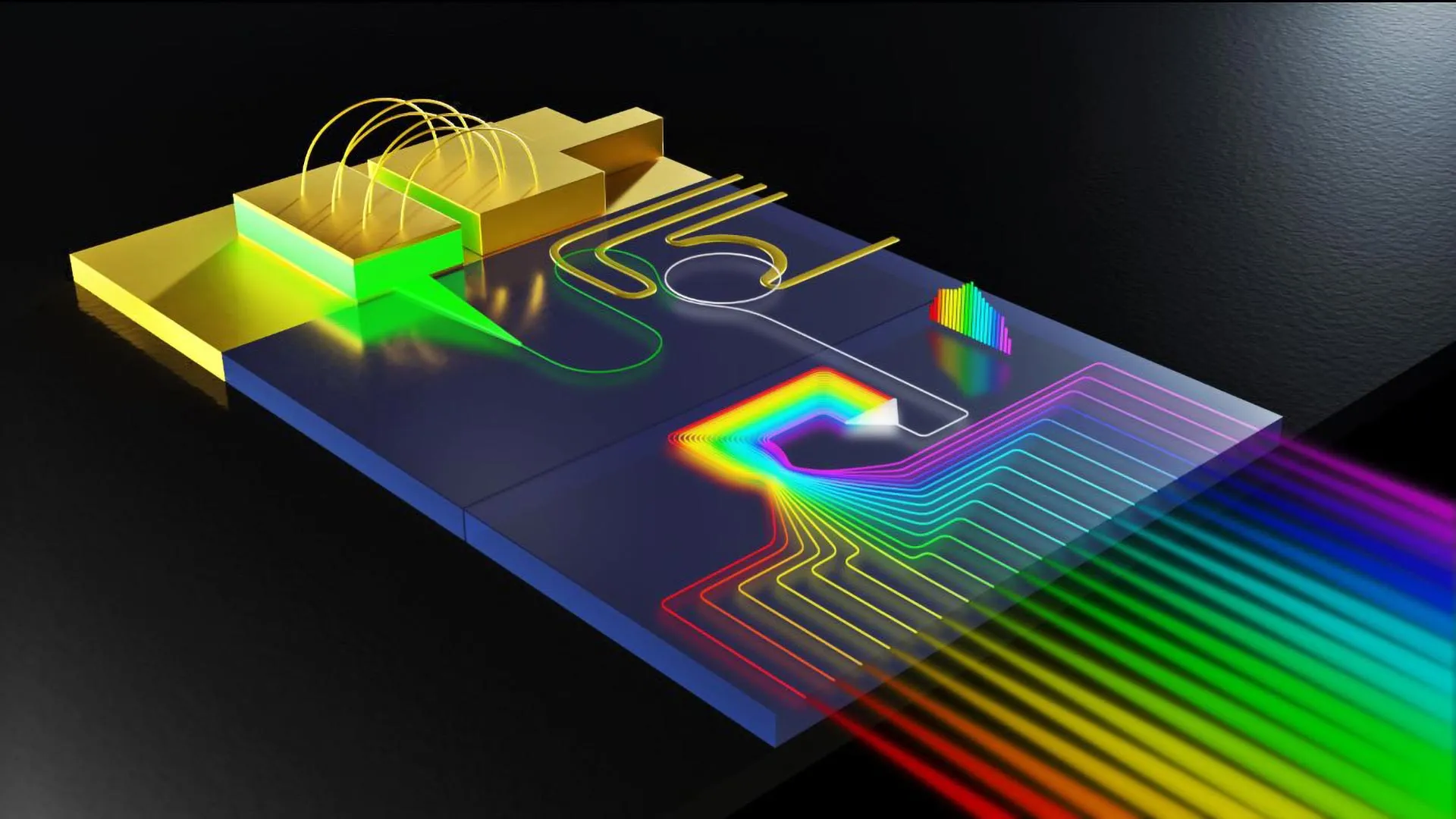
Revolutionizing Data Transmission: A Silicon Photonics Breakthrough Creates On-Chip Frequency Combs
The relentless demand for faster, more efficient data transfer is driving innovation in photonics, and a recent breakthrough from Columbia University’s Lipson Lab promises to be a game-changer. Researchers have successfully created a powerful frequency comb – a sophisticated light source capable of transmitting multiple data streams concurrently – directly on a silicon chip. This achievement, published in Nature Photonics, dramatically reduces the size, cost, and energy consumption associated wiht current high-bandwidth communication technologies, paving the way for a new era of data center efficiency and beyond.
Understanding the Power of Frequency Combs
At its core, this innovation centers around the frequency comb. Imagine a rainbow,but rather of a gradual blend of colors,it’s comprised of distinct,brightly defined bands. A frequency comb is precisely that – a spectrum of light containing numerous, evenly spaced frequencies (or colors). On a spectrogram, these frequencies appear as sharp “teeth” on a comb, hence the name.
The importance lies in the ability to utilize each of these “teeth” as an self-reliant communication channel. Unlike traditional single-wavelength lasers, a frequency comb allows for wavelength-division multiplexing (WDM), enabling the simultaneous transmission of dozens of data streams through a single fiber optic cable. This is the same principle that underpinned the explosive growth of the internet in the late 1990s, and its submission within data centers promises a similar leap in performance.
From Bulky Lasers to a Single Chip
Historically, generating a robust frequency comb required complex and expensive setups involving large lasers and amplifiers. The Lipson Lab, led by professor Michal Lipson, has overcome this hurdle by integrating the technology onto a single silicon photonics chip. This represents a significant engineering feat, and a crucial step towards widespread adoption.
“Data centers have created tremendous demand for powerful and efficient sources of light that contain many wavelengths,” explains Andres Gil-Molina,a principal engineer at Xscape Photonics and former postdoctoral researcher in Lipson’s lab. “Our technology takes a very powerful laser and turns it into dozens of clean, high-power channels on a chip. That means you can replace racks of individual lasers with one compact device, cutting cost, saving space, and opening the door to much faster, more energy-efficient systems.”
The Science Behind the Breakthrough: Taming a ‘Messy’ Laser
The team’s approach began with a readily available, high-power laser diode – a type commonly used in medical devices and laser cutting tools. While capable of producing substantial light output, these lasers are inherently “messy,” meaning their light is not coherent and lacks the precision needed for advanced applications.
The key to success lay in a novel “locking mechanism” leveraging the unique properties of silicon photonics. This mechanism effectively purifies the laser’s output, reshaping and stabilizing the beam to achieve high coherence. Once purified, the chip’s nonlinear optical properties then split the single, powerful beam into the evenly spaced frequencies characteristic of a frequency comb.
This process effectively combines the raw power of an industrial laser with the precision and stability required for cutting-edge communication and sensing technologies. The result is a compact, high-efficiency light source that overcomes the limitations of traditional approaches.
Why This matters Now: Addressing the AI-Driven Data Deluge
The timing of this breakthrough is notably critical. The exponential growth of artificial intelligence (AI) is placing unprecedented strain on data center infrastructure. moving data quickly and efficiently between processors and memory is becoming a major bottleneck.
While fiber optic links are already widely used within data centers, most still rely on single-wavelength lasers. frequency combs offer a solution by dramatically increasing the bandwidth capacity of these links. By enabling dozens of data streams to travel in parallel through the same fiber, this technology can alleviate congestion and unlock significant performance gains.
Beyond Data Centers: A Broad Spectrum of Applications
The potential applications extend far beyond data centers. The compact, high-performance frequency combs developed by the Lipson Lab coudl revolutionize:
* portable Spectrometers: Enabling on-site chemical analysis and environmental monitoring.
* Ultra-Precise Optical Clocks: Improving timing accuracy in critical infrastructure and scientific research.
* Compact Quantum Devices: Facilitating the progress of next-generation quantum technologies.
* Advanced LiDAR Systems: Enhancing the resolution and range of autonomous vehicles and mapping applications.
“This is about bringing lab-grade light sources into real-world devices,” emphasizes Gil-Molina.”If you can make them powerful, efficient, and small enough, you can put them almost anywhere.”
A Milestone in Silicon Photonics
Professor Lipson underscores the broader significance of this work. “This research marks another milestone