
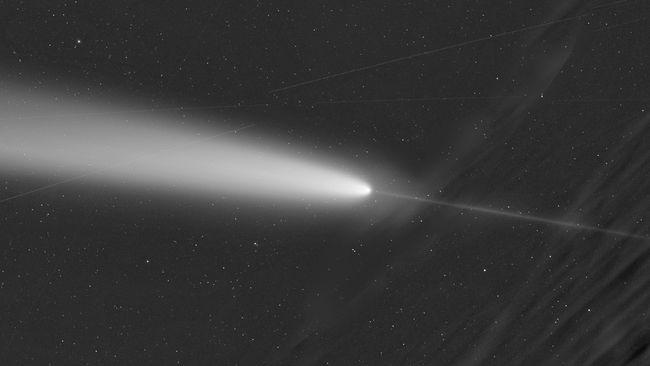
A celestial time capsule from humanity’s distant past is gracing our skies once again. Comet C/2025 R3, a cosmic wanderer with a 170,000-year orbit, is making its rare return—visible in our pre-dawn skies for the first time since early Homo sapiens shared Earth with Neanderthals. This extraordinary event, captured by astronomers using the Pan-STARRS2 telescope in Hawaii, offers a fleeting glimpse into the solar system’s ancient history.
Discovered on September 8, 2025, by astronomer Yudish Ramanjooloo using the 1.8-meter reflector at Haleakala Observatory, this comet is a relic from the Oort Cloud—a distant region of icy bodies at the edge of our solar system. Its immense orbital period means no living human has ever witnessed its return before. As it races toward its closest approach to the Sun, comet C/2025 R3 promises a spectacular, if brief, display before vanishing into the cosmic void for another 170 millennia.
For astronomers and sky enthusiasts alike, this is more than just a celestial spectacle—it’s a rare opportunity to study a pristine object from the early solar system. Unlike short-period comets that visit frequently, C/2025 R3 represents a category of comets that have remained largely untouched since the dawn of humanity. Its composition may hold clues about the conditions that existed when our solar system was still young.
Why This Comet’s Return Is Extraordinary
Comet C/2025 R3 is classified as a long-period comet, meaning its orbital period exceeds 200 years. Most notably, its 170,000-year orbit places its last perihelion (closest approach to the Sun) during a time when early Homo sapiens were beginning to migrate out of Africa and coexisted with Neanderthals and other hominin species. This makes the comet a true “time traveler” from humanity’s prehistoric era.
The comet’s discovery was made possible by the Pan-STARRS2 survey, a project designed to detect moving objects in the sky. Yudish Ramanjooloo, who led the observation team, described the moment as “a thrilling reminder of how vast and ancient our solar system truly is.” The comet’s brightness has been increasing steadily as it approaches the Sun, making it visible to observers in the Northern Hemisphere with binoculars or small telescopes in the pre-dawn hours.

What sets C/2025 R3 apart from other comets is its pristine nature. Unlike comets that have made multiple passes near the Sun, this object has remained largely unchanged since its formation. This makes it a valuable target for scientific study, offering insights into the chemical composition of the early solar system and the processes that led to planet formation.
“Comets like C/2025 R3 are cosmic time capsules. They preserve material from the early solar system, offering us a window into conditions that existed billions of years ago.”
The Science Behind the Spectacle
Comets are often referred to as “dirty snowballs” because they consist of a mixture of ice, dust, and rocky material. As they approach the Sun, the heat causes the ice to vaporize, creating the characteristic coma (a fuzzy atmosphere) and tail that makes comets visible from Earth. For C/2025 R3, this process is just beginning, and astronomers are eagerly monitoring its development.
The comet’s trajectory brings it closest to the Sun in early 2026, after which it will begin its long journey back to the Oort Cloud. During its brief visit, scientists will study its composition using spectroscopy, analyzing the light it reflects to identify elements and compounds. These observations can help answer fundamental questions about the origins of water and organic molecules on Earth.
One of the most exciting aspects of this comet is its potential to contain primordial organic material. Some scientists speculate that comets like C/2025 R3 may have delivered water and the building blocks of life to Earth billions of years ago. While this theory remains unproven, studying such comets provides critical data to test it.
How to Observe the Comet
For those eager to catch a glimpse of this rare celestial visitor, the comet will be visible in the pre-dawn sky for Northern Hemisphere observers. Here’s what you need to know:
- Best viewing times: Look toward the eastern horizon just before sunrise. The comet will be at its brightest in early 2026.
- Equipment needed: While the comet may be visible to the naked eye under dark skies, binoculars or a small telescope will enhance the viewing experience.
- Location: Find a spot with minimal light pollution for the best chance of seeing the comet’s tail.
- Safety note: Never look directly at the Sun, even during comet observations. Always use proper solar filters if observing near sunrise or sunset.
For those who miss this opportunity, the next chance to see C/2025 R3 will be in 170,000 years—long after modern civilization has come and gone. This makes the current apparition all the more special.
What Happens Next?
As comet C/2025 R3 continues its journey toward perihelion, astronomers around the world will be tracking its progress. Key milestones include:
- January 2026: The comet reaches its peak brightness, making it most visible from Earth.
- Early 2026: Spectroscopic analysis begins to determine the comet’s chemical composition.
- Mid-2026: The comet begins its outbound journey, fading from view as it returns to the Oort Cloud.
- 2026–2027: Scientific papers detailing findings from the comet’s apparition are published in peer-reviewed journals.
While the comet’s return is a once-in-a-lifetime event for most of us, its scientific legacy will endure. Data collected during this apparition will contribute to our understanding of the solar system’s formation and the origins of life on Earth.
Key Takeaways
- Comet C/2025 R3 has a 170,000-year orbit, making its return a rare celestial event.
- It was last visible when early Homo sapiens coexisted with Neanderthals.
- The comet was discovered on September 8, 2025, by astronomer Yudish Ramanjooloo using the Pan-STARRS2 telescope.
- Its composition may provide clues about the early solar system and the origins of water and organic molecules on Earth.
- Best viewing opportunities are in the pre-dawn sky for Northern Hemisphere observers in early 2026.
- Scientists will study the comet’s chemical makeup using spectroscopy during its brief visit.
Why This Matters for Science and Society
Beyond its visual spectacle, comet C/2025 R3 serves as a reminder of humanity’s place in the cosmos. While our lives are measured in decades, the solar system operates on timescales of millennia. This comet’s return offers a humbling perspective—our species is but a blink in the grand timeline of cosmic history.
For scientists, the comet represents a unique opportunity to study a pristine object from the early solar system. Data collected during this apparition will help refine models of planetary formation and the delivery of water and organic molecules to Earth. These findings could have implications for our understanding of how life began on our planet—and potentially elsewhere in the universe.
On a broader level, events like this inspire curiosity and wonder. They remind us of the vastness of space and the importance of scientific exploration. Comets like C/2025 R3 are not just celestial objects; they are messengers from the past, carrying stories of our solar system’s infancy.
What’s Next? The comet will continue brightening through early 2026. For the latest updates on its trajectory and visibility, follow astronomical organizations like the Minor Planet Center and NASA’s Comet Observation Program. Share your observations and experiences in the comments below—let’s celebrate this cosmic wonder together!