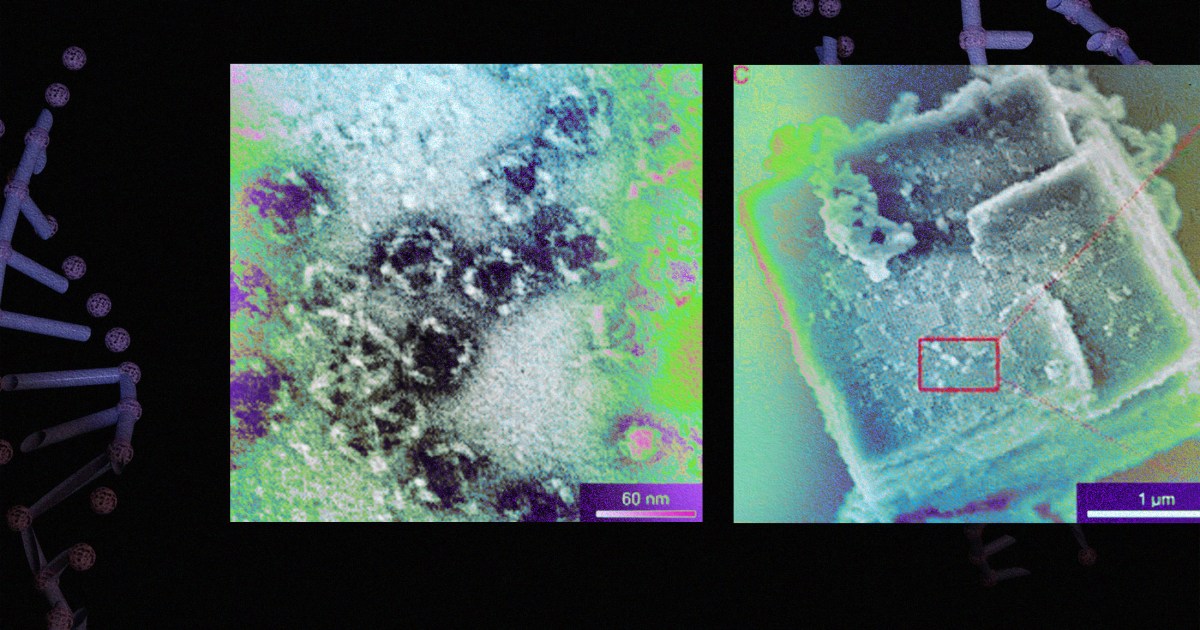
Researchers have successfully combined DNA and pure glass to create a supermaterial that is four times stronger and five times lighter than steel. The innovative approach uses the intricate structure of DNA as a scaffold to shape pure glass into a resilient 3D framework.
Flawless Glass and Nano-Sized Structures
While regular glass shatters easily due to imperfections such as micro-cracks or missing atoms, flawless glass can endure immense pressures. However, crafting large unblemished pieces of glass is extremely difficult, making nano-sized structures less than a micrometer thick ideal for achieving both power and feather-light qualities, according to reporting by Freethink.
DNA Origami Technique
To construct the frames, the research team employed a technique known as “DNA origami,” combining large scaffolding strands of DNA with short staple strands in a liquid solution. Through self-assembly driven by hydrogen bonding, these strands fold into a desired shape and bind together to form a repeating pattern known as a lattice.
We focused on using DNA as a programmable nanomaterial to form a complex 3D scaffold, and we wanted to explore how this scaffold will perform mechanically when transferred into more stable solid-state materials,
said Aaron Michelson, the study’s lead author and a postdoctoral researcher at Brookhaven.
Silica Glass Coating
Scientists then coated the self-assembling DNA lattices in a thin layer of silica glass roughly 5 nanometers thick, leaving the inner spaces empty to maintain an ultra-lightweight design. For the structures tested mechanically in the study, the DNA acted as a temporary scaffold that was subsequently heat-treated, solidifying the silica and removing the DNA. Simulations indicated that the DNA core helped suppress large-scale buckling and delayed failure, allowing the structures to survive much larger deformations.

The inspiration behind the project drew heavily from popular culture. I am a big fan of Iron Man movies, and I have always wondered how to create a better armor for Iron Man,
said Oleg Gang, a study author and nanomaterials scientist at Columbia University.
Worth a look