Researchers from École Polytechnique, the Collège de France, and Helmholtz-Zentrum Dresden-Rossendorf have experimentally realized the world’s first all-optical photonic time crystal. Published in Nature, the device uses ultrafast terahertz pulses to modulate optical properties in picoseconds, offering a new pathway for advanced telecommunications and terahertz-scale lasers.
From Spatial Patterns to Temporal Modulation
For decades, photonic crystals have relied on static, repeating spatial structures—similar to a lattice—to manipulate the flow of light. By adjusting the refractive index of these materials, scientists could guide or block specific wavelengths, forming the basis for modern fiber optics and lasers. However, these traditional structures remain fixed once fabricated.
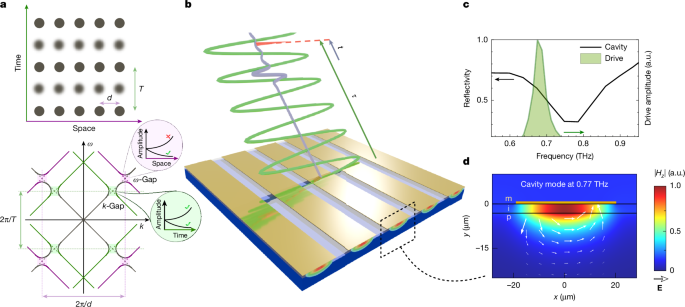
The new research, led by Prof. Yannis Laplace of the Laboratory of Irradiated Solids (LSI) at École Polytechnique, moves beyond static geometry. By introducing a periodic modulation of optical properties over time, the team created a plasmonic metamaterial
that functions as a photonic time crystal (PTC). This material dynamically alters its reflectivity and resonance frequency on picosecond timescales, which are comparable to the light’s own oscillation cycle.
Engineering the Plasmonic Metamaterial
Constructing the device required a precise, multi-layered architecture. The researchers designed micrometer-scale gold crenellated structures—resembling battlements—positioned over an insulating layer and a semiconductor composed of indium and antimony. These gold structures form tiny cavities that trap photons.
When the semiconductor surface is excited, it generates surface plasmons
—collective waves of electrons that act as a medium for capturing and maintaining light oscillations. According to published findings in Nature, this interaction allows for the manipulation of light at speeds 1,000 times faster than current electronic components, effectively bridging the gap between electronic and photonic technologies.
The Role of TELBE Terahertz Pulses
The experimental success hinged on the ability to deliver intense, phase-stable energy to the material. The team utilized the TELBE superradiant terahertz source at the ELBE accelerator in Germany. This source provided the necessary frequency-tunable laser pulses to drive the system into the PTC regime.
The modulation was both strong and rapid. Researchers reported that the process reduced photon dissipation by half, a significant improvement in energy efficiency for trapped light.
Future Applications and Theoretical Confirmation
This model not only validated the observed behavior of the photons but also provided a framework for future experiments. The team suggests that by further increasing the number of trapped photons, they may eventually achieve the amplification levels required for new types of tunable terahertz lasers.
As PhD student and lead author Tingwen Guo noted, the ability to extend photonic control from space to time opens a new dimension for light manipulation. Beyond the immediate scientific implications, the researchers anticipate this technology could eventually influence fields ranging from ultrafast optical computing to advanced wireless communication systems.
While the team has confirmed the successful modulation of light within the crystal, they continue to investigate the potential for photon amplification. For now, the successful realization of the PTC remains a significant milestone in high-frequency optical research, with the projected goal of refining these devices for broader technological integration.
Keep reading
- Qualcomm Snapdragon Price Hikes: Will Android Phones Get More Expensive?
- SwissChain Holding SA Issues Blockchain Shares with Full Legal Effect
- World’s First Photonic Time Crystal Breakthrough Revolutionizes Light Control (newsdirectory3.com)
- Why Nepal Keeps the World's Only 45-Minute Time Zone (daybreakwire.com)