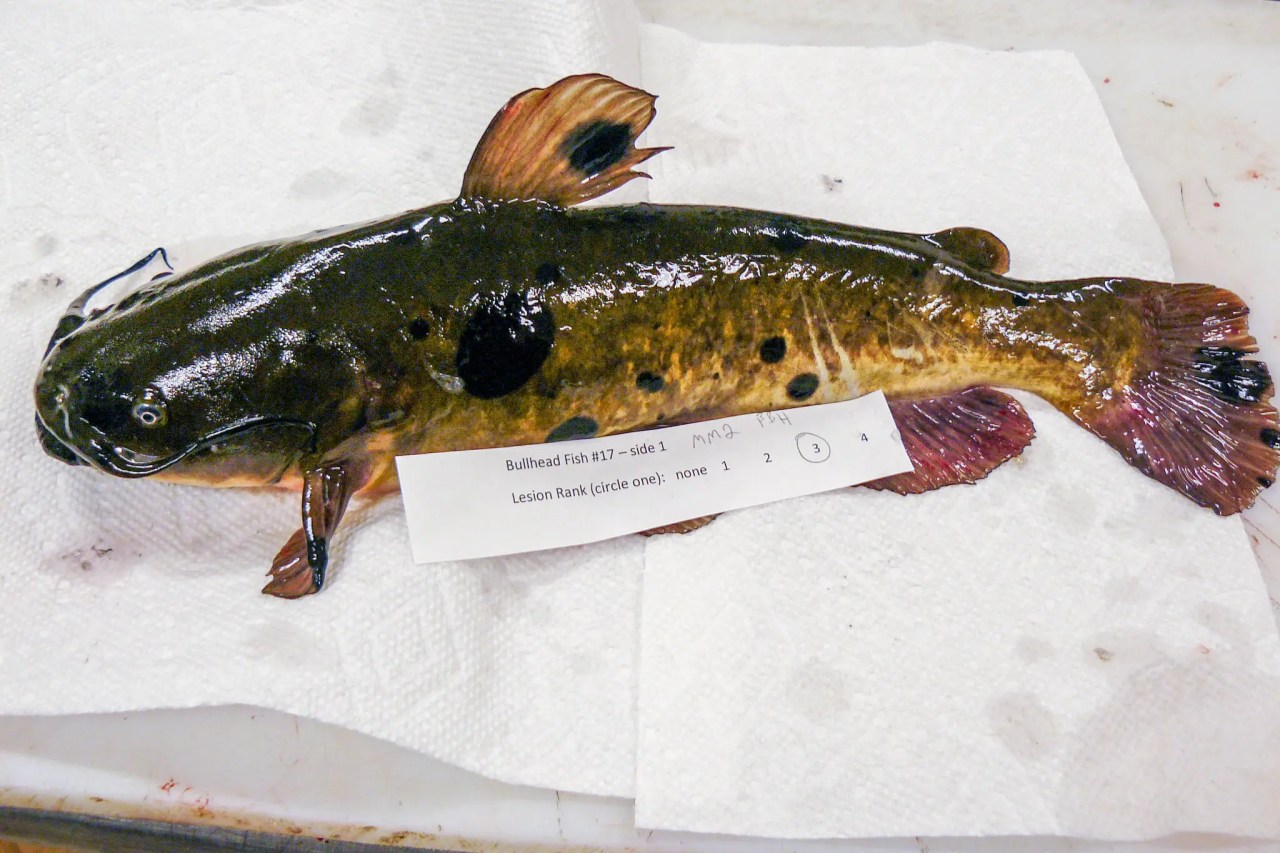
Researchers have discovered a contagious form of skin cancer spreading among brown bullhead catfish in Lake Memphremagog along the Vermont-Quebec border. Published in the journal Nature, the finding marks the first documented case of a transmissible cancer in a fish and the first in fresh water and only the fourth naturally occurring contagious cancer known to science.
The investigation began when anglers and biologists started pulling up catfish marked with distinct black skin patches. Between 2012 and 2013, surveys across Lake Memphremagog revealed that between 23% and 37% of the sampled brown bullhead catfish carried melanoma lesions.
Genetic Sequencing Reveals Clonal Tumors in Lake Memphremagog Catfish
Initially, scientists suspected that environmental contaminants, a virus, or pollution triggered the outbreak. Regional water quality had suffered following flooding in 2011 caused by Tropical Storm Irene. Researchers examined whether those hydrocarbons were responsible, but waters with far higher levels held clean fish.
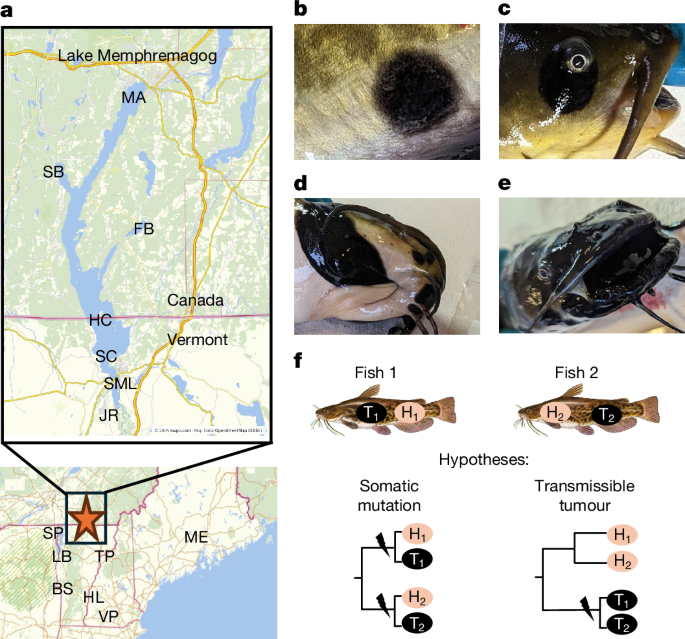
Instead, whole-genome sequencing conducted at the University of Vermont pointed to an extraordinary biological mechanism. When geneticists compared DNA samples from the tumors against healthy fish tissues, they found that the cancer cells were far more closely related to each other than to their individual hosts. Hundreds of thousands of mutations appeared consistently across tumor samples while remaining absent from the host fish.
“It’s a clonal cancer. It’s not driven by a bacteria or a virus. It’s the infectious agent itself, and it’s moving from fish to fish.”
Julie Dragon, associate professor of microbiology and molecular genetics at the University of Vermont
That genetic profile matches the signature of a clonally transmissible cancer. Rather than arising independently inside each animal, the malignant cells themselves act as the contagious agent, surviving outside the original host and establishing new growths in another.
Comparing Catfish Melanoma With Other Known Transmissible Cancers
With this discovery, brown bullhead catfish join a variety of animals affected by naturally occurring contagious cancers. Previously, scientists had documented transmissible tumors in animal groups including dogs, Tasmanian devils, a few different kinds of clams and some shellfish.

| Species Affected | Type of Transmissible Cancer | Ecosystem |
|---|---|---|
| Brown bullhead catfish | Malignant melanoma | Freshwater lake |
| Tasmanian devils | Transmissible cancer | Terrestrial |
| Dogs | Transmissible cancer | Terrestrial |
| Clams and shellfish | Transmissible cancer | Marine / Estuarine |
The newly identified catfish melanoma represents the first transmissible cancer found in a fish and the first in fresh water.
How the Contagious Disease Spreads Among Bottom-Feeding Fish
Biologists are still working to pinpoint how the cancer cells move through the water. Brown bullheads spend their lives near lake bottoms, searching for food with whisker-like barbels that can be shortened by the black tar-like melanoma growths.
“It looks like a plague,”
Peter Emerson, fish biologist with the Vermont Fish and Wildlife Department
Geographic spread presents another puzzle.
Implications for Public Health and Cancer Biology
Researchers have noted that transmissible cancers could emerge anywhere, including in our own species. However, the American Cancer Society maintains cancers being spread between humans is not possible, and there’s little research to indicate otherwise.
Instead, the value of the finding lies in basic science. By studying how a vertebrate can transmit cancer cells directly through an aquatic environment, researchers gain a living model to investigate cancer cell survival, immune evasion, and evolution. Understanding these mechanisms may ultimately offer broader insights into how malignancies develop and spread across different species.
Related reading