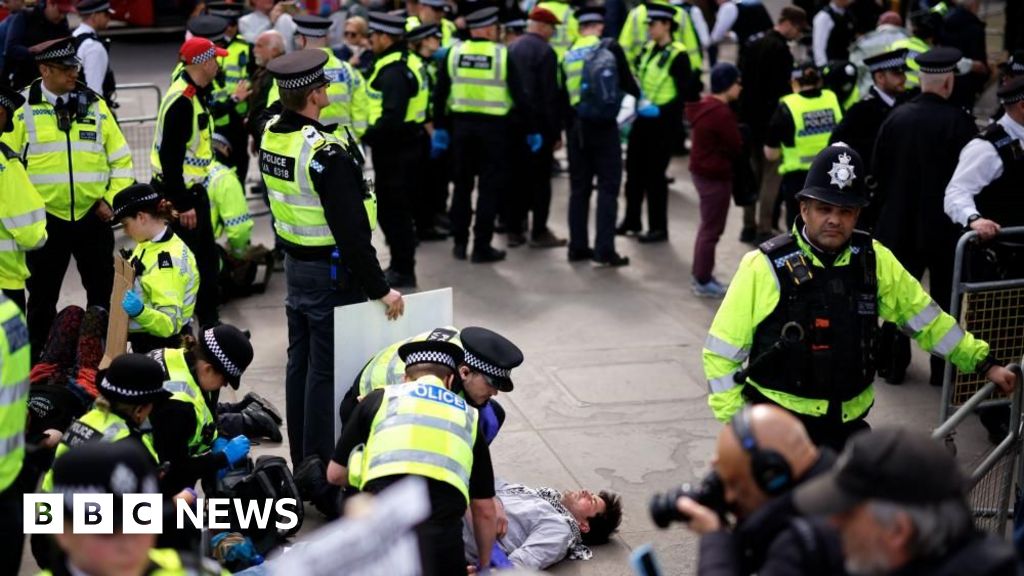
Central London became the site of significant unrest this Saturday as the Metropolitan Police carried out more than 200 arrests at Palestine Action protest events. The demonstrations, centered in Trafalgar Square, were organized to challenge the legal proscription of the group Palestine Action and to voice opposition to the ongoing conflict in Gaza.
The Metropolitan Police confirmed that the arrests were made on the grounds that individuals were showing support for a proscribed organization. The crackdown follows a period of legal volatility regarding the group’s status, with the police warning attendees ahead of the “Everyone Day” rally that showing support for such an organization is a criminal offense under the Terrorism Act under anti-terror legislation.
The event was called by the campaign group Defend our Juries, which framed the turnout as a testament to the “unwaning resistance” against the government’s ban. Demonstrators were seen carrying placards with slogans such as “I oppose genocide. I support Palestine Action,” although others expressed broader opposition to the policies of the United States and Israel and advocated for the fundamental right to protest.
Among those detained in the mass arrests was Robert Del Naja, a musician from the band Massive Attack, highlighting the high-profile nature of the support for the movement despite the legal risks involved among 200 held over Palestine Action rally.
The Legal Battle Over Proscription
The current tension in London is the result of a complex legal timeline. Supporting Palestine Action became illegal in July 2025 after the UK government banned the group under anti-terror legislation. But, this ban was subsequently ruled unlawful by the courts in February 2026.
Despite the High Court’s judgment, the ban has remained in place pending an appeal. This created a period of ambiguity for both protesters and law enforcement. Following the February ruling, the Metropolitan Police had initially indicated that officers would be unlikely to make arrests. That stance shifted in March, when the force announced it would resume arresting protesters who expressed support for Palestine Action.
Commander Claire Smart, who led the policing operations this weekend, emphasized that the force would not hesitate to act where the law is broken. In a statement issued prior to the demonstration, the Met urged the public to reflect on the “potential consequences” of attending, specifically noting that the Terrorism Act makes it an offense to support a proscribed organization.
Resistance and the Right to Protest
For the organizers and participants, the arrests are viewed not as a deterrent, but as a catalyst for further mobilization. Defend our Juries stated that the demonstration showed the resistance to the ban was “stronger than ever.” Many attendees told reporters they were fully aware of the risks and were willing to face arrest to make their political point.
The protest served as a focal point for several intersecting grievances. While the primary goal was to oppose the ban on Palestine Action, the gathering also became a platform for those advocating for the right to peaceful assembly. The use of signs echoing previous Palestine Action protests suggests a coordinated effort to maintain the group’s visibility despite its legal status.
Key Timeline of Events
| Date | Event/Action |
|---|---|
| July 2025 | Government bans Palestine Action under anti-terror legislation. |
| February 2026 | The ban is ruled unlawful by the High Court. |
| March 2026 | Metropolitan Police announce the resumption of arrests for supporting the group. |
| April 11, 2026 | “Everyone Day” protest leads to more than 200 arrests in central London. |
Broader Implications for Civil Liberties
The events in London mirror a wider global tension between state security legislation and the freedom of assembly. The use of anti-terror laws to restrict political expression has become a point of contention for human rights advocates who argue that such measures can be used to suppress dissent.
This pattern of restricting public gatherings is not isolated to the UK. For instance, reports indicate similar trends in Hungary, where legislation has been used to ban demonstrations marking the International Day of Trans Visibility under the guise of child protection Hungary’s LGBT Protest Ban. Critics in those regions argue that the lack of credible evidence for such bans raises serious concerns about the legitimacy of government authority and the health of democratic institutions.
In the UK, the ability of the Metropolitan Police to arrest hundreds of people for “showing support” for a group—even one whose ban was previously ruled unlawful—highlights the significant power granted to law enforcement under current terrorism legislation. The outcome of the pending appeal regarding the ban will likely determine whether these arrests are viewed as lawful enforcement or an infringement on civil liberties.
The situation remains fluid as the legal system determines the final status of Palestine Action. The next critical checkpoint will be the resolution of the government’s appeal against the High Court’s ruling that the ban was unlawful.
World Today Journal encourages readers to share their thoughts on the balance between national security and the right to protest in the comments section below.
Worth a look