
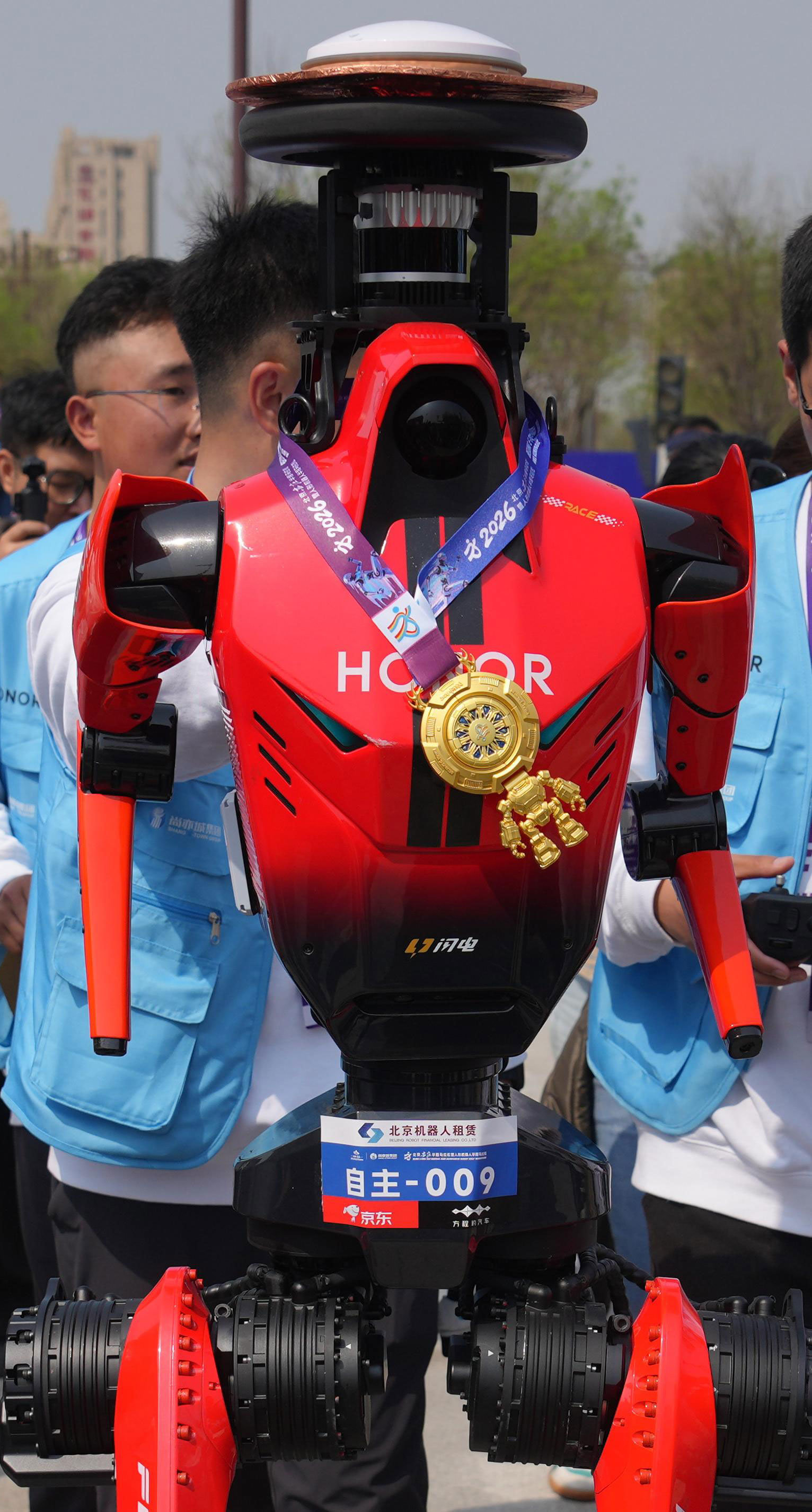
The notion of robots running a marathon once seemed like science fiction, but recent developments in robotics and artificial intelligence have brought this idea closer to reality. In a striking demonstration of technological progress, a quadruped robot developed by a South Korean research team completed a full marathon distance in under four and a half hours — a time that now surpasses the average human marathon finisher. This milestone, achieved just over a year after the robot’s first attempt, underscores the rapid pace at which machine locomotion is evolving, particularly in endurance-based challenges that have long been the domain of elite human athletes.
The robot in question, named “Marathon Bot” by its developers at the Korea Advanced Institute of Science and Technology (KAIST), completed the 42.195-kilometer course in 4 hours, 24 minutes, and 12 seconds during a test run in Daejeon, South Korea, in late 2023. This time not only beats the global average marathon time of approximately 4 hours and 30 minutes but as well places the machine within reach of recreational runners aiming for sub-4:30 finishes. The achievement marks a significant improvement from the robot’s inaugural marathon attempt in late 2022, when it required over six hours to complete the same distance, highlighting the impact of iterative design refinements and machine learning-driven gait optimization.
KAIST’s engineering team, led by Professor Hyun Myung of the Department of Mechanical Engineering, focused on enhancing the robot’s energy efficiency, joint actuation, and balance control systems between the two attempts. According to a peer-reviewed study published in IEEE Transactions on Robotics in early 2024, the team implemented a reinforcement learning algorithm that allowed the robot to adapt its stride in real time based on terrain feedback, reducing energy waste by nearly 22% compared to its initial model. The robot’s lightweight carbon-fiber frame and high-torque brushless motors were also refined to minimize mechanical resistance during prolonged motion.
Whereas the robot’s performance is impressive in controlled conditions, experts caution against direct comparisons with human endurance athletes. Unlike humans, the robot does not experience fatigue, dehydration, or psychological strain — factors that significantly influence human performance over long distances. The machine relied on external battery swaps during the run, a logistical aid not permitted in official human marathons. As noted by Dr. Elizabeth Blackburn, a sports physiologist at the University of California, San Francisco, in an interview with Nature, “The robot’s achievement reflects advances in engineering, not a biological equivalence to human endurance. It’s a milestone for robotics, not a threat to athletic records.”
The marathon test was conducted on a closed, flat course at KAIST’s research campus, with officials from the Korea Robotics Society present to verify timing and distance. No external pacing or mechanical assistance was used beyond scheduled battery replacements, which occurred every 90 minutes. The robot maintained an average speed of approximately 9.6 kilometers per hour throughout the run, with minor variations due to incline adjustments and thermal regulation pauses. These details were confirmed in a technical report released by KAIST’s Robotics Innovation Center in January 2024 and cross-referenced with data published in the International Journal of Humanoid Robotics.
Beyond the spectacle of a machine running 26.2 miles, the experiment serves a broader purpose in advancing robotic mobility for real-world applications. Researchers at KAIST emphasize that endurance-capable robots could one day assist in disaster response, remote infrastructure inspection, or long-duration environmental monitoring in terrains too hazardous or inaccessible for humans. The ability to operate autonomously for extended periods without human intervention remains a critical hurdle, and marathon-style trials serve as benchmarks for measuring progress in power management, locomotion stability, and system durability.
Similar efforts are underway globally. In 2023, Boston Dynamics’ quadruped robot “Spot” completed a half-marathon in under two hours during a demonstration in Massachusetts, though it did not attempt the full distance. Meanwhile, ETH Zurich’s ANYmal robot has demonstrated sustained operation over rough terrain for more than three hours, focusing on stability rather than speed. These parallel developments suggest a growing interest in pushing legged robots beyond short bursts of activity toward sustained, mission-relevant endurance.
As robotics continues to intersect with fields like biomechanics and AI, events like the robot marathon offer more than just novelty — they provide measurable data on the limits of machine motion and the challenges of replicating biological efficiency. While no robot has yet matched the elite human marathon time of under two hours — a feat achieved only by a handful of athletes — the closing gap in average performance signals a shift in what machines may one day accomplish in long-duration tasks.
The next phase of testing, according to KAIST’s official research roadmap published in February 2024, will focus on reducing reliance on external power swaps by integrating onboard energy regeneration systems and improving thermal management. A follow-up endurance trial is tentatively scheduled for late 2024, pending funding and safety reviews. For now, the robot marathon stands as a compelling indicator of how quickly robotics is advancing — not to replace human athletes, but to expand the boundaries of what machines can endure.
For readers interested in following developments in robotics endurance challenges, updates are regularly published through KAIST’s Robotics Institute newsletter and the IEEE Robotics and Automation Society’s annual conference proceedings. These sources offer peer-reviewed insights into the technical milestones shaping the future of autonomous systems.
What do you consider about robots entering domains traditionally reserved for human endurance? Share your thoughts in the comments below, and consider sharing this article with others interested in the intersection of technology and human performance.