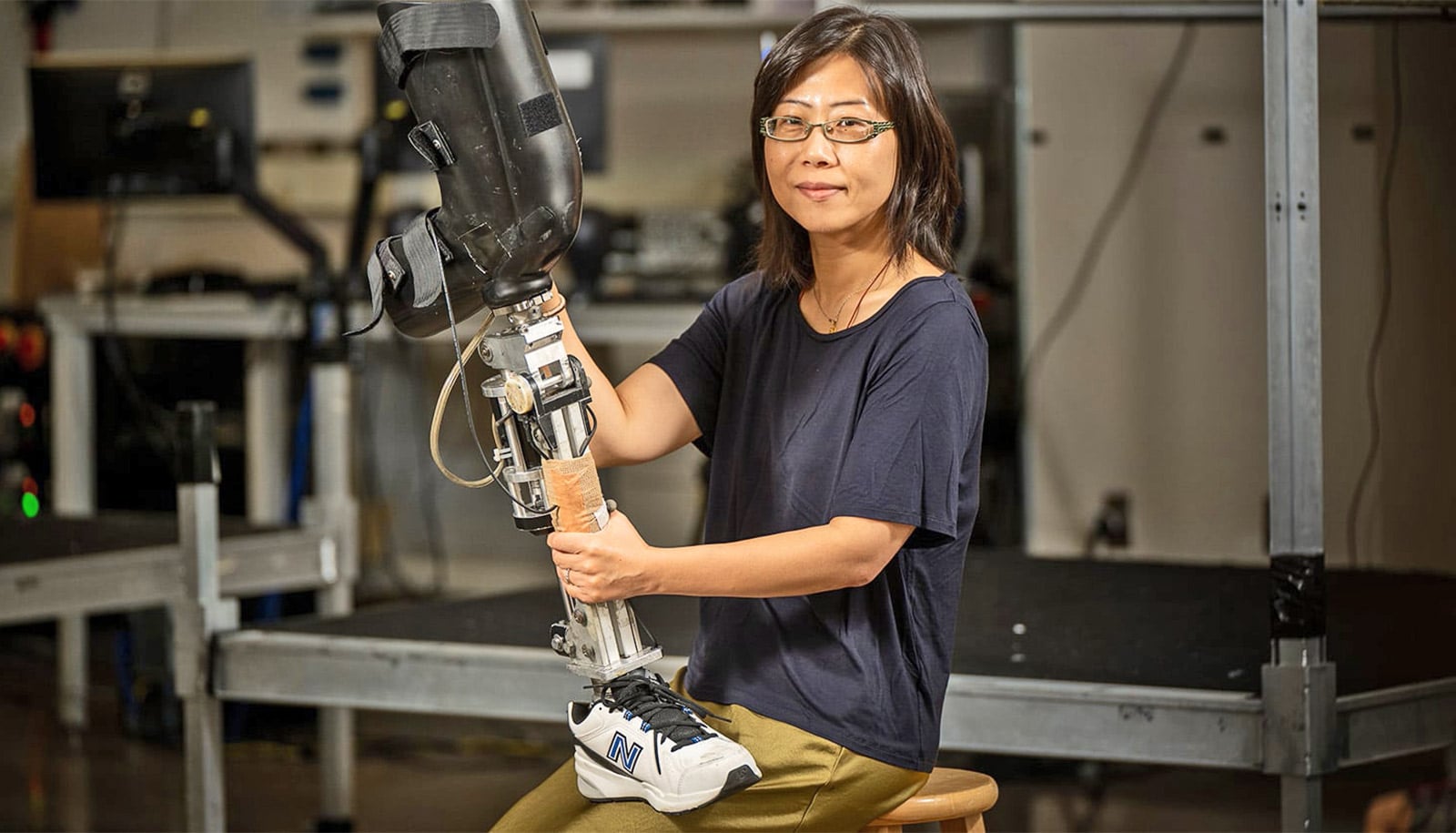
Beyond the Knee: New Prosthetic Control Algorithm Addresses Amputee Hip Health & Natural Gait
For decades, advancements in robotic prosthetics have largely centered on replicating the function of a missing limb – specifically, restoring movement at the point of amputation. While notable progress has been made in prosthetic knee and ankle technology, a crucial element has often been overlooked: the impact of the prosthesis on the entire body, particularly the hip and lower back. Now, researchers at North Carolina State University are pioneering a new approach that promises to not only restore mobility but also proactively safeguard the long-term musculoskeletal health of amputees.
This groundbreaking work, recently published in IEEE Transactions on Robotics, introduces an innovative algorithm that moves beyond simply controlling the prosthetic joint. It intelligently coordinates the movement of the prosthetic knee with the natural biomechanics of the user’s hip, leading to a more fluid, natural gait and a significant reduction in the risk of secondary complications like hip pain and lower back issues.
The Problem with traditional Prosthetic control
Existing robotic prosthetic knees, while sophisticated, operate largely in isolation. Their software focuses on optimizing knee flexion and extension, often without considering how this movement impacts the rest of the leg and the body’s overall balance and posture. This can lead to compensatory movements, placing undue stress on the hip joint and potentially causing chronic pain, instability, and even accelerated degeneration. As anyone who has worked with amputee patients can attest, achieving a natural gait is a complex challenge, and simply restoring knee function isn’t enough.
A Holistic Approach: Inverse Reinforcement Learning for Prosthetic Control
The NC State team, led by Dr. Helen Huang, a professor of biomedical engineering, and Dr. Pavan Nalam, has tackled this challenge by leveraging the power of artificial intelligence, specifically inverse reinforcement learning. This technique differs from traditional prosthetic control methods. Instead of explicitly programming the knee to move in a certain way, the algorithm learns the user’s natural movement patterns.
“Our previous work focused on ‘tuning’ prosthetic knees using reinforcement learning, allowing patients to walk comfortably much faster than with traditional clinical adjustments,” explains Dr.Huang. “Though, that system only considered the prosthesis itself. This new algorithm builds on that foundation by incorporating the user’s own movement – specifically, their hip motion – into the control loop.”
The system utilizes sensors embedded in the prosthetic knee to track its movement, and additional sensors monitor the user’s hip. The algorithm then analyzes this data to adjust the prosthetic knee’s behavior, encouraging a more natural hip movement pattern. this isn’t about forcing the hip to move a certain way; it’s about assisting the user in achieving their natural gait.
Demonstrated Benefits: Improved Gait & Hip Health
The researchers conducted a proof-of-concept study involving five participants – two with above-knee amputations and three without. Participants performed a series of walking tasks under two conditions: one using standard prosthetic control software, and another using the new algorithm. The results were compelling.
“We observed a significant improvement in hip range of motion for all participants when using the new algorithm,” reports Dr. Nalam. “This is a strong indicator that it can positively impact hip health. Furthermore,we saw changes in gait patterns – subjects took longer steps and exhibited movements that felt more natural.”
This improvement in gait isn’t merely cosmetic. A more natural gait reduces energy expenditure, improves balance, and minimizes the strain on other joints, contributing to a higher quality of life for amputees.
Looking ahead: Clinical Translation & Expanded Applications
The NC State team is already planning the next steps, focusing on clinical trials to assess the long-term benefits of the algorithm on user well-being. They are also actively seeking partnerships with prosthetic manufacturers to integrate this technology into commercially available devices.
“From a practical standpoint, we want to see this technology translated into real-world benefits for amputees,” says Dr. Huang. “we’re also exploring how this approach can be applied to other aspects of human locomotion, such as trunk movement and symmetrical walking.”
Dr. Nalam adds, “This is just the beginning. We believe this approach has the potential to address a wide range of locomotive challenges and improve the lives of individuals with mobility impairments.”
Why This Matters: A Paradigm Shift in Prosthetic Care
This research represents a significant paradigm shift in prosthetic care. By moving beyond a purely mechanical approach and embracing a holistic, biomechanically-informed strategy, the NC State team is paving the way for prosthetics that not only restore function but also protect the long-term health and well-being of their users. This is a crucial step towards
- Limerence vs. Love: Understanding the Difference and Signs of Emotional Infatuation
- Amira Aly Shares Adorable Update on Her Growing Baby Bump
- Apple Pencil Pro Unleashes Advanced New Features on Powerplanet with Fast Shipping (world-today-news.com)
- John Stones in advanced talks to join Inter Milan on free transfer (time.news)