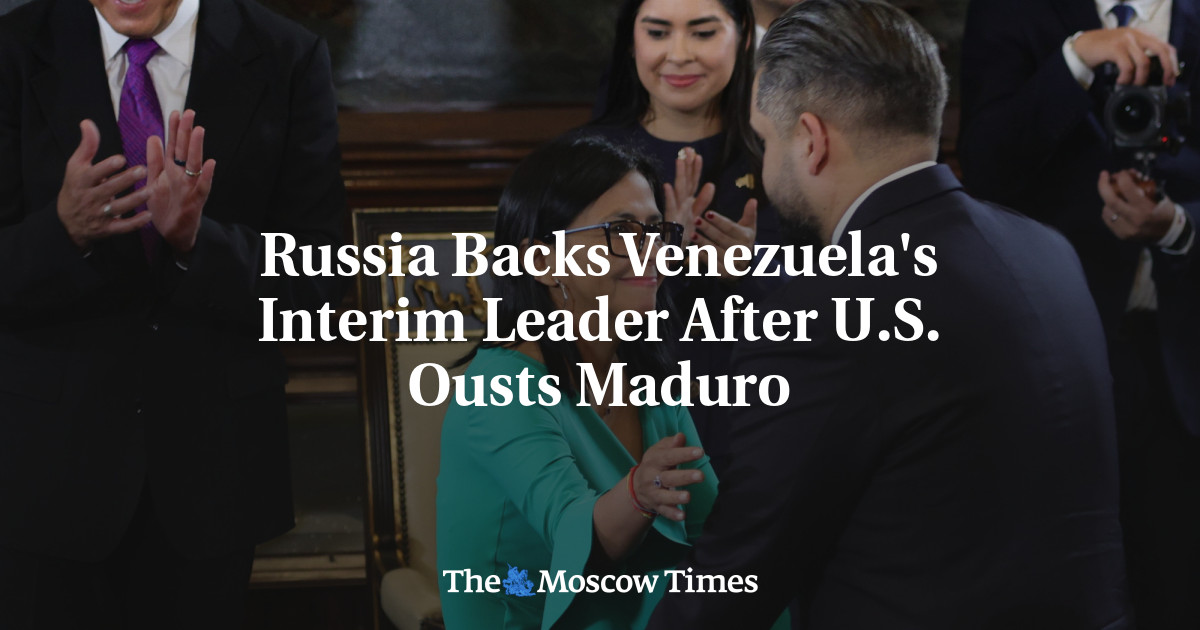
The political landscape of Venezuela underwent a dramatic shift recently, as former Vice president Delcy Rodríguez assumed the presidency following a U.S. military operation that led to the detention of Nicolás Maduro. This unprecedented intervention has sparked international reactions and left the future of the oil-rich nation uncertain.
Venezuela’s Leadership Transition and International Response
Rodríguez was sworn in as the acting president after Maduro and his wife were taken into custody by U.S. forces and transported to New York. Maduro subsequently entered a plea of not guilty to charges of drug trafficking and related offenses in a U.S. court.
Russia’s Foreign Ministry quickly voiced its support for Rodríguez, emphasizing the importance of maintaining stability and constitutional order within Venezuela. They believe her appointment demonstrates a commitment to preserving the established chain of authority and averting a constitutional crisis.
According to the Russian Foreign Ministry, Rodríguez’s inauguration also establishes the groundwork for peaceful and stable development
in Venezuela, especially in the face of what they characterize as blatant neocolonial threats and external armed aggression.
This echoes concerns voiced by several nations regarding potential interference in the region’s affairs.
Did You Know? Venezuela holds the world’s largest proven oil reserves, estimated at 303.8 billion barrels as of January 2026, according to the Oil & Gas Journal. This makes the contry a key player in global energy markets.
Moscow has consistently called for Maduro’s release following the U.S. military action, but has, so far, refrained from taking further direct steps to support its South American ally. the Kremlin continues to advocate for de-escalation and a resolution to the dispute through dialog and adherence to international law, specifically the UN Charter.
The ministry underscored the necessity of maintaining Latin America and the Caribbean as a zone of peace
, signaling a desire to prevent further regional instability.
Russia has also pledged to continue providing necessary support
to Venezuela, reaffirming its long-standing relationship with the nation.
President Donald Trump asserted that the U.S. is now in charge
in Venezuela, stating that Rodríguez’s tenure will be contingent upon her willingness to do what we want
. This statement, as reported by Politico, hints at the possibility of further intervention should Caracas not fully cooperate with U.S. demands.
Rodríguez has indicated a willingness to engage with Washington, particularly concerning access to Venezuela’s substantial oil reserves. Though, she is also attempting to consolidate support from hardliners within Maduro’s management, who maintain control over the country’s security apparatus and paramilitary groups.
Maria Corina Machado, a Nobel Peace Prize-winning opposition leader, has strongly criticized Rodríguez, labeling her as rejected
by the Venezuelan people and accusing her of being a key figure in torture, persecution, corruption, narcotrafficking.
This highlights the deep divisions within Venezuelan society.
The current crisis unfolds after a quarter-century of leftist governance, leaving Venezuela’s approximately 30 million citizens – and the world’s largest proven oil
Worth a look