
In the grand theater of 21st-century geopolitics, two vastly different visions of connectivity and division are currently competing for the global spotlight. On one hand, there exists the long-standing, almost mythic concept of a Bering Strait tunnel—a physical link that could theoretically unite the economies of Asia and North America. On the other, the stark reality of the war in Ukraine presents a definitive breaking of ties, as Ukrainian President Volodymyr Zelensky maintains a resolute stance against Russian territorial ambitions in the Donetsk region.
These two narratives—one of potential infrastructure-driven unity and the other of hard-fought national sovereignty—illustrate the profound tension defining modern international relations. While the dream of bridging the gap between Russia and the United States through massive engineering feats remains a topic of historical and economic fascination, the immediate reality is one of deepening fragmentation and uncompromising territorial defense.
As the global community watches the trajectory of the conflict in Eastern Europe, the contrast is impossible to ignore. The theoretical “bridge” across the Bering Strait represents a future of interconnected trade and shared prosperity, whereas the current struggle for the Donbas represents a fundamental rejection of such connectivity in favor of protecting national borders and democratic independence.
The Bering Strait Concept: A Vision of Global Connectivity
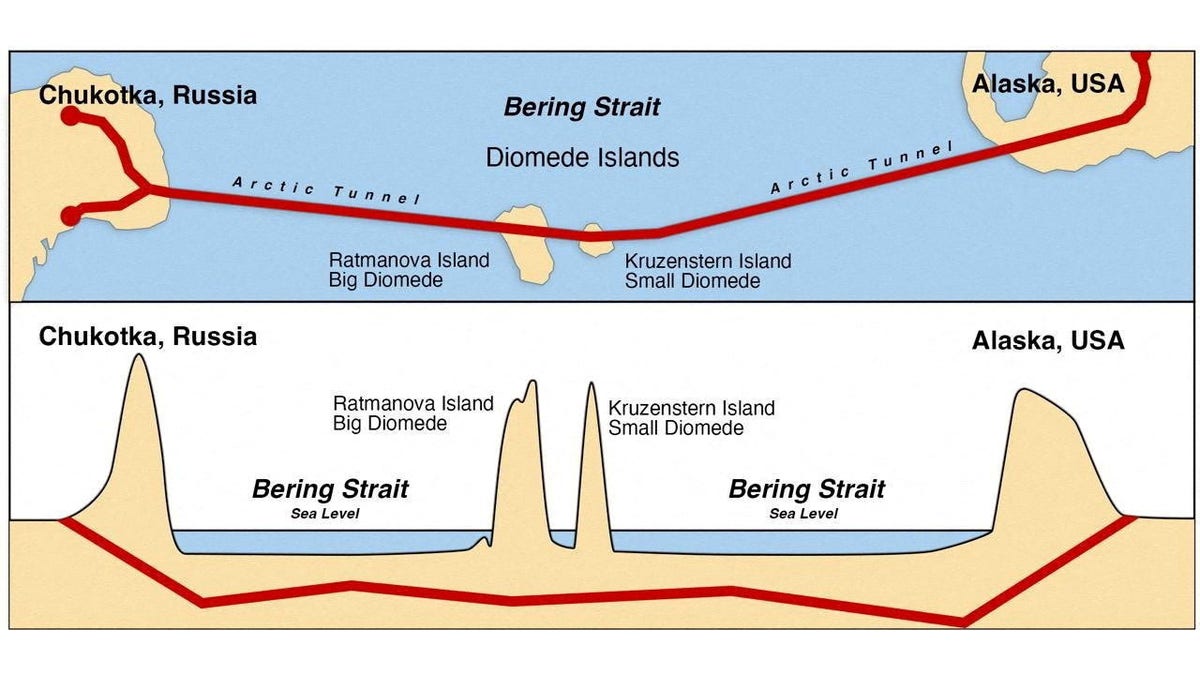
The idea of a tunnel or bridge under the Bering Strait, connecting the Russian Far East with Alaska in the United States, has been a subject of geopolitical speculation for decades. The project, often discussed in the context of the “TKM-Asia” concept, involves spanning the roughly 82-kilometer (51-mile) gap between the two continents. If realized, such a feat of engineering would create a continuous land and rail link from London to New York, fundamentally altering global logistics and trade routes.

Proponents of the project have long argued that a Bering Strait link would facilitate unprecedented economic exchange between the markets of Asia and the Americas. By connecting the Trans-Siberian Railway to the North American rail network, the tunnel could serve as a primary artery for goods, significantly reducing transit times compared to current maritime routes. The scale of the project is immense, requiring not only the tunnel itself but also massive infrastructure developments in the remote and sparsely populated regions of Chukotka in Russia and western Alaska.
However, despite the recurring interest from engineers and economists, the project faces insurmountable hurdles in the current political climate. There is no verified agreement between the United States and Russia to pursue such a massive undertaking. In fact, the current state of diplomatic relations between Washington and Moscow is at its lowest point in decades, characterized by sanctions, frozen diplomatic channels and intense security competition. The cooperation required to fund, design, and manage a project of this magnitude—estimated to cost hundreds of billions of dollars—is currently non-existent.
The logistical challenges are equally daunting. The region is subject to extreme Arctic weather conditions, permafrost, and significant seismic activity, all of which would drive construction costs and technical complexity to unprecedented levels. Without a period of sustained geopolitical stability and a shared economic interest between the two superpowers, the Bering Strait tunnel remains a theoretical marvel rather than a looming reality.
Ukraine’s Red Line: The Fight for Donetsk and Sovereignty
While the Bering Strait remains a distant dream of connectivity, the battle for territorial integrity in Ukraine is a pressing and violent reality. President Volodymyr Zelensky has consistently articulated a clear and uncompromising message to the Kremlin: the sovereignty of Ukraine is non-negotiable, and the nation will not cede its land to achieve a cessation of hostilities.
Central to this struggle is the Donetsk region, a key part of the Donbas area that has been a focal point of conflict since 2014. Zelensky has repeatedly asserted that Ukraine will remain an independent, sovereign state and that the occupation of its territories, including Donetsk, is an illegal violation of international law. His rhetoric emphasizes that any peace settlement must respect Ukraine’s internationally recognized borders, a position that stands in direct opposition to Russian attempts to annex these regions.
The significance of Donetsk cannot be overstated. It is not only a strategic and industrial heartland for Ukraine but also a symbol of the nation’s broader fight for self-determination. For the Ukrainian leadership, the refusal to relinquish Donetsk is not merely a matter of territory, but a matter of national survival and the preservation of democratic values against external aggression. This stance has been bolstered by significant international support, with many Western nations providing military and financial aid to help Ukraine defend its borders.
The conflict in the Donbas has resulted in immense human suffering and significant destruction of infrastructure. As the fighting continues, the international community remains divided on the path to peace, but Zelensky’s position remains a cornerstone of Ukraine’s diplomatic and military strategy: independence and territorial integrity are the only acceptable outcomes.
Geopolitical Implications: The Widening Chasm
The juxtaposition of these two topics—the proposed Bering Strait link and the war in Ukraine—highlights the two diverging paths of global geopolitics. One path seeks to overcome geography to foster integration, while the other is defined by the hardening of borders and the use of force to redraw them.
The current geopolitical landscape is characterized by a shift away from the era of hyper-globalization toward a period of “de-risking” and the formation of competing blocs. The dream of a Bering Strait tunnel is a relic of a more optimistic era of international cooperation, a time when large-scale infrastructure was seen as a tool for peace. Today, such projects are viewed through the lens of national security and strategic competition.

In Ukraine, the conflict has fundamentally altered the security architecture of Europe. It has revitalized NATO, strengthened the European Union’s focus on defense, and created a new reality where territorial sovereignty is being tested by brute force. The refusal of Ukraine to cede Donetsk is a signal to the rest of the world that the post-World War II order, which prohibits the conquest of territory by force, remains a vital principle for many nations.
the ability of the world to move from a state of conflict to a state of connectivity depends on resolving these fundamental disputes over sovereignty and security. Until the issues of territorial integrity and international law are addressed, the “bridges” between the East and West will remain more theoretical than tangible.
Key Takeaways
- Bering Strait Tunnel: A long-standing concept to link Asia and North America via a massive engineering project; however, no current agreement exists between the US and Russia, and geopolitical tensions make it highly improbable.
- Ukraine’s Sovereignty: President Zelensky has maintained a firm stance that Ukraine will remain independent and will not cede the Donetsk region to Russia.
- Geopolitical Tension: The contrast between the hope for global connectivity and the reality of regional conflict illustrates the current fragmentation of international relations.
- Territorial Integrity: The conflict in the Donbas serves as a critical test for the international principle that borders cannot be changed through military aggression.
The situation in Ukraine continues to evolve rapidly, with significant developments expected in the coming months regarding both military movements and diplomatic efforts. We will continue to monitor official statements from the Ukrainian Presidency and international monitoring bodies for the next major update on the status of the Donetsk region.
What are your thoughts on the future of global connectivity versus the current trend of geopolitical fragmentation? Share your insights in the comments below and share this article with your network.
Related reading