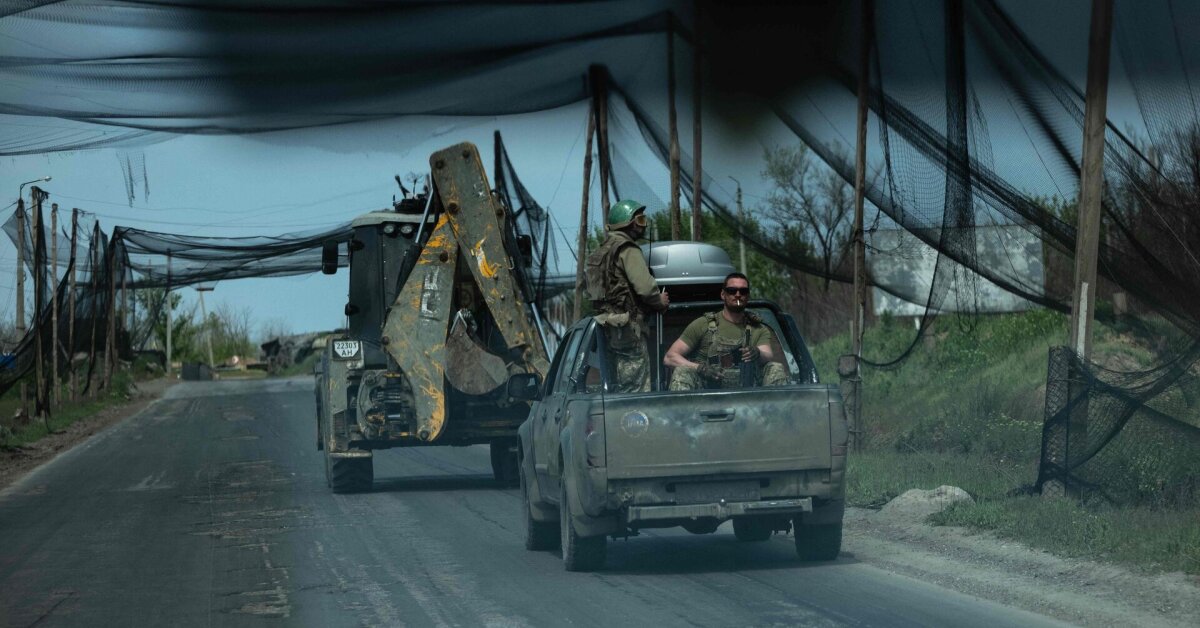
The operational landscape in eastern Ukraine has shifted as Ukrainian forces intensify a campaign of deep-strike drone operations targeting the Russian military’s logistical backbone. Recent reports indicate that supply lines in the occupied parts of the Donetsk region, particularly those orbiting the strategic port city of Mariupol, are no longer secure, creating significant friction for Russian troop movements and resupply efforts.
These Ukrainian drone strikes Mariupol logistics operations are striking targets deep behind the front lines, some as far as 105 kilometers into occupied territory. By targeting the specific highways that feed Russian offensive operations in the north and south of the Donetsk region, Ukraine is effectively attempting to isolate frontline units from their primary depots and reinforcement hubs.
The strategic significance of these strikes lies not just in the immediate destruction of equipment, but in the systemic disruption of the Russian military’s ability to sustain high-intensity combat. When logistics are compromised at such a distance, the “last mile” of delivery becomes a gauntlet, forcing Russian commanders to either risk larger convoys or rely on smaller, less efficient transport methods that cannot sustain a major offensive.
According to analysis from the Institute for the Study of War (ISW), these capabilities could serve as a critical force multiplier for future Ukrainian counteroffensives. By degrading the enemy’s ability to rotate troops and move ammunition, Ukraine is creating “logistical vacuums” that can be exploited during active ground maneuvers.
Severing the Arteries: The T-0509 and M-14 Highways
The current drone campaign is focused on two primary logistical arteries: the T-0509 and the M-14 highways. These roads are not merely transport routes; they are the lifeblood of the Russian presence in the south and east of Ukraine.

The T-0509 highway, which connects Mariupol to Donetsk, has become a primary target. Geolocated footage from May 6 and May 8 shows Ukrainian drones successfully striking Russian military trucks on this route, approximately 95 kilometers from the front line. The T-0509 is essential for supplying Russian forces currently engaged in offensive operations within the northern Donetsk region. Any disruption here directly impacts the volume of shells and fuel reaching the front.

Simultaneously, Ukrainian drones have been spotted operating over Mariupol and along the M-14 highway. This route is of even greater strategic importance as it supports Russian logistics moving toward Orikhiv and the left bank of the Dnipro River. The M-14 serves as a primary conduit for reinforcements and heavy equipment moving between the occupied Zaporizhzhia and Kherson regions, making it a high-value target for long-range reconnaissance and strike drones.
The ability to monitor and strike these routes in real-time means that Russian logistics are now operating under constant surveillance. This creates a psychological burden on personnel and forces the Russian military to implement costly and time-consuming countermeasures, such as electronic warfare (EW) bubbles and physical camouflage, which slow down the overall pace of supply.
The Reach of the Azov Brigade
A central player in these deep-strike operations is the 1st Corps of the National Guard Azov. On May 8, the unit reported successful strikes against Russian military facilities in the vicinity of Mariupol, demonstrating a sophisticated integration of reconnaissance and precision strike capabilities.
The technical reach of these operations is particularly notable. Reports indicate that Ukrainian drones are disrupting Russian logistics at distances of up to 160 kilometers from the operators’ positions. This range allows Ukrainian forces to launch strikes from relatively safe zones, minimizing the risk to their own personnel while projecting power deep into the Russian rear.
The Azov Brigade’s focus on Mariupol is deeply symbolic and strategically calculated. As a city that was the site of a brutal siege, the return of Ukrainian precision strikes to its outskirts signals that the Russian “safe zone” in the south is evaporating. These strikes are not random; they are surgical hits on facilities and convoys that provide the necessary support for the Russian occupation of the wider Donetsk oblast.
Strategic Analysis: The Impact on Counteroffensive Potential
The shift toward “logistics warfare” is a hallmark of modern conflict, as seen in various global theaters where precision munitions are used to starve the front lines. For Ukraine, the ability to strike 100+ kilometers behind the line changes the calculus for any planned counteroffensive.
Military analysts suggest that the primary goal of these strikes is to create “operational paralysis.” When a military cannot guarantee the safety of its supply trucks on major highways like the T-0509, It’s forced to decentralize its depots. While decentralization can protect supplies from a single large strike, it complicates the distribution process, making it harder to surge resources to a specific sector of the front during a crisis.
the use of drones for reconnaissance over Mariupol and the M-14 allows the Ukrainian General Staff to map Russian troop rotations and equipment movements in near real-time. This intelligence is invaluable; knowing exactly when a convoy of ammunition trucks is moving allows for the timing of strikes to maximize disruption, potentially coinciding with ground assaults to leave Russian defenders without adequate support.
The Evolution of Deep-Strike Drone Warfare
The current situation near Mariupol reflects a broader evolution in the war’s technological trajectory. Ukraine has moved from using slight, commercial First-Person View (FPV) drones for tactical strikes to employing sophisticated, long-range unmanned aerial vehicles (UAVs) capable of strategic interdiction.
This evolution is characterized by several key developments:
- Extended Range: The leap to 160km operational ranges suggests the use of enhanced communication links or satellite-guided systems, reducing the reliance on line-of-sight operations.
- Integrated Intelligence: The coordination between the National Guard Azov and broader intelligence networks allows for the targeting of specific, high-value vehicles rather than general areas.
- Psychological Attrition: The knowledge that drones are operating directly over occupied cities like Mariupol creates a sense of vulnerability among Russian garrison forces, who previously viewed these areas as secure rear zones.
As the conflict continues, the battle for the “rear” will likely become as important as the battle for the trenches. The ability to project power into the enemy’s logistical heartland is often the deciding factor in whether a front line holds or collapses.
For the Russian military, the challenge is now one of survival and adaptation. To secure the T-0509 and M-14 highways, they must invest heavily in mobile air defense and electronic warfare. However, the sheer number of drones being deployed makes total coverage nearly impossible, leaving their logistics permanently exposed to Ukrainian precision.
The next critical checkpoint for observers will be the Russian military’s response to these disruptions—specifically whether they attempt to reroute logistics through more difficult, unpaved terrain or if they can successfully deploy new EW capabilities to blind Ukrainian operators. Updates on the stability of the Mariupol-Donetsk supply corridor are expected as the operational season progresses.
World Today Journal encourages readers to share this analysis and join the conversation in the comments below regarding the evolving role of UAVs in modern geopolitical conflicts.