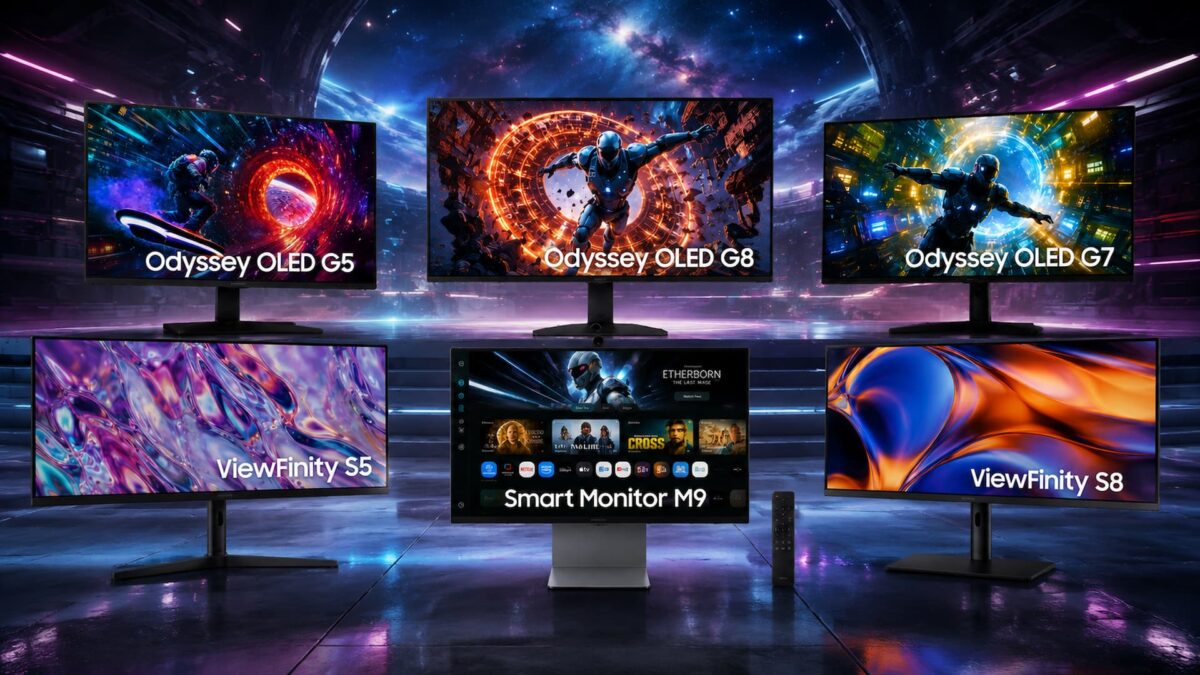
The landscape of high-performance desktop computing is undergoing a significant shift as Samsung Electronics pushes the boundaries of display technology. As we move into the next phase of the 2026 product cycle, the company’s latest iteration of its Odyssey monitor lineup is signaling an aggressive push toward ultra-high resolution and extreme refresh rates. For professionals and enthusiasts alike, these new Samsung OLED monitors for 2026 represent a concerted effort to merge professional-grade color accuracy with the rapid response times required for competitive gaming.
My experience in software engineering and hardware evaluation has taught me that the “spec sheet war” often masks the real-world usability of a monitor. However, the integration of advanced QD-OLED panels and higher pixel densities—specifically those moving toward 6K resolutions—suggests that Samsung is aiming to eliminate the traditional trade-offs between screen real estate and motion clarity. By leveraging its proprietary display architecture, the company is attempting to set a new benchmark for what users should expect from their primary workstations.
Pushing the Limits: High Resolution Meets Extreme Refresh
The most compelling narrative in this year’s hardware rollout is the arrival of high-resolution panels that do not sacrifice fluidity. Historically, users have had to choose between the razor-sharp text clarity of a 5K or 6K display and the buttery-smooth motion of a high-refresh-rate gaming monitor. Samsung’s recent engineering efforts, as detailed in their latest official product communications, suggest that the 2026 Odyssey lineup is designed to bridge this gap.
The inclusion of panels capable of reaching 330 Hz refresh rates represents a technical milestone for OLED technology, which has traditionally struggled with thermal management at such high frame rates. This advancement is critical for the gaming sector, where every millisecond of latency reduction is scrutinized. According to industry display standards, maintaining color consistency at these high frequencies requires sophisticated panel driving logic, an area where Samsung has invested heavily in recent years.
The QD-OLED Advantage in Professional Workflows
Beyond the gaming specs, the move toward QD-OLED technology has profound implications for creative professionals. Unlike traditional W-OLED, Quantum Dot OLED (QD-OLED) technology provides superior color volume at higher brightness levels. This is essential for color grading, architectural rendering and high-fidelity video editing. The “TrueBlack” certification often cited in these releases refers to the panel’s ability to achieve near-infinite contrast ratios by completely turning off individual pixels, a feature that remains the gold standard for black-level performance.
For those of us who spend twelve hours a day in an IDE or a design suite, the reduction in sub-pixel layout issues—which historically caused text fringing on some OLED displays—is the most welcome improvement. Samsung’s latest iteration of its pixel structure aims to address these concerns, ensuring that the sharpness required for text-heavy applications is finally on par with high-end IPS panels.
Key Developments in the 2026 Display Roadmap
- Increased Pixel Density: The transition toward 6K resolution allows for more “Retina-like” scaling, providing more usable workspace without sacrificing clarity.
- Thermal Management: New cooling architectures are being implemented to support sustained high-brightness output without the risk of image retention.
- Connectivity Standards: Expect full integration of DisplayPort 2.1 and HDMI 2.1a to handle the massive bandwidth requirements of 6K, 330 Hz signals.
- Form Factor Innovation: Ultra-thin panel designs are migrating from high-end mobile devices to desktop monitors, reducing the physical footprint of these “beast” displays.
What This Means for the Global Market
The competitive pressure in the monitor space is currently at an all-time high. With LG and other key manufacturers also aggressively iterating on their OLED roadmaps, Samsung’s move to dominate the high-end segment with 6K resolution and extreme refresh rates is a strategic play to maintain its lead in the premium consumer electronics market. For the average user, this competition is driving down the price of entry-level OLEDs while simultaneously pushing the ceiling for what is possible in a desktop environment.
However, I caution readers to remain objective. While the marketing materials for these 2026 models are impressive, the true test lies in long-term reliability and the efficacy of anti-burn-in software protections. As a journalist, I will be closely monitoring the official support documentation and user feedback cycles as these units reach the retail market later this year.
Looking Ahead: The Next Phase
We are currently in the pre-launch phase for the broadest availability of these models. The next significant checkpoint will be the release of full technical white papers and independent lab testing results, which are expected to coincide with the next major industry trade shows in late 2026. These tests will be the final arbiter of whether these monitors can truly deliver on their promise of being the “end-game” display for enthusiasts.
Are you considering an upgrade to an OLED workstation, or are you waiting for the prices to stabilize? The shift toward high-resolution, high-refresh panels is an exciting chapter in digital innovation. I invite you to share your thoughts and questions in the comments section below—I look forward to hearing how you plan to integrate this technology into your own setups.