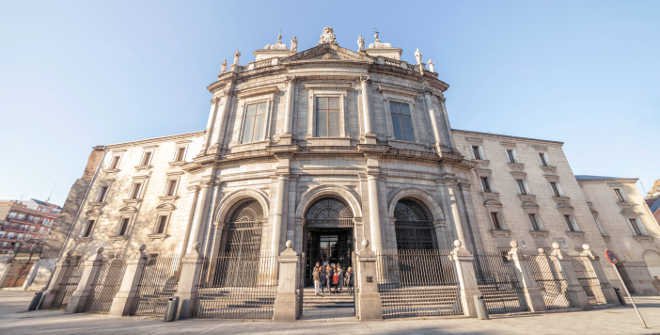
Madrid’s Royal Basilica of San Francisco El Grande stands as a testament to Spanish Baroque architecture and a repository of significant religious art. Recently reopened to the public after a period of closure, the basilica offers visitors a glimpse into Spain’s rich artistic and religious heritage. The structure, located in the heart of the La Latina neighborhood, is notable not only for its impressive dome – the fourth largest in Europe – but also for the masterpieces housed within its walls, including works by Goya and Zurbarán.
The basilica’s history is interwoven with legend and architectural evolution. Although the current structure dates back to the 18th century, its origins are believed to lie in land gifted to Saint Francis of Assisi during his pilgrimage to Santiago de Compostela in 1214. Before the present church, three previous buildings occupied the site, reflecting the enduring spiritual significance of the location. Construction of the current basilica, commissioned by the Franciscan order, began in 1776 and was completed in 1784 under the direction of Francisco Sabatini, a prominent Spanish architect known for his neoclassical designs. Madrid Secreto reports on the recent reopening, highlighting its accessibility to the public.
Architectural Grandeur and Artistic Treasures
The Royal Basilica of San Francisco El Grande is characterized by its circular design, dominated by a massive dome reaching 58 meters in height and 33 meters in diameter. This dome ranks as the fourth largest in Europe, surpassed only by those of St. Peter’s Basilica in Rome, the Pantheon in Rome, and the Florence Cathedral (Santa Maria del Fiore). The basilica’s structure also includes a main chapel and six surrounding chapels, each crowned with its own dome, creating a harmonious and visually stunning interior space. The architectural style is distinctly classical, reflecting the aesthetic preferences of the late 18th century.
Yet, the basilica’s appeal extends beyond its architectural merits. It houses a remarkable collection of sacred art, featuring works by some of Spain’s most celebrated artists. Francisco Goya and Francisco de Zurbarán are prominently represented, alongside contributions from Casto Plasencia, Francisco Jover, Martínez Cubells, José del Castillo, Moreno Carbonero, Eugenio Oliva, Menéndez Pidal, González Velázquez, Gregorio Ferro, Gaspar Crayer, Vicente Carducci, Antonio Carnicero, Alonso Cano, and Lucas Jordán. The collection encompasses paintings and sculptures, primarily dating from the 18th and 19th centuries, offering a comprehensive overview of Spanish religious art during that period. The museum within the basilica is managed by the “Obra Pía de los Santos Lugares,” a public institution affiliated with the Spanish Ministry of Foreign Affairs, European Union and Cooperation, ensuring the preservation and accessibility of this cultural treasure.
Goya and Zurbarán: Masters Within the Basilica Walls
The presence of works by Francisco Goya within the Royal Basilica of San Francisco El Grande is particularly noteworthy. Goya, a pivotal figure in Spanish Romanticism, is renowned for his diverse artistic output, ranging from portraits and historical paintings to depictions of Spanish life and social commentary. His paintings within the basilica offer a glimpse into his evolving style and his profound engagement with religious themes. The Culture Trip details locations in Madrid where visitors can view Goya’s masterpieces, including those housed in this basilica.
Alongside Goya, the works of Francisco de Zurbarán contribute significantly to the basilica’s artistic richness. Zurbarán, a leading figure of the Spanish Golden Age, was celebrated for his austere and deeply spiritual paintings, often depicting monks, saints, and religious scenes. His mastery of chiaroscuro – the dramatic use of light and shadow – imbues his works with a powerful sense of realism and emotional intensity. The Frame Blog provides context on Zurbarán’s work and its place within the broader tradition of Spanish Baroque art.
Recent Developments and Accessibility
The recent reopening of the Royal Basilica of San Francisco El Grande to the public marks a significant moment for cultural tourism in Madrid. Having been closed to visitors for an unspecified period, the basilica is now once again accessible, allowing both locals and tourists to experience its architectural grandeur and artistic treasures. The reopening, reported on February 18, 2026, by Madrid Secreto, underscores the city’s commitment to preserving and promoting its cultural heritage. Admission to the basilica is currently free, making it an attractive destination for budget-conscious travelers.
The basilica’s location in the La Latina neighborhood further enhances its appeal. La Latina is known for its vibrant atmosphere, traditional tapas bars, and historic streets, making it a popular destination for those seeking an authentic Madrid experience. A visit to the basilica can be seamlessly integrated into a broader exploration of this charming neighborhood.
The Historical Context of the La Latina Neighborhood
The La Latina neighborhood, where the basilica is located, has a rich and storied past. Historically a working-class district, it has undergone significant transformation in recent decades, becoming a popular destination for both locals and tourists. The neighborhood’s narrow, winding streets and traditional architecture evoke a sense of old-world charm. It is also known for its lively Sunday market, El Rastro, one of the largest open-air markets in Europe.
The basilica’s presence within La Latina adds to the neighborhood’s cultural significance, attracting visitors interested in art, history, and religious heritage. The combination of architectural beauty, artistic masterpieces, and a vibrant neighborhood atmosphere makes the Royal Basilica of San Francisco El Grande a must-see destination for anyone visiting Madrid.
As the basilica continues to welcome visitors, it remains a vital center for cultural preservation and a testament to the enduring legacy of Spanish art and architecture. Future updates regarding exhibitions, restoration projects, and visitor information can be found through the Spanish Ministry of Foreign Affairs, European Union and Cooperation, which oversees the “Obra Pía de los Santos Lugares” responsible for the basilica’s management.
We encourage readers to share their experiences and insights about the Royal Basilica of San Francisco El Grande in the comments below. Your perspectives contribute to a richer understanding of this remarkable cultural landmark.
Keep reading