
The landscape of 18th-century period dramas often leans toward the grand and the romantic, but the upcoming production Savage House takes a markedly different, more cynical approach. With a narrative centered on the lives of status-obsessed nobles navigating a landscape defined by political upheaval and social maneuvering, the film offers a raw, satirical look at the complexities of power and class. At the heart of this raucous period yarn are Claire Foy and Richard E. Grant, whose performances anchor the film’s high-energy exploration of greed and ambition.
Directed by Peter Glanz, the film transports viewers to a crumbling country estate, where the atmosphere is thick with the tension of a shifting political environment. By focusing on the internal dynamics of the Savage household, the production examines the lengths to which individuals will go to maintain their standing in a society that seems to be falling apart around them. For audiences who appreciate historical settings stripped of their usual polish, Savage House provides a gritty, often biting perspective on the realities of the era.
A Study in Status and Satire
The core of Savage House lies in the complex, often strained relationship between its two leads. Richard E. Grant portrays Sir Chauncey, a character defined by his background as a social climber who has strategically aligned himself with the Hanoverian dispensation while harboring a deep disdain for the Jacobite cause. His marriage to Lady Savage, played by Claire Foy, is depicted not as a union of affection, but as a calculated maneuver for financial stability and social elevation. The character of Sir Chauncey, having adopted his wife’s noble name to further his own standing, serves as the primary engine for the film’s satirical commentary on the nature of the 18th-century aristocracy.
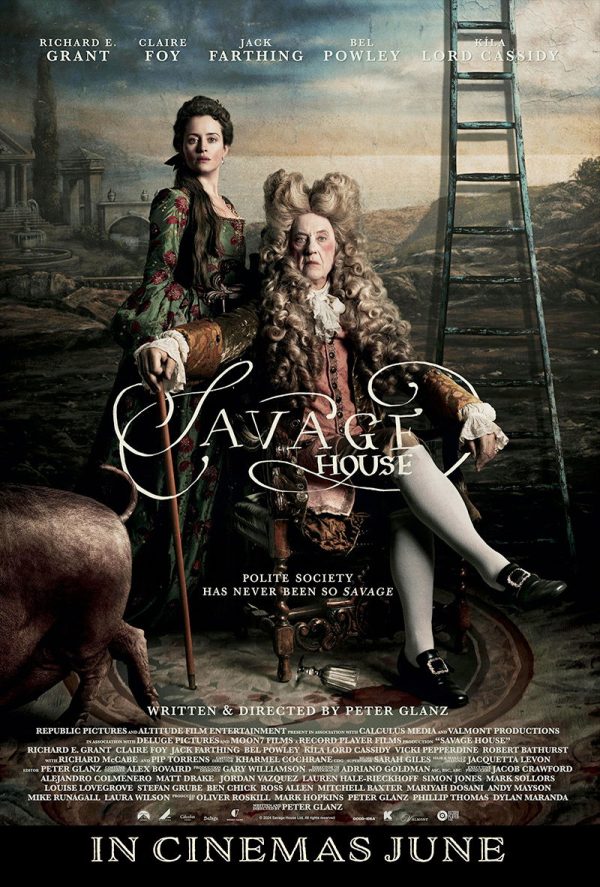
Foy’s portrayal of Lady Savage adds a layer of depth to the narrative, as she balances her own motivations with the roguish nature of her husband. The film suggests that while she was initially drawn to his personality, their relationship has devolved into a series of mutual betrayals and hidden agendas. The domestic discord is further heightened by their respective extramarital involvements: Lady Savage is depicted as being engaged in an affair with the footman, Halifax, played by Jack Farthing, while Sir Chauncey maintains his own connection with the maid, Dorothy, portrayed by Bel Powley. These dynamics serve to highlight the hypocrisy inherent in their social status, as the characters struggle to maintain a veneer of nobility while their private lives remain in disarray.
Crafting a Grimy Period Aesthetic
Director Peter Glanz utilizes a specific visual and auditory language to distinguish Savage House from more traditional costume dramas. The film relies heavily on candlelit interiors, creating a claustrophobic and often dim environment that reflects the decay of the characters’ estate. This aesthetic choice is paired with a score characterized by sudden, intense orchestral stabs, which serve to punctuate the frantic movements of the characters as they navigate the halls of their home. Such stylistic decisions suggest an intent to move away from the idealized depictions of the 18th century, focusing instead on the physical and psychological toll of the period’s social pressures.
Supporting the main cast are Richard McCabe and Vicki Pepperdine, who play the couple’s neighbors. Their presence in the film provides a necessary contrast to the Savage household, serving as the only individuals who interact with the central pair. The portrayal of these neighbors, described as having a distinctly unrefined appearance, emphasizes the isolation of the Savages within their own social circle. This dynamic reinforces the theme of a family clinging to their fading status, unwilling to acknowledge the reality of their decline.
The Impact of Period Dramas on Modern Audiences
The appeal of period dramas often lies in their ability to reflect contemporary anxieties through the lens of history. Savage House appears to tap into this tradition by focusing on themes of social climbing, political instability, and the fragility of class structures. By placing its characters in a world defined by the threat of pox outbreaks and the lingering tension of the Jacobite uprising, the film creates a sense of constant, underlying pressure that drives the characters’ desperate behaviors. This approach allows the film to engage with the audience on a level that feels relevant, even when the setting is centuries removed from the present day.

As the film prepares for its wider release, it stands as a testament to the enduring interest in the 18th century as a site for both artistic exploration and social critique. The performances by Foy and Grant, in particular, suggest that the human elements of the story—the desire for power, the pain of betrayal, and the struggle for identity—remain the most compelling aspects of the period genre. Whether the film succeeds in its broader satirical goals remains to be seen, but the commitment of its cast to these complex, morally ambiguous roles is likely to be a significant point of discussion for critics and viewers alike.
Looking Ahead
As of mid-2026, details regarding the specific theatrical distribution schedule for Savage House remain subject to updates from production studios. Audiences interested in tracking the film’s progress, including upcoming trailers, official release dates in various global territories, and potential festival appearances, should consult official studio press releases or verified entertainment news portals for the most current information. We encourage our readers to share their thoughts on the evolution of the period drama genre in the comments section below.
Related reading