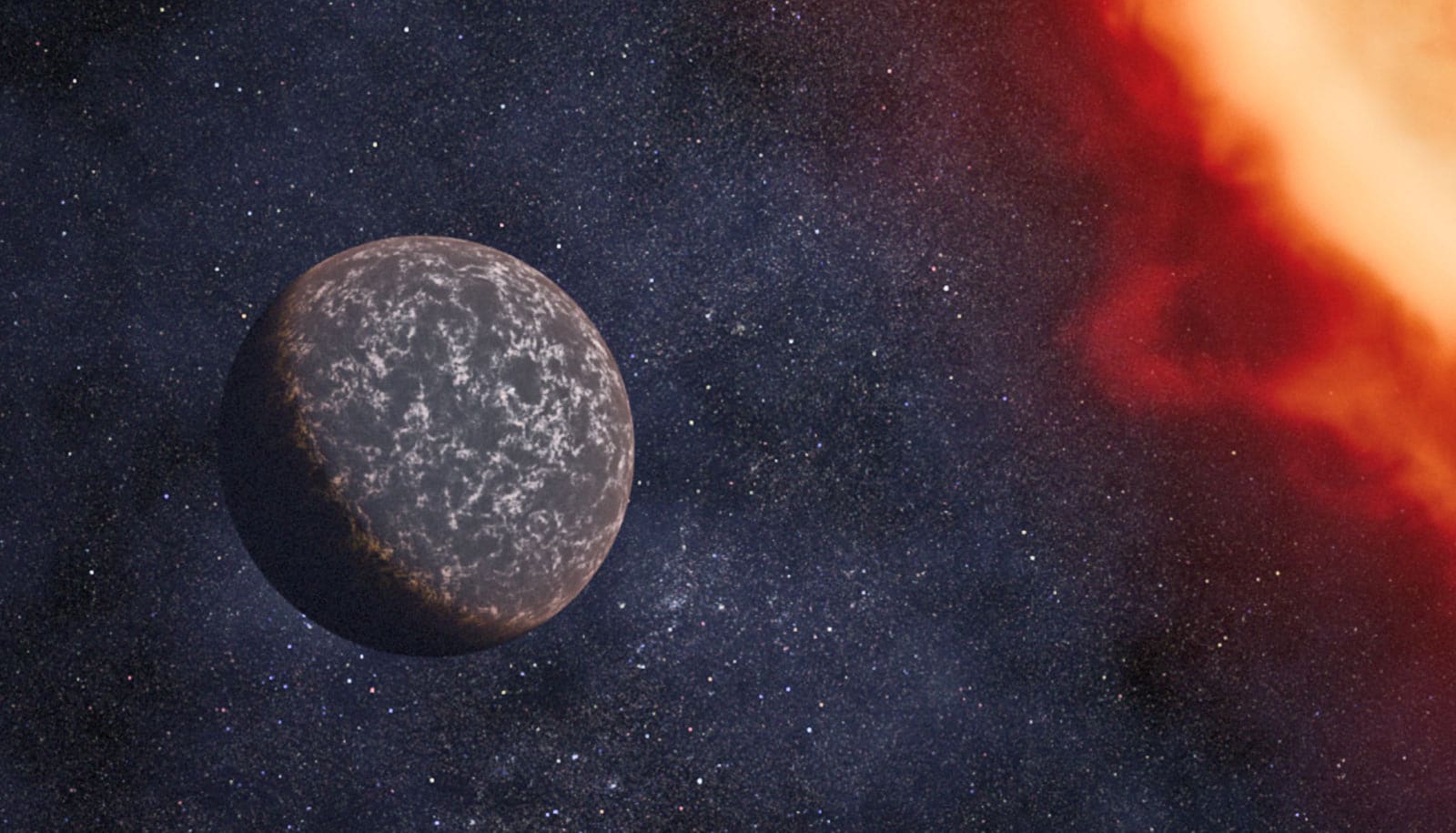
For astronomers and planetary scientists, the question of what a distant world actually looks like has long been one of the most elusive puzzles in space exploration. While we have identified thousands of exoplanets in our galaxy, most remain mere shadows—detected by the gravitational tug they exert on their stars or the brief dimming of light as they transit their host. Now, however, researchers have achieved the best-ever look at the surface of a distant planet, using the advanced infrared capabilities of the James Webb Space Telescope (JWST) to peer across the void.
The planet, known formally as LHS 3844 b, has provided a rare, high-resolution glimpse into the nature of rocky worlds beyond our own. Located approximately 48 light-years from Earth in the constellation Indus, this exoplanet is roughly twice the mass of our home planet. The findings, published in the journal Nature Astronomy, suggest that LHS 3844 b is a dark, dry, and geologically inactive world, likely covered in basaltic rock similar to the volcanic landscapes found in Hawaii or Iceland.
Understanding the Secondary Eclipse Technique
Because exoplanets are typically too small and distant to be imaged directly, scientists rely on sophisticated indirect methods to “see” them. For this study, the research team utilized the “secondary eclipse technique.” This method involves monitoring a star system as the planet passes behind its host star from our perspective on Earth. By measuring the light from the system before and during this eclipse, astronomers can isolate the light emitted or reflected by the planet itself.
This process allows researchers to gather data on the planet’s surface temperature and composition. As noted by the study authors, the James Webb Space Telescope has fundamentally changed the landscape of exoplanet research, enabling the characterization of rocky, terrestrial-sized worlds that were previously beyond our reach. The team, which included researchers from the University of Chicago and the Max Planck Institute for Astrophysics, analyzed data from three separate secondary eclipses to construct a model of the planet’s surface.
A World of Extremes: The Nature of LHS 3844 b
LHS 3844 b presents a starkly different environment than Earth. The planet is locked in a tight orbit, completing a full revolution around its star in just 0.5 Earth days. This proximity results in extreme temperatures: the side of the planet permanently facing its star is subjected to intense solar radiation, reaching temperatures of approximately 1,300 degrees Fahrenheit, while the far side remains in perpetual darkness.
The data revealed a lack of significant atmospheric signals, such as carbon dioxide or sulfurous gases, which are often associated with volcanic activity. The dark color of the surface suggests the absence of a granite-rich crust. On Earth, granite formation is typically linked to the presence of water and the long-term geological processes of plate tectonics. The absence of these features on LHS 3844 b suggests that the planet likely lacks the dynamic, shifting crust that helps regulate Earth’s climate and sustains a habitable environment.
Key Findings and Scientific Significance
- Surface Composition: The planet appears to be covered in dark, weathered basaltic rock, potentially in the form of a fine, volcanic powder similar to the regolith found on the Moon or Mercury.
- Atmospheric Status: Observations indicate little to no atmosphere, suggesting the planet is unable to retain a gaseous envelope.
- Geological Activity: The findings point toward a lack of active plate tectonics, contrasting with Earth’s geologically active nature.
- Research Methodology: The study combined data from the James Webb Space Telescope with previous observations from the Transiting Exoplanet Survey Satellite (TESS) and the NASA Exoplanet Archive.
Why Studying Rocky Planets Matters
One of the primary goals of modern exoplanet research is to determine how common Earth-like, habitable conditions are throughout the universe. By studying planets like LHS 3844 b, scientists are building a “sample size” of rocky worlds to understand the diverse ways in which planets form and evolve. As researchers have pointed out, our own solar system contains only four rocky planets, each with vastly different characteristics—some with atmospheres, some without, and only one currently known to support life.

Understanding why LHS 3844 b is dry and inactive helps refine our search parameters for potentially habitable worlds. It allows astronomers to distinguish between planets that might possess the essential “ingredients” for stability and those that are fundamentally hostile to life as we know it. The research team is now looking toward future observations with the James Webb Space Telescope to further map the surface roughness of the planet, marking the next step in our ongoing effort to characterize the distant corners of our galaxy.
The study received support from several institutions, including NASA and the National Science Foundation of China (NSFC), as well as academic fellowships supporting the graduate researchers involved. As we continue to refine our tools and techniques, each new discovery brings us closer to answering the fundamental question of whether we are alone in the universe.
Have thoughts on this discovery or the future of exoplanet exploration? Share your perspective in the comments below.
Worth a look