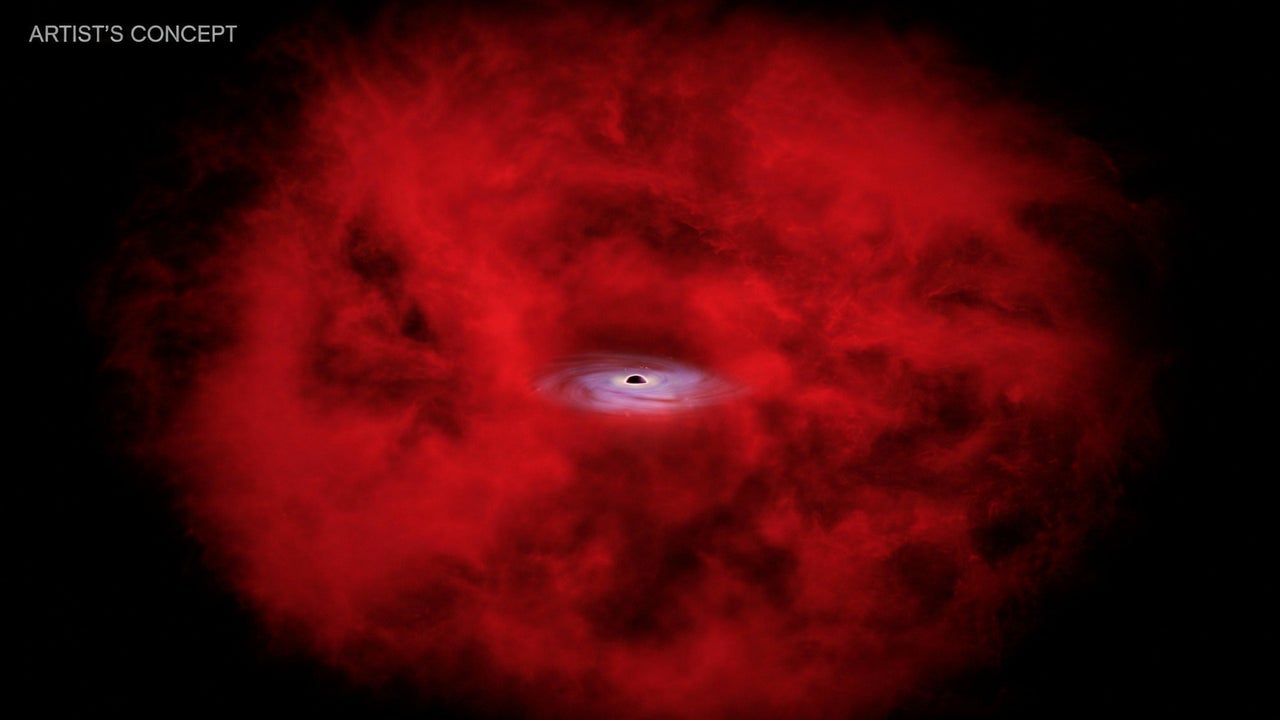
In the quiet, cold expanse of the early universe, astronomers have identified a peculiar phenomenon that is currently rewriting our understanding of cosmic evolution: the presence of “little red dots.” These compact, intense objects, observed through the lens of the James Webb Space Telescope (JWST), are challenging the long-held consensus regarding how galaxies and their central supermassive black holes grow. As we peel back the layers of the deep past, these findings suggest that the fundamental relationship between a galaxy and its massive core may be far more complex—and perhaps more inverted—than previously theorized.
For decades, the prevailing model of galactic formation suggested that galaxies grew gradually, with supermassive black holes accumulating mass over eons in tandem with their host stellar populations. However, new data from the European Space Agency (ESA) and NASA indicates that some of these gargantuan objects were already firmly established in the early universe, seemingly predating the very galaxies that now host them. This discovery is not merely a curiosity of deep-space observation; We see a fundamental challenge to the standard model of cosmology, prompting researchers to question the physical laws that governed the dawn of time.
The Mystery of the Little Red Dots
The “little red dots” are characterized by their compact size and distinct reddish hue, a color signature that typically suggests high levels of dust obscuration or intense, redshifted light from active galactic nuclei (AGN). When astronomers first analyzed these objects using the James Webb Space Telescope, they were struck by the sheer luminosity concentrated in such small volumes. These were not typical star-forming regions; they were dense, energetic engines operating at a time when the universe was less than a billion years old.

The significance of these observations lies in the timing. According to the Big Bang theory and standard cosmological models, the growth of a black hole is limited by the amount of matter it can consume—a limit known as the Eddington limit. If a black hole grows too quickly, the radiation pressure it emits should push away the surrounding gas, effectively cutting off its own fuel supply. The existence of massive black holes at such an early stage suggests that either our understanding of this limit is incomplete, or these black holes formed through a process of “direct collapse,” bypassing the typical evolutionary stages of stellar death.
Challenging the Physics of Galactic Birth
Recent research, including studies published by teams utilizing data from the University of Cambridge, has highlighted specific black holes that appear to be significantly more massive than the total mass of the stars in their host galaxies. In the local universe, we typically see a proportional relationship where the black hole mass is a small fraction of the galaxy’s bulge mass. Finding a “heavy” black hole in a “light” galaxy suggests that the central engine formed first, acting as a seed around which the galaxy eventually coalesced.
This “black-hole-first” scenario is a radical departure from traditional views. It implies that the gravitational influence of these massive objects may have actually triggered the collapse of gas clouds, accelerating the birth of the first stars. This perspective shifts the black hole from a passive occupant of a galaxy to an active architect of galactic structure. For astronomers working with the Webb telescope, the challenge is now to distinguish between the light emitted by the accretion disk—the swirling gas falling into the black hole—and the light from the emerging star clusters surrounding it.
Key Insights into Early Universe Dynamics
- Direct Collapse Hypothesis: Large clouds of primordial gas may have collapsed directly into massive black holes, skipping the stellar death phase.
- Accretion Efficiency: These early black holes may have been able to feed at “super-Eddington” rates, allowing them to gain mass much faster than previously thought possible.
- Cosmic Architecture: The presence of a massive central object likely dictated the distribution of dark matter and gas, influencing how the host galaxy took shape.
The Role of Advanced Instrumentation
The ability to observe these phenomena is entirely dependent on the infrared capabilities of the James Webb Space Telescope. Because the universe is expanding, light from the most distant objects is stretched into the infrared spectrum, rendering it invisible to optical telescopes like Hubble. Webb’s Near-Infrared Spectrograph (NIRSpec) allows scientists to decompose this light, revealing the chemical signatures and velocities of the gas surrounding these distant black holes.
As we continue to analyze data from the JWST’s ongoing deep-field surveys, the scientific community is preparing for a series of follow-up observations. The next major checkpoint will involve high-resolution spectroscopic mapping of these “little red dots” to determine the exact ratio of black hole mass to stellar mass in a larger sample of galaxies. These results are expected to be presented in upcoming cycles of the Space Telescope Science Institute’s technical briefings.
As technology continues to evolve, our capacity to simulate these early conditions also improves. By combining observational data with high-performance computing, researchers hope to create a comprehensive timeline of how these gargantuan black holes influenced the history of the cosmos. The “little red dots” are not just points of light; they are the keys to understanding the very foundations of our universe.
What do you think about the possibility that black holes formed before galaxies? Does this change how you view the history of our own Milky Way? Share your thoughts in the comments below, and stay tuned to World Today Journal for the latest updates on space exploration and technological discovery.