
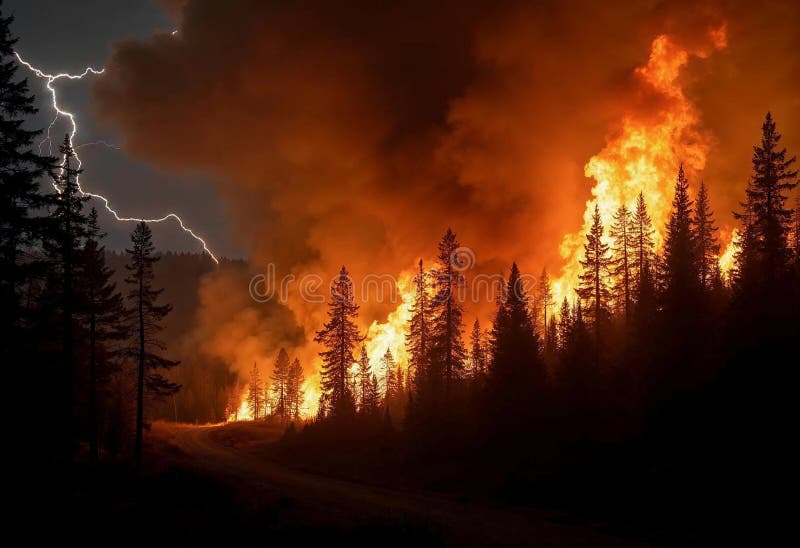
Three wildfires erupted in Salzburg, Austria, on Sunday evening following severe thunderstorms and lightning strikes, prompting emergency evacuations and firefighting operations in the regions of Hüttau and Werfenweng. Authorities confirmed that the blazes were brought under control within hours, though some areas remain under close monitoring due to lingering risks of flare-ups. The incident underscores growing concerns over extreme weather events in the Alpine region, where climate change has intensified both storm frequency and wildfire risks.
According to the Salzburg Fire Department, the three fires—all sparked by lightning—occurred around 20:30 local time in the Pongau district. Firefighters from multiple stations responded immediately, deploying helicopters and ground crews to suppress the flames. The largest blaze, near Hüttau, covered approximately 1.2 hectares before being contained, while smaller fires in Werfenweng were extinguished more quickly. No injuries were reported, though several homes in the vicinity were evacuated as a precaution.
The Austrian Meteorological Service (ZAMG) had issued storm warnings for the region earlier in the day, citing high winds, heavy rain, and a significant risk of lightning strikes. “Such conditions create ideal scenarios for wildfires, especially in dry, forested areas,” said a ZAMG spokesperson, noting that Salzburg has experienced above-average temperatures in recent weeks, exacerbating fire risks. The fires came just weeks after Austria declared a state of emergency over a prolonged drought, which has left vast stretches of forest and grassland parched and vulnerable.
Why Are Wildfires Increasing in Austria?
Climate experts attribute the rise in wildfires across Austria to a combination of prolonged droughts, rising temperatures, and more frequent extreme weather events. Data from the European Forest Institute shows that Austria recorded 1,200 wildfires in 2023—nearly double the average of the previous decade. The Salzburg region, in particular, has seen a 40% increase in lightning-induced fires since 2020, according to local environmental reports.
Dr. Markus Reichstein, a climate scientist at the Max Planck Institute for Biogeochemistry, explained that “the Alps are warming faster than global averages, and this directly correlates with longer dry seasons and more intense thunderstorms.” He added that while lightning strikes have always posed a fire risk, the current conditions—dry vegetation combined with high humidity in the air—create “a perfect storm” for uncontrollable blazes. The Austrian government has since allocated €50 million to wildfire prevention and response efforts, including increased aerial surveillance and community education programs.
How Are Authorities Responding to the Fires?
Firefighting teams from Salzburg, Tyrol, and Upper Austria collaborated to tackle the blazes, with support from the Austrian Air Force, which deployed two firefighting helicopters. The largest fire near Hüttau was declared under control by midnight, though crews remained on standby to monitor hotspots. “We’re treating this as a high-risk situation,” said Brigadier General Peter Mayer of the Salzburg Fire Department. “Even small embers can reignite if conditions remain dry, so we’re maintaining a strong presence in the area.”
Residents in affected areas were advised to avoid outdoor activities until further notice, while local authorities distributed sandbags and firebreaks in high-risk zones. The Austrian Red Cross set up emergency shelters for evacuated families, though most were allowed to return home once the fires were contained. Meanwhile, the Salzburg provincial government announced a review of wildfire preparedness protocols, including the expansion of early warning systems and the training of volunteer firefighters.
What Are the Long-Term Risks for Salzburg?
While the recent fires were relatively small, experts warn that Salzburg’s forested regions—home to some of Austria’s most biodiverse ecosystems—face growing threats. A report by the Austrian Environment Agency highlighted that 60% of Salzburg’s forests are at “high vulnerability” to wildfires due to climate change. “We’re seeing a shift from traditional forest management challenges to extreme weather-driven risks,” said Dr. Elisabeth Tasser, a forest ecologist at the University of Natural Resources and Life Sciences in Vienna.
Tasser noted that while controlled burns and forest thinning can reduce fire risks, funding and political will remain barriers. “Austria has made progress in wildfire prevention, but we’re still playing catch-up with the pace of climate change,” she said. The recent storms and fires have reignited debates over whether Austria needs a national wildfire task force, similar to those in countries like Canada and Australia, where such teams have proven critical in managing large-scale blazes.
Key Takeaways
- Three wildfires broke out in Salzburg on Sunday evening, all caused by lightning strikes during severe storms.
- Firefighters contained the largest blaze near Hüttau within hours, with no injuries reported but several evacuations.
- Climate change is increasing wildfire risks in Austria, with droughts and extreme weather making forests more vulnerable.
- Authorities are reviewing emergency response protocols and expanding early warning systems.
- Long-term solutions include forest management reforms and potential national wildfire task forces.
The next official update from the Salzburg Fire Department is expected by Wednesday, when a full assessment of fire damage and recovery efforts will be released. In the meantime, residents are advised to stay vigilant and report any smoke or unusual activity to emergency services. For real-time updates, the Austrian government’s disaster management portal provides live alerts and safety guidance.

Have you experienced severe weather or wildfires in your region? Share your stories in the comments below—or help spread awareness by sharing this report with others who may be affected.
Keep reading