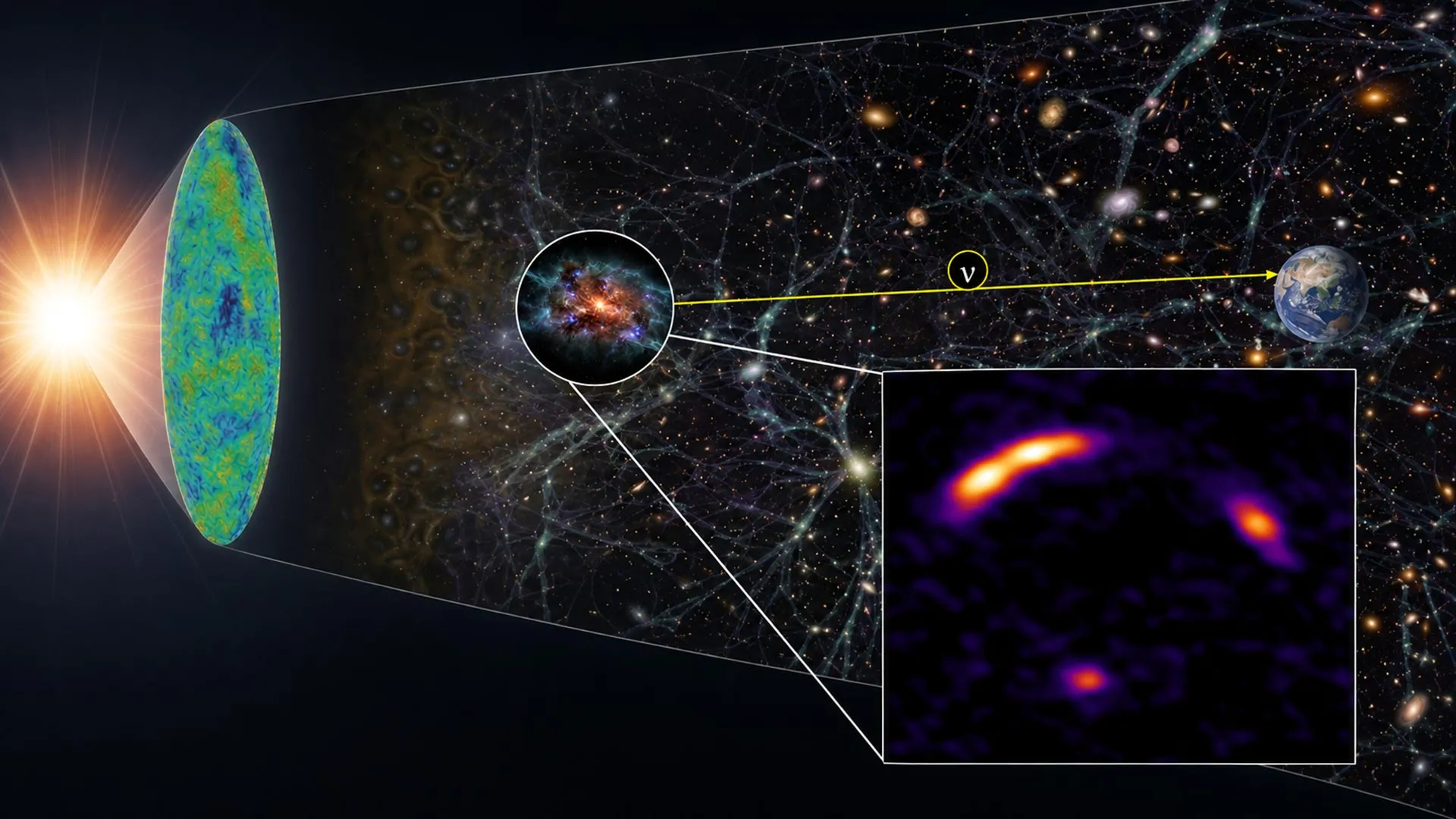
Astronomers have identified a massive, dust-obscured galaxy as a prolific source of high-energy cosmic neutrinos, challenging the long-standing assumption that only supermassive black holes could generate such particles. Observations of the galaxy, known as NGC 1068, indicate that intense star formation—rather than a central black hole—is likely driving the emission of these subatomic particles, according to data from the IceCube Neutrino Observatory.
The discovery, published in Science, suggests that starburst galaxies—regions of the universe where stars are born at an accelerated rate—may account for a larger portion of the high-energy neutrino flux detected on Earth than previously estimated by astrophysicists. By analyzing over a decade of data from the Antarctic-based detector, researchers have moved closer to mapping the origins of these elusive “ghost particles,” which travel across the cosmos largely unimpeded by matter or magnetic fields, as reported by the IceCube Collaboration.
Shifting the Search for Cosmic Neutrinos
For years, the scientific community focused primarily on active galactic nuclei (AGN) as the primary engines behind high-energy neutrinos. These are galaxies with supermassive black holes at their centers that consume surrounding gas and dust, emitting massive jets of radiation. However, the identification of NGC 1068 as a neutrino factory suggests that the “starburst” process is a significant, yet previously underestimated, contributor to the cosmic neutrino background.
According to the Nature reporting on the 2022 findings, the neutrinos detected from NGC 1068 appear to be produced in the dense environments where stars are formed. These environments are often shrouded in thick clouds of dust, making them difficult to observe with traditional optical telescopes. Neutrinos, however, pass through this dust, acting as a unique messenger that allows scientists to “see” into the heart of these obscured regions.
Why Starburst Galaxies Matter
The distinction between a black-hole-driven source and a starburst-driven source is significant for our understanding of galactic evolution. In a starburst galaxy, the rapid birth and death of massive stars create shockwaves and high-energy cosmic rays. When these rays interact with the surrounding gas, they produce neutrinos. This process provides a clearer picture of how galaxies regulate their own growth and distribute energy into the intergalactic medium.

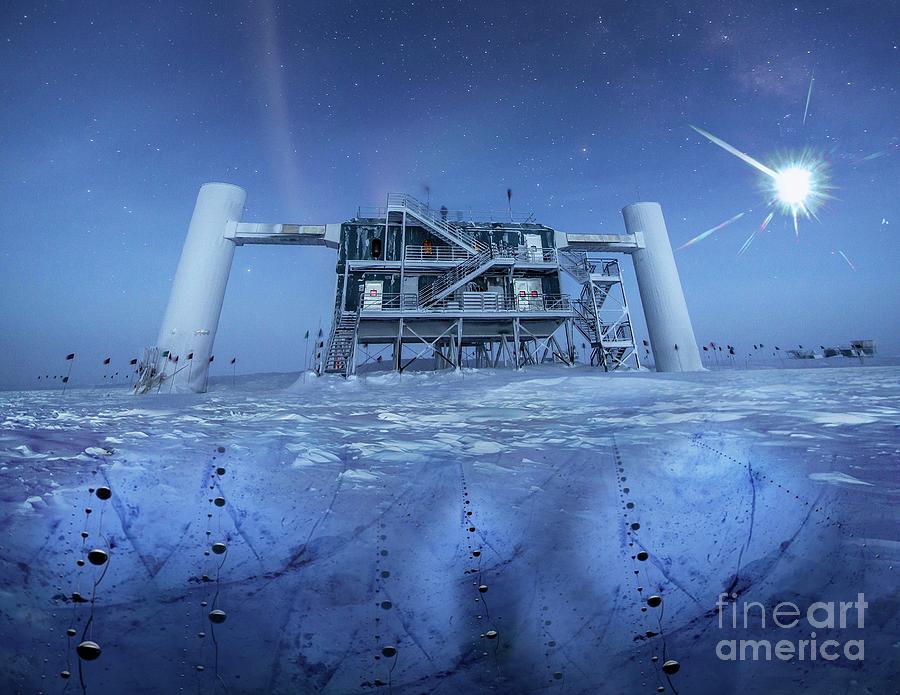
Researchers utilize the IceCube Neutrino Observatory, a cubic-kilometer array of sensors buried deep within the Antarctic ice, to detect the faint flashes of light produced when a neutrino interacts with an atom. Because neutrinos are notoriously difficult to capture, the observatory must monitor a massive volume of ice to catch even a handful of these particles. The recent identification of NGC 1068 required the processing of years of accumulated data to distinguish the signal from the background noise of atmospheric particles.
Future Observations and Next Steps
The scientific community now faces the challenge of determining how many other “neutrino factories” exist in the universe. If starburst galaxies are indeed common sources of these particles, it would imply that the high-energy universe is much more active than current models suggest. Astronomers are now looking to combine IceCube data with information from the James Webb Space Telescope (JWST) to better characterize the dust-filled environments of these distant galaxies, according to updates from the NASA scientific portal.
The next major milestone for this research involves the planned expansion of the IceCube array, known as IceCube-Gen2. This upgrade is intended to increase the observatory’s sensitivity by a factor of ten, allowing for the detection of lower-energy neutrinos and more precise localization of their sources. As of the latest project updates, the IceCube-Gen2 project is currently in the planning and development phase, with international partners coordinating the logistics for the next generation of deep-ice instrumentation.

This discovery underscores the importance of multi-messenger astronomy—the practice of using different types of signals, including light, gravitational waves, and neutrinos, to study the same celestial event. By integrating these diverse data streams, researchers hope to resolve long-standing questions about the most energetic processes in the universe. Readers interested in following the progress of the IceCube mission can monitor the official IceCube Neutrino Observatory website for upcoming data releases and publication updates.
What are your thoughts on how multi-messenger astronomy is changing our view of the cosmos? Join the conversation in the comments section below and share this report with your network.
Worth a look