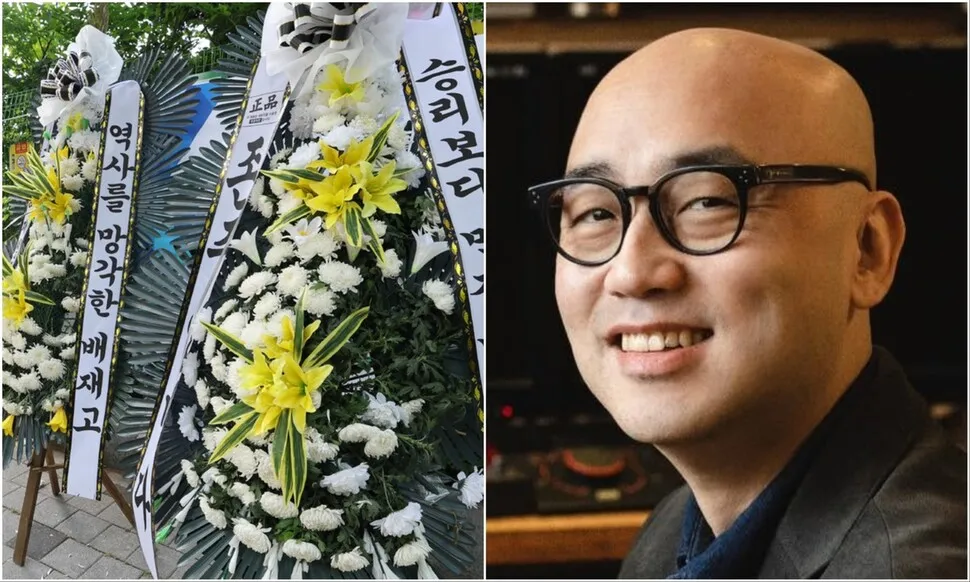
South Korean singer Harim, a relative of the May 18 Democratic Uprising victims, has publicly condemned the placement of funeral wreaths at Baejae High School, sparking a social media controversy where he was labeled a member of the far-right community Ilbe. Harim described the situation as a “comedy,” citing his identity as a bereaved family member of the May 18 Democratic Uprising while being accused of aligning with a group known for distorting that very history.
The dispute began after Harim criticized the sight of numerous funeral wreaths lined up at the entrance of Baejae High School. In a post shared via social media, Harim questioned the appropriateness of the display, asking, “Wouldn’t the children attending school be scared?” according to reports from Hankyoreh. The singer’s concern focused on the intimidating atmosphere created by the “parade” of wreaths at an educational institution.
Following his criticism, some social media users accused Harim of being an “Ilbe” member. Harim responded to these allegations by highlighting the irony of his personal history, stating that he is a bereaved family member of the May 18 victims.
Harim’s Response to Ilbe Allegations
Harim expressed disbelief at the accusations through a post on his social media, labeling the experience as a “comedy.” He pointed out the contradiction of being a bereaved family member of the May 18 Democratic Uprising while simultaneously being branded as a member of a community associated with the distortion of that event. According to Herald Economy, the singer emphasized the absurdity of the claim given his familial ties to the tragedy.
The May 18 Democratic Uprising occurred in 1980. Because Ilbe users often target the victims of this uprising with derogatory content, the accusation against Harim was viewed by supporters as a mischaracterization of his identity.
The Controversy Over Baejae High School Wreaths
The catalyst for this exchange was the appearance of funeral wreaths at Baejae High School. The visual impact of a “procession” of wreaths at a school gate drew Harim’s attention. He argued that such displays are inappropriate for an environment where students are attempting to learn and enter their campus without fear.
The incident has sparked a wider debate in South Korean media about the use of funeral wreaths as a form of protest. An editorial in Incheon Ilbo characterized such actions as “malicious acts done with flowers,” calling for an end to the practice of using funeral symbols in public spaces, particularly around schools.
Context of the May 18 Democratic Uprising
To understand the weight of the “Ilbe” accusation, it is necessary to look at the historical context of the May 18 movement. The uprising remains a deeply sensitive topic in Korean society, with the bereaved families continuing to fight for the full disclosure of the military’s actions in 1980.
For a bereaved family member like Harim, the accusation of belonging to Ilbe is a denial of his family’s suffering and the legitimacy of the democratic movement. The “comedy” Harim referenced refers to the gap between his lived reality as a victim’s family member and the digital persona attributed to him by critics.
As the discussion continues on social media, the focus has shifted from the appropriateness of the school wreaths to the volatility of online labeling in South Korea. Harim’s public response serves as a critique of how quickly individuals can be categorized into political extremes regardless of their actual background or stated positions.
Further updates regarding the school’s response to the wreath displays or official statements from the administration of Baejae High School are awaited.