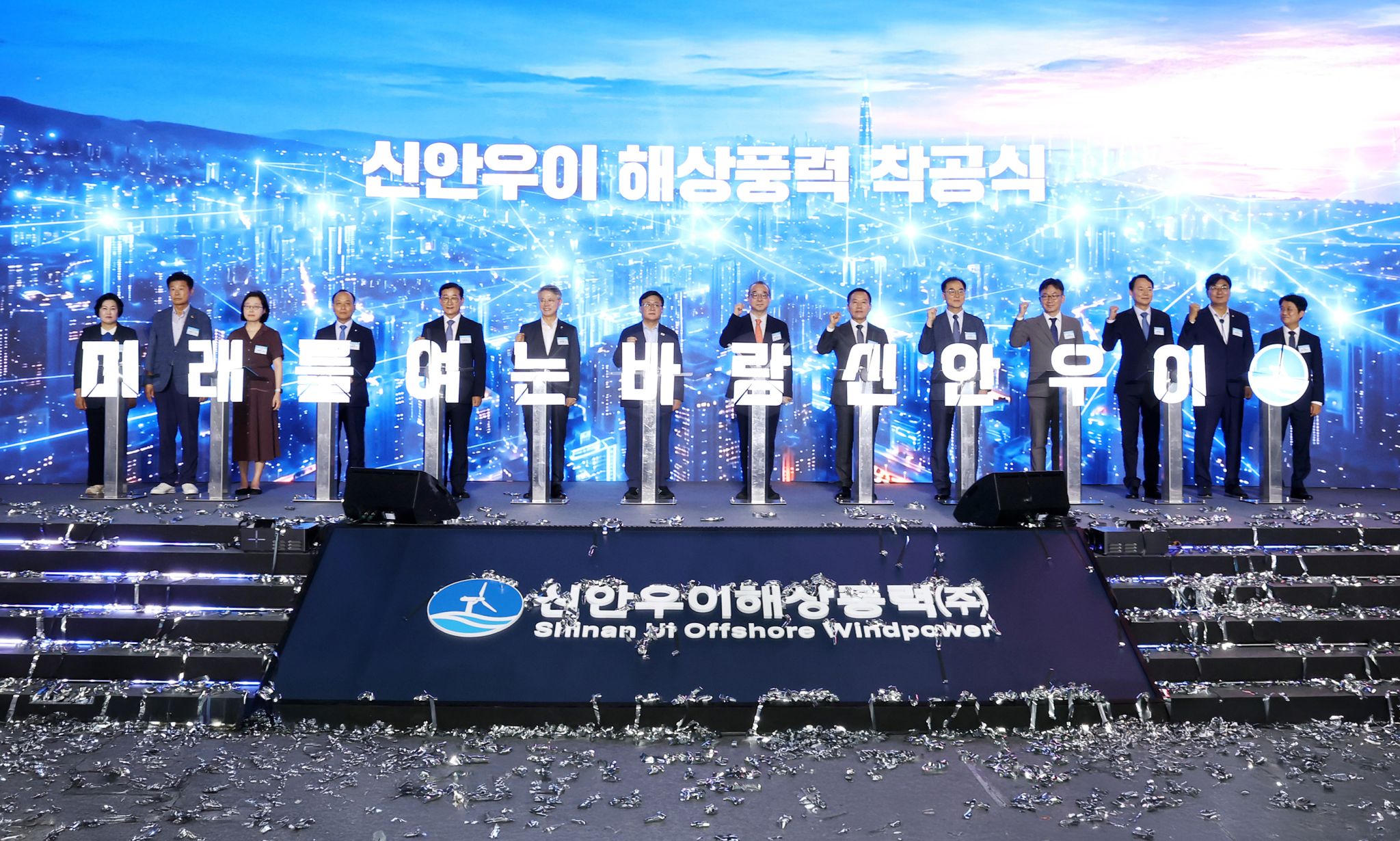
Construction has officially begun on the 390 MW Shinan Ui offshore wind farm in South Jeolla Province, South Korea. Driven by a coalition of domestic firms and funded entirely by local capital, the project is scheduled to reach commercial operation by January 2029, targeting an annual output sufficient to power 300,000 households.
Groundbreaking at Shinan County
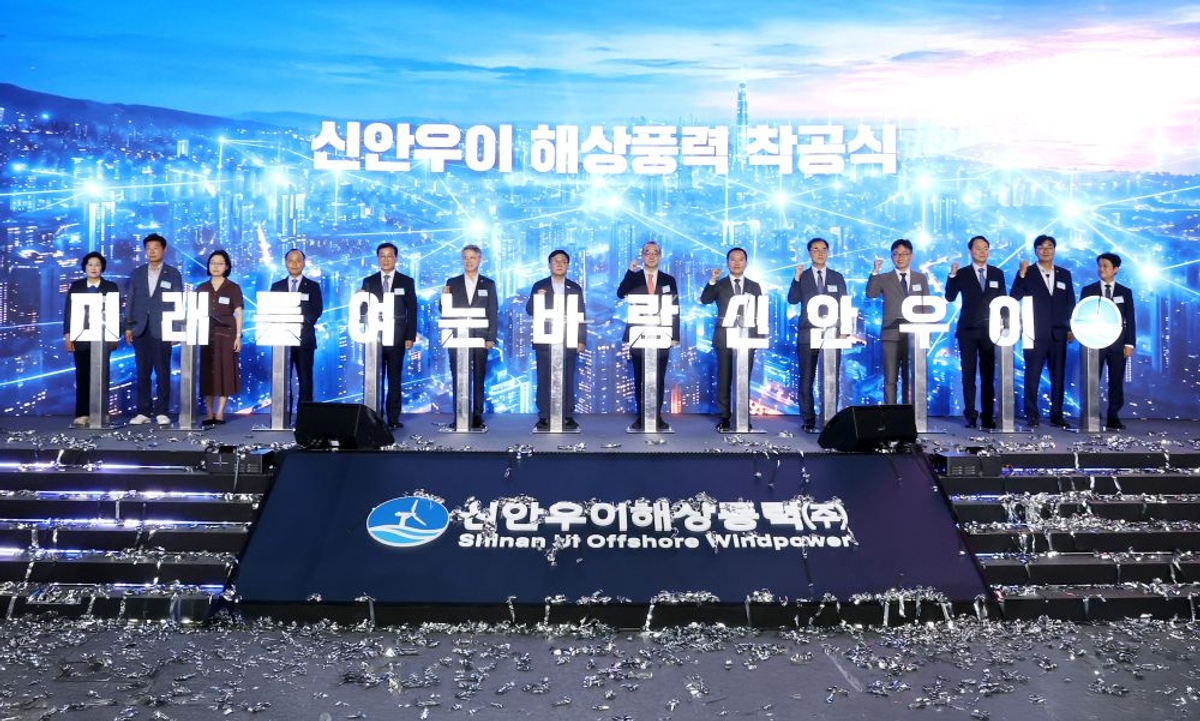
On July 16, officials gathered at the Jeonnam Shinan National Sports Center to mark the start of construction on the Shinan Ui offshore wind project. The ceremony signaled the transition of the 390 MW development from the planning phase to active construction in the waters near Uido-ri, Docho-myeon, Sinan County. Attendees included Minister of Climate, Energy and Environment Kim Seong-hwan, Hanwha Ocean President Jung In-sub, Jindo County Governor Lee Jae-gak, and Shinan County Governor Kim Tae-seong.
The project is spearheaded by a consortium that includes Hanwha Ocean, SK Eternix, KOMIPO (Korea Midland Power), the Future Energy Fund, and Hyundai Engineering & Construction. According to project disclosures, Hanwha Ocean is serving as both the lead developer and the primary EPC (engineering, procurement, and construction) contractor, overseeing project development, permitting, investment, engineering, procurement, and construction. Hyundai Engineering & Construction is participating as an EPC contractor, while KOMIPO will operate the wind farm for 25 years after it enters commercial operation.
Domestic Capital and Industrial Strategy
A defining characteristic of the Shinan Ui project is its reliance on domestic financial and industrial resources. Unlike many previous regional projects that depended on international financing or foreign technology, this development is backed entirely by local capital. The project is a national representative energy-transition project carried out in line with the government’s policy to expand renewable energy and its offshore wind industry promotion strategy.
To finance the massive upfront costs, the project was selected as the inaugural investment of the state-backed National Growth Fund. Together with the Future Energy Fund, public-backed financing provided 1.3 trillion won—roughly 40 percent of the total budget—ensuring financial stability and a timely start to construction. The total investment for the farm is estimated at 3 trillion won, or approximately $2.5 billion.
Technology and Supply Chain Integration
The company has procured major equipment centered on the domestic supply chain, excluding the turbines. In December 2023, Vestas signed a preferred supplier agreement for the project. If the project materializes, it will feature 26 units of V236-15.0 MW turbines, which will be installed on fixed foundations in the southeastern waters of Ui Island. Vestas will also deliver 20 years of operation and maintenance service for the wind farm when it becomes operational.
Purvin Patel, President of Vestas Asia Pacific, stated, We are honoured that our Korean partners, Hanwha Corporation E&C Division, have placed their trust in us and selected us as preferred turbine supplier for the project.
Nam Cheol Lee, Head of Wind Power Business at Hanwha Corporation E&C Division, added, We plan to strengthen our position as a leading company in the field of renewable energy by carrying out large-scale wind power projects that require high quality technology.
To facilitate the installation of these turbines, Hanwha Ocean is investing approximately 800 billion won (nearly EUR 500 million) into a next-generation wind turbine installation vessel (WTIV), which is expected to be deployed on the Shinan Ui project. This investment is aimed at strengthening the company’s offshore wind EPC and installation capabilities and supporting the development of South Korea’s offshore wind supply chain.
Regional Impact and Operational Outlook
Once completed, Korea Midland Power will secure a total offshore wind capacity of 550 MW, as the Shinan Ui project follows previous initiatives including the Southwest Offshore Wind Demonstration Complex (60 MW) and the Jeju Hallim Offshore Wind Farm (100.08 MW). The project is expected to contribute to stable electricity supply from local industrial complexes, revitalization of the regional economy, and job creation.

The project also utilizes a sea breeze income
model, which is a win-win approach to be applied to the development. As construction progresses toward the 2029 target, stakeholders continue to emphasize the role of the site in the broader national energy transition and the company’s goal of strengthening its offshore wind operating competitiveness.
Sources: Offshorewind, 매일경제.
Keep reading