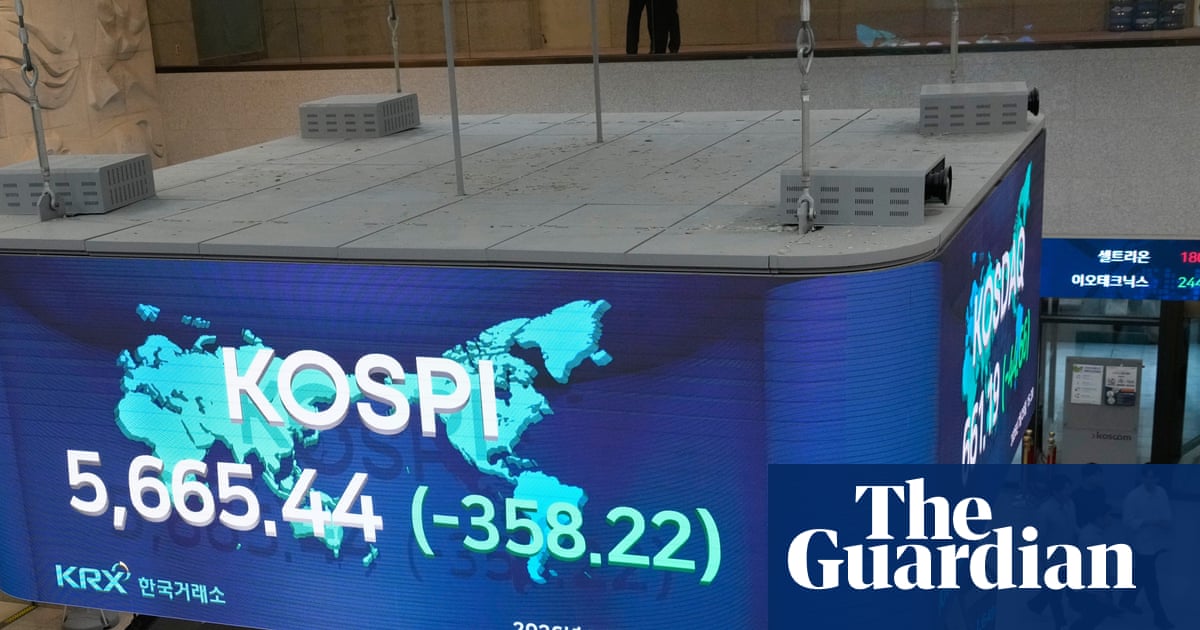
South Korea’s Kospi index plummeted 6% on Wednesday, extending a two-day rout that wiped up to $2.18 trillion from the equity market. The sell-off was triggered by disappointing earnings from chipmaker SK Hynix and fueled by the forced unwinding of leveraged retail positions.
SK Hynix Earnings Miss Sparks Seoul Market Rout
South Korea’s stock market experienced a brutal reckoning on Wednesday, with the benchmark Kospi index plunging 6% by the closing bell. The session followed a near 11% slump the previous day, putting the market on course for its steepest monthly decline on record. At its lowest point during trading, the semiconductor-heavy index slid as much as 12.6%, wiping an astonishing $2.18 trillion from Seoul’s equity market values and leaving retail investors reeling.
The turmoil was initially sparked by quarterly financial results from SK Hynix. Even though the prominent chipmaker reported a sixfold surge in operating profit, the numbers still fell short of lofty analyst expectations.
“SK Hynix delivered strong results, but in today’s AI market, strong is no longer enough.”
Gary Tan, portfolio manager at Allspring Global Investments in Singapore
Market analysts pointed out that investors were hunting for additional catalysts, specifically targeting long-term agreements and heightened shareholder returns to sustain a memory sector that serves as the epicentre of the global AI trade. Consequently, SK Hynix shares dropped by as much as 16% before trimming losses to close down 9.6% on the session. Fellow semiconductor titan Samsung Electronics fell 5.2% after sliding as much as 14% earlier in the day.
Leveraged Retail Trading Amplifies Panic Selling in Seoul
The severity of the crash laid bare the risks embedded in South Korea’s retail trading ecosystem. Much of the buying frenzy that pushed the Kospi to a peak just a little over a month ago was fueled by small-time investors utilizing borrowed money to maximize their exposure. When momentum reversed, that dynamic accelerated the downward spiral.

Brokers forcibly shut down losing positions as panic selling took hold, preventing any meaningful market rebound. Finance Minister Koo Yun-cheol faced intense pressure from lawmakers during a parliamentary session, where he apologized for the introduction of single-stock leveraged exchange-traded funds and admitted they had not been considered carefully enough.
During the parliamentary hearing, a lawmaker noted that the governor of the Bank of Korea, Finance Minister Koo, and the heads of financial regulators would convene on Wednesday afternoon to discuss emergency stabilization measures. Those discussions follow tighter regulations announced just two weeks prior on July 16 to cool an overheated ETF investment boom.
Benzimra added that the hardest-hit equities are predictably those carrying the heaviest leverage, noting the difficulty in predicting when the liquidation cycle will finally bottom out.
Broad Asian Semiconductor Decline and Safe-Haven Shifts
The contagion quickly spread across regional chip manufacturing hubs. In Taiwan, shares of TSMC fell 3.5% in Taipei, while foundry peer UMC tumbled 9.7%. Japanese memory chipmaker Kioxia experienced a steep 13.9% drop, and Tokyo Electron sank 10.6% on the Nikkei 225, which ultimately finished the day down 1.5%.
Meanwhile, global investors fleeing high-flying technology names sought shelter in reliable consumer strongholds. Apple shares briefly surged to push the iPhone manufacturer past the $5tn (£3.76tn) valuation mark, making it the second ever company to cross that threshold.
As equity markets reeled, macroeconomic pressures added further friction. Oil prices rebounded following an escalation in the Middle East conflict, with Brent crude climbing 3.1% to $84.58 a barrel and hitting $87.14 in early trading according to international benchmark trackers, after air defenses intercepted missiles over Jordan and military forces struck militia sites in Iraq.
Related reading