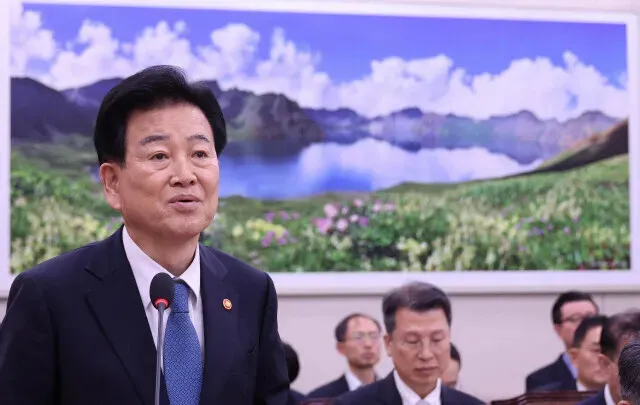
In a move to de-escalate a growing domestic political firestorm, South Korea’s Ministry of Unification has clarified that the “peaceful two-state” concept outlined in its recent Unification White Paper is a strategic framework intended for peaceful coexistence, rather than a formal legal recognition of North Korea as a sovereign state.
The clarification comes amid intense scrutiny from political leaders and legal scholars who argue that shifting the terminology of inter-Korean relations could fundamentally undermine the constitutional mandate of the Republic of Korea (ROK). For decades, the official stance of Seoul has been predicated on the principle of eventual reunification, viewing the North not as a separate country, but as a territory currently under illegal occupation.
The Ministry’s distinction is critical: it seeks to manage the practical reality of two separate entities existing on the Korean Peninsula to prevent military conflict, while maintaining the legal fiction—or legal reality, depending on the perspective—that the North remains part of the ROK’s sovereign claim. This nuance is intended to provide a roadmap for stability in an era where North Korean leadership has increasingly signaled a desire to abandon the goal of peaceful reunification.
Navigating a New Diplomatic Reality
The controversy stems from the latest Unification White Paper, which introduces language suggesting a transition toward a “peaceful two-state” relationship. This shift in rhetoric marks a significant departure from previous administrations, which focused heavily on the “one nation, two systems” or “unification-first” models. The new approach appears to be a pragmatic response to the deteriorating security environment on the peninsula.
According to officials within the Ministry of Unification, the “two-state” terminology is a “coexistence strategy.” The goal is to establish a framework where both sides can exist without constant threat of war, acknowledging that the current status quo is one of two distinct political and social systems operating in close proximity. By framing it as a strategy for coexistence, the Ministry aims to create a buffer of stability, even as the ideological bridge toward reunification becomes increasingly fragile.
This strategic pivot is largely seen as a reaction to the aggressive stance taken by Pyongyang. In recent months, North Korean leader Kim Jong Un has fundamentally redefined the relationship, labeling the South as a “hostile state” and explicitly discarding the long-standing goal of peaceful reunification. As North Korea moves toward a formal declaration of separation, Seoul is attempting to find a middle ground that manages the tension without conceding its constitutional identity.
The Constitutional Dilemma
Despite the Ministry’s attempts to frame the move as purely strategic, the political backlash in Seoul has been swift. The primary point of contention lies in the ROK Constitution, which serves as the ultimate legal authority for the South Korean state. Article 3 of the Constitution explicitly states: “The territory of the Republic of Korea shall consist of the Korean Peninsula and its adjacent islands.”
Critics, led by members of the ruling People Power Party, argue that adopting “two-state” language is a “manifest violation” of this constitutional principle. The argument is twofold: first, that recognizing the existence of two states implies that the ROK’s territorial claim is no longer absolute; and second, that it creates a legal loophole that could be used to justify the permanent division of the peninsula.
Legal experts have noted that the distinction between “functional coexistence” and “legal recognition” is a narrow one. While the Ministry argues that they are merely describing the current state of affairs to prevent war, opponents argue that once the state begins to act as though it is dealing with a foreign neighbor rather than a domestic insurgent or a breakaway province, the constitutional foundation begins to erode. This debate has effectively turned the Unification White Paper into a political battlefield, with the opposition accusing the administration of abandoning the very essence of the South Korean state.
Key Takeaways: The “Two-State” Controversy
- The Ministry’s Position: The “peaceful two-state” concept is a strategy for coexistence and conflict prevention, not a legal recognition of North Korean sovereignty.
- The Constitutional Conflict: Article 3 of the ROK Constitution defines the nation’s territory as the entire Korean Peninsula, making “two-state” rhetoric legally contentious.
- The Driver of Change: North Korea’s recent shift toward declaring the South a “hostile state” has forced Seoul to reconsider its traditional reunification-centric approach.
- Political Impact: The ruling party has labeled the new direction a constitutional violation, sparking intense debate in the National Assembly.
Geopolitical Implications and the Path Ahead
Beyond the domestic legalities, the shift in South Korean policy carries significant weight for regional and global security. For decades, the international community has operated under the assumption that the ultimate goal for the Korean Peninsula is reunification. A formal or semi-formal move toward a “two-state” reality could alter the calculus for major powers, including the United States, China, and Japan.

If South Korea officially moves toward a coexistence model, it may change the nature of diplomatic engagement. Instead of focusing on “denuclearization for reunification,” the focus might shift toward “stability through coexistence.” While this could reduce the immediate risk of accidental military escalation, it also raises questions about the long-term viability of the international sanctions regime currently aimed at North Korea.
the internal political rift in Seoul could complicate South Korea’s ability to present a unified front in international forums. If the administration’s unification policy is viewed as unconstitutional or politically unstable, it may diminish the credibility of South Korea’s leadership on North Korean affairs.
As the debate continues, the Ministry of Unification faces the daunting task of balancing the need for a realistic security strategy with the imperative to uphold the nation’s founding legal principles. The coming months will likely see further legislative challenges and official clarifications as the government attempts to navigate this unprecedented shift in inter-Korean relations.
Next Steps: Observers are closely watching the upcoming sessions of the South Korean National Assembly, where further debates on the Unification White Paper and potential constitutional challenges are expected to take place.
What are your thoughts on South Korea’s strategic shift? Does a “peaceful coexistence” model offer more stability, or does it undermine the nation’s long-term goals? Let us know in the comments below and share this article with your network.
Related reading