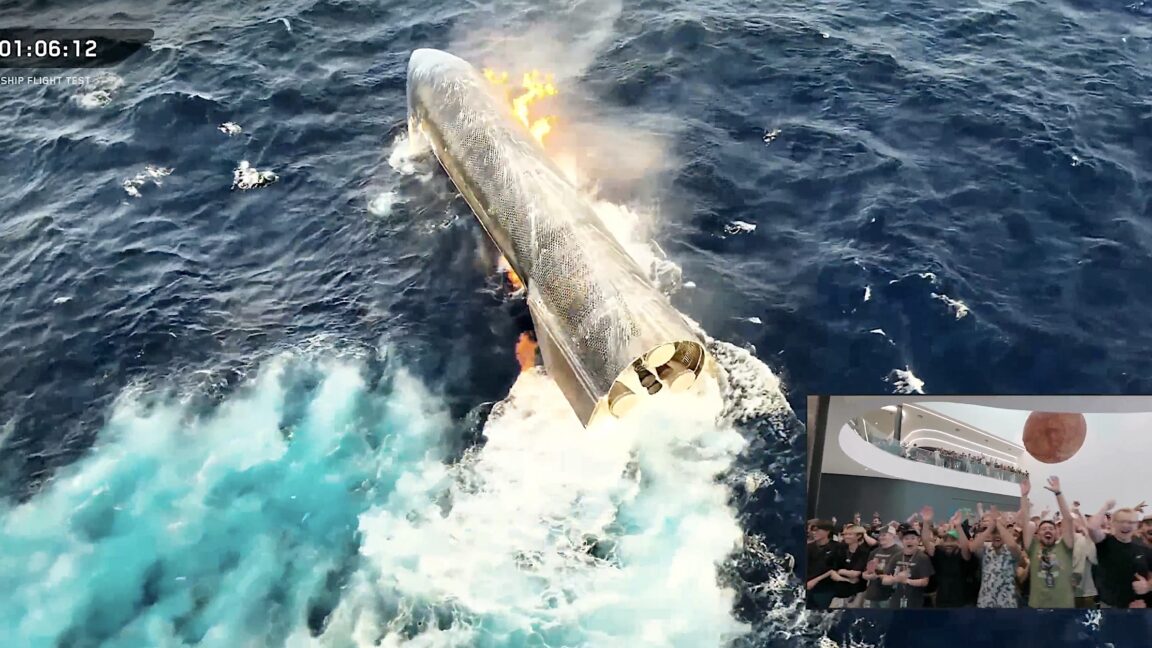
SpaceX successfully completed the 13th full-scale test flight of its Starship rocket on Friday, sending the vehicle on an hour-long suborbital trajectory from South Texas to an intact splashdown in a remote section of the Indian Ocean. While previous water landings resulted in explosive destructions, this flight concluded with the buoyant spacecraft coming to rest upright and floating west of Australia, according to company officials.
The milestone provides engineers with vital data on the performance of the vehicle’s thermal protection system. Following the splashdown, SpaceX deployed drones to inspect the more than 18,000 ceramic tiles insulating the stainless steel airframe. These tiles withstood temperatures reaching up to 2,600 degrees Fahrenheit (1,430 degrees Celsius) during atmospheric reentry, enduring significantly higher dynamic pressure on the ascent than previous iterations.
Encouraged by the successful landing, company founder and CEO Elon Musk indicated that SpaceX plans to attempt a tower catch of the ship on its next flight. If cleared by mission data reviews, the upcoming test will feature a longer-range trajectory designed to bring the spacecraft back to its launch site, where mechanical arms on the launch tower will attempt to capture it mid-air as it slows to a hover.
Data Collection and Heat Shield Durability
Refining the durability of the heat shield remains one of the primary engineering hurdles for the Starship program. Because SpaceX ultimately intends to achieve rapid turnaround times with multiple flights per day, the insulation tiles cannot be routinely replaced or refurbished after every mission. Surviving extreme thermal and vibrational stresses without major structural failure is essential for operational reuse.
“This is the first time we’ve put an intact Starship in the water,” said Dan Huot, a SpaceX communications manager providing commentary on the company’s live webcast. “This is a dream scenario for the team that’s trying to get this heat shield data.”
The intact recovery opens up possibilities for towing the vehicle to shore—likely in Australia—for more comprehensive metallurgical and structural evaluations. Although Starship is built for reuse, exposure to corrosive salt water presents new post-flight challenges that engineers must evaluate to prepare the fleet for commercial operations.
Launch Mechanics and Booster Recovery Progress
Friday’s mission marked the 13th launch of Starship integrated with its Super Heavy booster, and the second flight of Starship Version 3. The 408-foot-tall (124-meter) rocket lifted off from Starbase, Texas, near the US-Mexico border, at 5:51 p.m. CDT. Thirty-three methane-fueled Raptor engines powered the Super Heavy booster during ascent before stage separation occurred over the Gulf of Mexico.
While the booster successfully completed the high-thrust portion of its boostback burn using all 33 engines for the first time on a Version 3 vehicle, subsequent relight attempts for the landing burn fell short. Several engines failed to ignite properly, causing the booster to experience a hard splashdown in the Gulf.
Orbital Capabilities and Starlink V3 Deployment
As the booster descended toward the Gulf, Starship continued its ascent into space, firing its six Raptor engines before initiating a 30-minute coast over the Caribbean Sea, Atlantic Ocean, and South Africa. Shortly after engine shutdown, the spacecraft opened its payload bay doors to deploy a test stack of 20 upgraded Starlink V3 satellites.
The V3 satellites feature substantial improvements in power and data throughput compared to earlier models. Because they are larger and heavier than Version 2 units, they exceed the payload capacity of SpaceX’s Falcon 9 rocket and require Starship for deployment. Using a specialized Pez-like dispenser, the spacecraft released the flat-panel satellites onto the suborbital path.
Although these particular test units were designed to burn up during atmospheric reentry less than an hour after launch, ground teams established radio and laser communication links to download key telemetry. This exercise provided the engineering team with critical operational data regarding the performance of Starlink V3 hardware in space.

Following the satellite drop, engineers executed a successful 14-second restart of a single Raptor engine—a test omitted during the previous flight—demonstrating core maneuvering capabilities required for future orbital missions.
Implications for Commercial Operations and NASA’s Artemis Program
Achieving stable orbital flight and returning the vehicle to the launch site will clear the path for launching operational Starlink V3 constellations. These deployments are expected to expand high-speed, direct-to-device connectivity for consumer markets and government users alike.
For NASA, mastering orbital flight is a prerequisite for executing orbital refueling demonstrations, which are required for missions beyond low-Earth transport, including lunar landings under the Artemis program. SpaceX and Blue Origin are currently developing human-rated lunar landers to ferry astronauts to and from the Moon’s surface.

“Excited for what will be learned from this mission,” NASA Administrator Jared Isaacman wrote on X after the launch of Flight 13. “When Starship comes online, its capabilities will be game-changing, not least of which will be ensuring we never give up the Moon again!”
To prepare for lunar missions, SpaceX is constructing additional Starship launch sites at Kennedy Space Center and Cape Canaveral Space Force Station in Florida, complementing its existing infrastructure in Texas. Orbital refueling will require automated rendezvous, docking, and cryogenic propellant transfers between multiple vehicles, setting a demanding technical agenda for the upcoming flight test campaign.
SpaceX has not yet announced an official target date for Flight 14, pending the completion of engineering data reviews from the Indian Ocean splashdown.