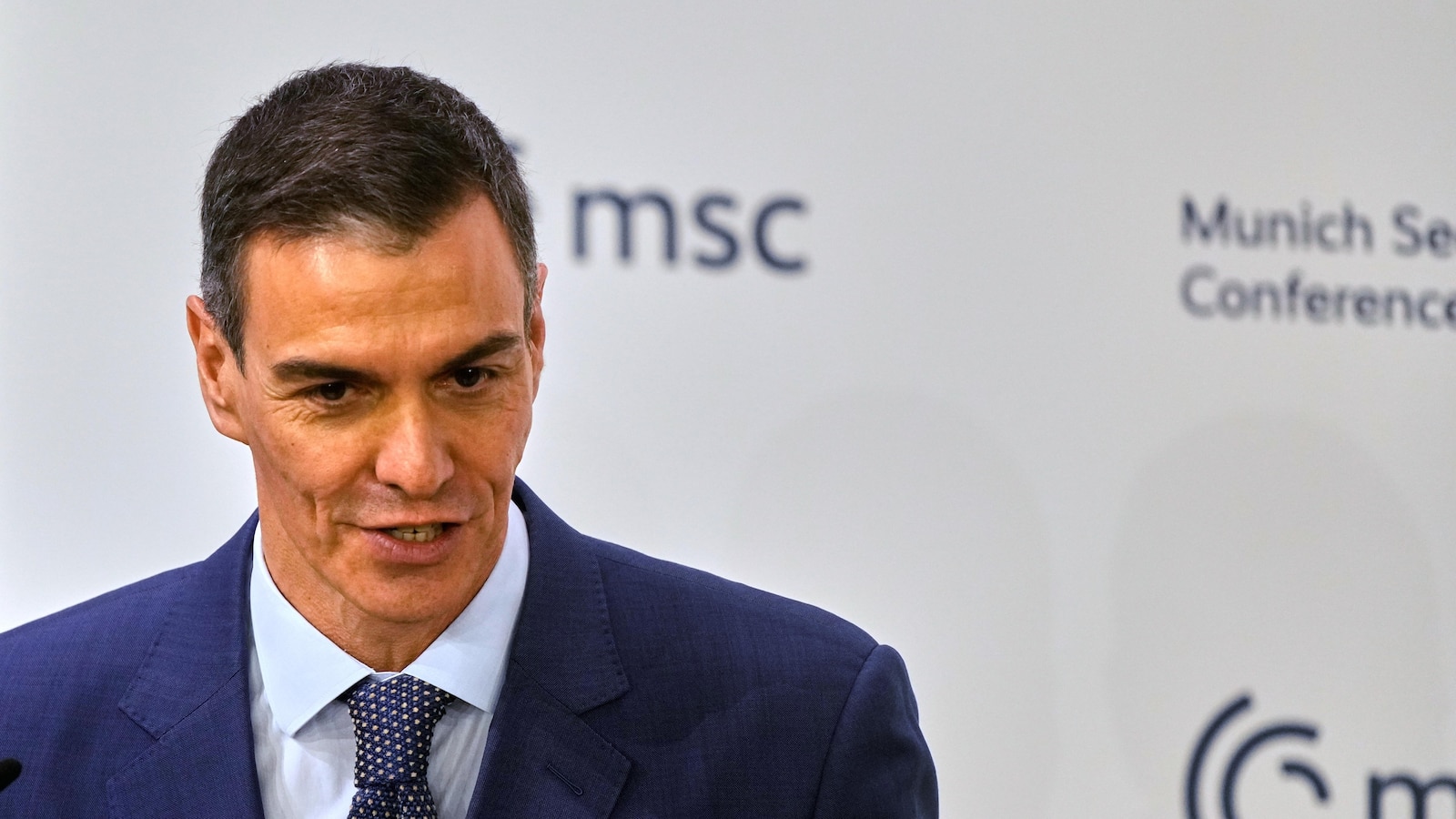
Madrid – Spanish Prime Minister Pedro Sánchez has reaffirmed his government’s opposition to military intervention in Iran, directly challenging a threat from former U.S. President Donald Trump to impose a full trade embargo on Spain. The escalating tensions stem from Madrid’s refusal to allow the United States to utilize jointly-run military bases in Spain for potential strikes against Iran. Sánchez’s firm stance underscores a growing divergence in transatlantic policy and raises questions about the future of security cooperation between Washington and key European allies.
The dispute unfolded publicly this week, with Trump accusing Spain of being a “terrible partner” in NATO and threatening severe economic consequences. Sánchez responded with a robust defense of his nation’s commitment to peace and international law, framing the situation as a choice between diplomacy and escalating conflict. This confrontation is not isolated; it reflects a pattern of strained relations between the Sánchez administration and the Trump administration, marked by disagreements over defense spending, Venezuela, and the Israeli-Palestinian conflict.
The core of the disagreement lies in Spain’s unwillingness to permit the use of its military facilities – specifically the Morón and Rota bases – as launchpads for potential U.S. Military action against Iran. These bases, strategically located in southern Spain, are crucial for U.S. Operations in the region, but ultimately remain under Spanish command. Trump asserted that the U.S. “could just fly in and use it,” but Sánchez’s government has maintained its position, prioritizing a diplomatic resolution to the escalating tensions in the Middle East. The BBC reported on Sánchez’s rebuttal, highlighting his emphasis on avoiding further conflict. https://www.bbc.com/news/articles/c93wwq1n542o
Trump’s Trade Threat and EU Implications
Trump’s threat to cut off all trade with Spain has raised significant questions about its feasibility and potential impact. As a member of the European Union, Spain’s trade relations are largely governed by the EU’s common commercial policy. The European Commission negotiates trade agreements on behalf of all 27 member states, meaning the U.S. Would require to pursue a trade dispute with the entire bloc, a considerably more complex undertaking.
German Chancellor Friedrich Merz reportedly informed Trump that a separate trade agreement with Germany, excluding Spain, was not viable. This intervention underscores the EU’s commitment to solidarity among its members and its resistance to unilateral pressure from external actors. The Guardian noted Sánchez’s comparison of the situation to “Russian roulette with the destiny of millions,” emphasizing the high stakes involved. https://www.theguardian.com/world/2026/mar/04/pedro-sanchez-donald-trump-threat-cut-off-trade-spain
the U.S. Supreme Court recently struck down Trump’s attempts to impose sweeping global tariffs, citing limitations on presidential emergency powers. While the court’s decision did not preclude the possibility of targeted embargoes, it significantly constrained the former president’s ability to unilaterally impose broad trade restrictions. However, Trump has maintained that the ruling still allows for the imposition of full-scale embargoes on nations of his choosing.
Sánchez’s Broader Critique of Military Intervention
Sánchez’s response to Trump’s threats extended beyond a defense of Spanish sovereignty. He delivered a televised address Wednesday, invoking the lessons of past military interventions, including the Iraq War, and warning against repeating “the mistakes of the past.” He explicitly stated his government’s position as “no to war,” emphasizing a commitment to peaceful resolution and adherence to international law. This stance aligns with Spain’s previous criticisms of Israel’s actions in Gaza and its broader advocacy for de-escalation in the Middle East.
The Spanish Prime Minister characterized the ongoing U.S. And Israeli strikes against Iran as a “disaster,” warning of a spiraling conflict with potentially catastrophic consequences. He cautioned against responding to “one illegality with another,” arguing that such a cycle of escalation would only exacerbate the crisis and undermine global stability. CNBC reported Sánchez’s warning about “playing Russian roulette with the fate of millions.” https://www.cnbc.com/2026/03/04/spain-pm-sanchez-trump-trade-nato-defense-iran-israel-crisis.html
NATO and Defense Spending Concerns
Trump likewise used the occasion to reiterate his long-standing criticism of Spain’s defense spending, accusing the country of failing to meet the NATO target of 2% of GDP. He went further, demanding that Spain increase its defense budget to 5% of GDP, a level significantly higher than the alliance’s agreed-upon benchmark. This issue has been a recurring point of contention between the U.S. And several European allies, with Trump consistently pressuring them to increase their military contributions.
While many NATO members have pledged to increase defense spending in recent years, achieving the 2% target remains a challenge for some. Spain’s current defense budget is below this threshold, and a substantial increase to 5% of GDP would require significant budgetary adjustments. The disagreement over defense spending underscores the broader tensions within NATO regarding burden-sharing and the future direction of the alliance.
The Broader Context: Spain-U.S. Relations
The current dispute over Iran represents the latest in a series of friction points between Spain and the U.S. Under the Trump administration. Spain was also a vocal critic of the U.S. Military incursion into Venezuela earlier this year, drawing further ire from Washington. These disagreements highlight a growing divergence in foreign policy priorities and a willingness on the part of the Sánchez government to assert its independence from U.S. Influence.
Spain’s commitment to multilateralism and its emphasis on diplomatic solutions contrast sharply with the more unilateral and confrontational approach often favored by the Trump administration. This difference in perspective is likely to continue shaping the relationship between the two countries, even as the political landscape in the U.S. Evolves.
The situation also reflects a broader trend of European nations seeking greater strategic autonomy and a more independent foreign policy. Driven by concerns about U.S. Reliability and a desire to protect their own interests, European countries are increasingly willing to challenge Washington’s leadership and pursue alternative approaches to global challenges.
Key Takeaways:
- Former U.S. President Trump threatened a trade embargo against Spain for refusing to allow U.S. Access to military bases for potential strikes against Iran.
- Spanish Prime Minister Pedro Sánchez firmly rejected the threat, reaffirming his government’s commitment to peace and international law.
- The dispute highlights a growing divergence in transatlantic policy and raises questions about the future of U.S.-European security cooperation.
- Spain’s position is rooted in its commitment to multilateralism and its skepticism towards military intervention.
- The feasibility of Trump’s trade threat is limited by the EU’s common commercial policy.
Looking ahead, the immediate focus will be on de-escalating tensions in the Middle East and preventing a wider conflict. The outcome of this crisis will likely have significant implications for the future of U.S.-European relations and the global balance of power. Further developments are expected as the EU assesses the situation and considers its response to Trump’s threats. Readers can stay informed through updates from the European Commission and statements from NATO officials.
What are your thoughts on the situation? Share your comments below and let us grasp what you think.
Worth a look