
For the past year, a phenomenon known as “vibe coding” has captured the imagination of the tech community. It described a world where non-developers and junior engineers could manifest complex applications simply by describing them to an AI, bypassing the traditional rigors of syntax, and architecture. While this lowered the barrier to entry and accelerated prototyping, it likewise introduced a significant amount of “slop”—code that works by chance but lacks the stability, security, and scalability required for professional environments.
We are now entering a second phase of AI-assisted engineering. The industry is shifting from the novelty of rapid prototyping to the necessity of spec-driven development, a methodology designed to bring discipline to agentic AI. For enterprise-scale software, the goal is no longer just to generate code that “vibes” with the user’s intent, but to produce viable, verifiable code that can be trusted in a production environment.
At the center of this transition is Kiro, an agentic AI development tool launched by Amazon. Designed to move developers from “vibe coding to viable code,” Kiro leverages autonomous agents to manage the entire software lifecycle—from initial project plans and technical specifications to the final code documentation via Kiro’s official platform. By centering the process on a structured specification, AWS aims to eliminate the volatility often associated with autonomous AI coding.
The Trust Model: Why Specifications Matter
The primary challenge of agentic coding at scale is trust. While an AI can write a function in seconds, verifying that the function behaves correctly across every edge case in a massive codebase is a daunting task for human reviewers. Spec-driven development addresses this by establishing a “trust model” where the specification acts as the single source of truth.
Rather than jumping directly from a natural language prompt to code, Kiro transforms a developer’s intent into clear requirements and acceptance criteria using EARS (Easy Approach to Requirements Syntax) notation according to Kiro’s development experience. This structured approach makes constraints explicit, ensuring that the AI agent reasons against a concrete set of rules throughout the development process.
Once requirements are locked, the system analyzes the existing codebase to propose an architecture, system design, and appropriate tech stack. This prevents the AI from introducing incompatible patterns or redundant libraries, a common pitfall in one-shot AI generation. The process then breaks the project into discrete, sequenced tasks based on dependencies, allowing developers to oversee the implementation plan before a single line of code is written.
Moving Beyond One-Shot Programming
Traditional AI coding assistants typically operate on a “one-shot” basis: a user provides a prompt, the AI generates a block of code, and the human manually checks if it works. In an enterprise setting, where developers may be managing hundreds of check-ins per week, this manual loop becomes a bottleneck.
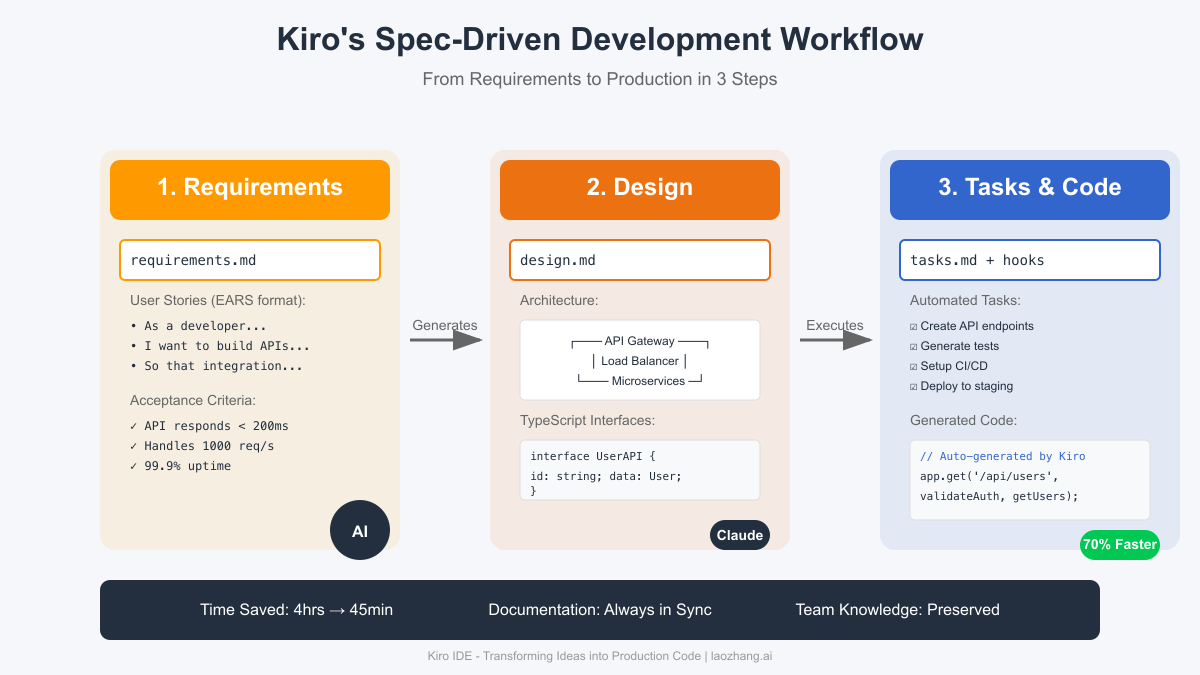
Spec-driven development enables a shift toward continuous autonomous development. In this model, the specification serves as an automated correctness engine. Agents can run in a continuous loop, feeding build and test failures back into their own reasoning and iterating until the output is functional and verifiable. This self-correction mechanism is anchored by the spec, preventing the agent from “drifting” away from the original intent.
This level of autonomy is critical for safety. During the AWS re:Invent keynote, AWS chief Matt Garman highlighted the need for these safeguards, noting that Kiro is designed to avoid the catastrophic pitfalls of unconstrained AI development, such as accidental database wipeouts or surprise drive deletions as reported by The Register.
Scaling with Frontier Agents and Multi-Agent Systems
To handle the complexity of enterprise software, AWS has introduced “frontier agents” that extend the capabilities of the Kiro IDE. These agents are designed to operate across the entire development lifecycle, moving beyond simple code completion to handle high-level orchestration.
- Autonomous IDE Integration: Kiro increases the autonomy of the development environment, allowing it to maintain awareness across sessions and learn from pull requests and feedback.
- DevOps Automation: New agents focus on triaging DevOps issues and pushing code to repositories while simultaneously checking for security vulnerabilities.
- Cross-Repository Management: Unlike basic AI tools, these agents can handle tasks that span multiple repositories, reducing the friction of manually coordinating changes across a distributed system per AWS announcements.
These agents often operate in parallel. In advanced workflows, multiple agents may be deployed to critique a single problem from different perspectives, while others focus on specific components of the system. This multi-agent approach allows for a level of rigor that mimics a human peer-review process, but at a fraction of the time.
The Infrastructure of Autonomous Coding
For agentic AI to be viable at scale, the underlying infrastructure must evolve. Local execution is often insufficient for the token-heavy demands of long-running agents. The industry is moving toward cloud-based agent execution, where workloads can run in parallel with enterprise-grade governance, cost controls, and reliability guarantees.
Kiro provides a highly interactive loop through a CLI (Command Line Interface) that supports macOS, Linux, and Windows, including headless CI/CD support via its installation documentation. This allows agents to be integrated directly into the developer’s existing workflow, whether they are working locally or over SSH. “agent hooks” allow developers to delegate tasks to AI agents that trigger automatically on specific events, such as saving a file, further compressing the delivery timeline.
Key Technical Shifts in Agentic Development
| Feature | Vibe Coding (Early AI) | Spec-Driven Development (Agentic AI) |
|---|---|---|
| Input | Natural language prompts | Structured specs (e.g., EARS notation) |
| Verification | Manual human review | Automated correctness engines / Property-based testing |
| Scope | Single files or snippets | Multi-repository orchestration |
| Workflow | One-shot generation | Continuous autonomous iteration |
| Reliability | High risk of “slop” or regressions | Verifiable against defined properties |
The Future Role of the Software Engineer
The rise of spec-driven development does not eliminate the need for expert developers; rather, it redefines their role. The focus is shifting from writing syntax to designing systems. In this new paradigm, a significant portion of a developer’s time is spent crafting the specification and “steering files” that guide the AI. The expertise lies in defining what “correct” looks like and establishing the boundaries within which the agent operates.
As LLMs become more token-efficient and agents gain the ability to write their own specifications for self-correction, the distance between a concept and a deployed feature will continue to shrink. The developers who thrive in this environment will be those who prioritize testability, verification, and system architecture over the ability to manually write boilerplate code.
With the introduction of these frontier agents and the formalization of spec-driven workflows, the industry is moving toward a future where autonomous agents are not just assistants, but collaborators capable of managing the heavy lifting of enterprise software maintenance and delivery.
AWS continues to update its agentic AI suite, with further integrations expected as the Kiro ecosystem expands. For those looking to implement these tools, official installation and documentation are available via the Kiro CLI portal.
Do you believe spec-driven development will fully replace manual code reviews in the enterprise, or will the “human thread” always be necessary? Share your thoughts in the comments below.