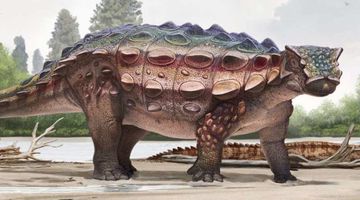
The world of paleontology has unveiled a remarkable recent species of dinosaur, Haolong dongi, meaning “spiny dragon,” offering an unprecedented glimpse into the skin and potential defenses of these ancient creatures. Discovered in northeastern China, this early Cretaceous dinosaur, dating back approximately 125 million years, is distinguished by its uniquely preserved integument – a combination of scales and striking, hollow keratinous spines. The discovery is reshaping our understanding of dinosaur skin and the evolutionary strategies employed for protection and potentially, thermoregulation.
Unlike the often-imagined smooth skin of dinosaurs, or the feathered coverings of their theropod relatives, Haolong dongi presents a novel skin structure. The fossil, representing a nearly complete juvenile skeleton, showcases a fascinating array of spines interspersed among scales. These spines, varying in size from a few millimeters to over four centimeters, are not simply surface features; they are preserved down to the cellular level, revealing a complex internal structure. This level of preservation is exceptionally rare, providing scientists with a detailed window into the biology of dinosaurs that was previously unattainable. The find challenges existing assumptions about dinosaur integument and opens new avenues for research into their evolutionary adaptations.
Unearthing the “Spiny Dragon”: A Detailed Look at Haolong dongi
The Haolong dongi fossil was recovered from the Yixian Formation in Liaoning Province, China, a region renowned for its remarkably well-preserved fossils. The Yixian Formation, known for its volcanic ash deposits, provides ideal conditions for fossilization, preserving even delicate structures like skin and soft tissues. Everything Dinosaur reports that the specimen is approximately 2.45 meters (8 feet) long, indicating it was a juvenile at the time of its death. The completeness of the skeleton, coupled with the exceptional preservation of the skin, makes this discovery particularly significant.
The spines themselves are composed of keratin, the same protein that forms human fingernails and hair and are structurally distinct from both the protofeathers found in some theropod dinosaurs and the scales of modern reptiles. Researchers have compared them to the quills of a porcupine, suggesting a potential defensive function. Histological analysis revealed that the spines were hollow and contained structures resembling keratinocyte nuclei, further confirming their composition and providing insights into their growth and development. The arrangement of the spines, aligned along the neck, back, and sides of the body, suggests a deliberate pattern designed to deter potential predators.
Evolutionary Significance and Potential Functions of the Spines
Haolong dongi belongs to the hadrosauroid group of ornithopod dinosaurs, plant-eating dinosaurs that would eventually give rise to the hadrosaurs, or duck-billed dinosaurs. Wikipedia details that the genus Haolong was formally named in 2026 by Huang et al., with the species name dongi honoring the prominent Chinese paleontologist Dong Zhiming. The discovery of Haolong dongi provides crucial information about the early evolution of hadrosaurs and their adaptations to the Cretaceous environment.
The function of the spines remains a subject of ongoing research, but several hypotheses have been proposed. One possibility is that they served as a form of defense against predators. While not necessarily capable of inflicting serious injury, the spines could have made the juvenile Haolong dongi a less appealing target, disrupting a predator’s attack or making it more difficult to grasp. The spines may also have played a role in thermoregulation, helping the dinosaur to regulate its body temperature in the relatively cool climate of northeastern China during the Early Cretaceous. Another possibility is that the spines served a tactile function, providing the dinosaur with increased sensory awareness of its surroundings.
Pascal Godefroit, a paleontologist at the Institute of Natural Sciences, emphasized the extraordinary nature of the find, stating, “Finding skin preserved at the cellular level in a dinosaur is extraordinary,” as reported by The Independent. “It gives us a window into the biology of these animals at a level that we never thought possible.” This unprecedented level of detail allows researchers to explore the physiological processes and evolutionary adaptations of dinosaurs in a way that was previously unimaginable.
Implications for Understanding Dinosaur Integument and Behavior
The discovery of Haolong dongi challenges the traditional view of dinosaur skin as being solely composed of scales or feathers. It demonstrates that a wider range of integumentary structures existed than previously recognized, and that these structures could have played a variety of roles in dinosaur biology. The spines of Haolong dongi represent a unique adaptation that has not been observed in any other dinosaur species to date, highlighting the diversity and complexity of dinosaur evolution.
The fact that the specimen is a juvenile raises questions about whether adult Haolong dongi also possessed these spines, or whether they were shed as the animal matured. Researchers are currently investigating this question, but the answer remains elusive. The spines’ structure, being keratinous, suggests the possibility of periodic shedding, similar to the way some modern reptiles shed their scales. Further discoveries of adult Haolong dongi specimens will be crucial to resolving this mystery.
The environment in which Haolong dongi lived was also home to relatively small carnivorous dinosaurs. This suggests that the spines may have evolved as a specific defense mechanism against these local predators. The spines, while not impenetrable, could have made the juvenile dinosaur a more difficult and time-consuming prey item, potentially reducing the likelihood of a successful attack. Researchers theorize that this defense wouldn’t necessarily prevent an attack, but would craft the prey less desirable, increasing its chances of survival.
Key Takeaways
- Haolong dongi, a newly discovered dinosaur species from China, exhibits unique keratinous spines alongside scales.
- The fossil provides unprecedented cellular-level preservation of dinosaur skin, offering insights into its structure and function.
- The spines likely served a defensive purpose, potentially deterring predators or aiding in thermoregulation.
- The discovery expands our understanding of dinosaur integument and highlights the diversity of evolutionary adaptations.
The ongoing research into Haolong dongi promises to reveal even more about the lives of these fascinating creatures. Future studies will focus on analyzing the biomechanical properties of the spines, investigating their potential role in thermoregulation, and searching for additional specimens to determine whether the spines were present in adult individuals. The continued exploration of the Yixian Formation and other fossil-rich sites around the world will undoubtedly yield further discoveries that shed light on the remarkable world of dinosaurs.
Researchers are planning further expeditions to the Yixian Formation in the coming months, hoping to uncover additional Haolong dongi specimens and gain a more complete understanding of this remarkable species. The team will also be employing advanced imaging techniques to further analyze the preserved skin and spines, seeking to unlock even more secrets about the biology of this “spiny dragon.” The next major update from the research team is expected in late 2026, following the completion of their analysis of the existing specimen and the initial findings from the new expeditions.
What are your thoughts on this incredible discovery? Share your comments below, and don’t forget to share this article with your friends and colleagues!
Worth a look