
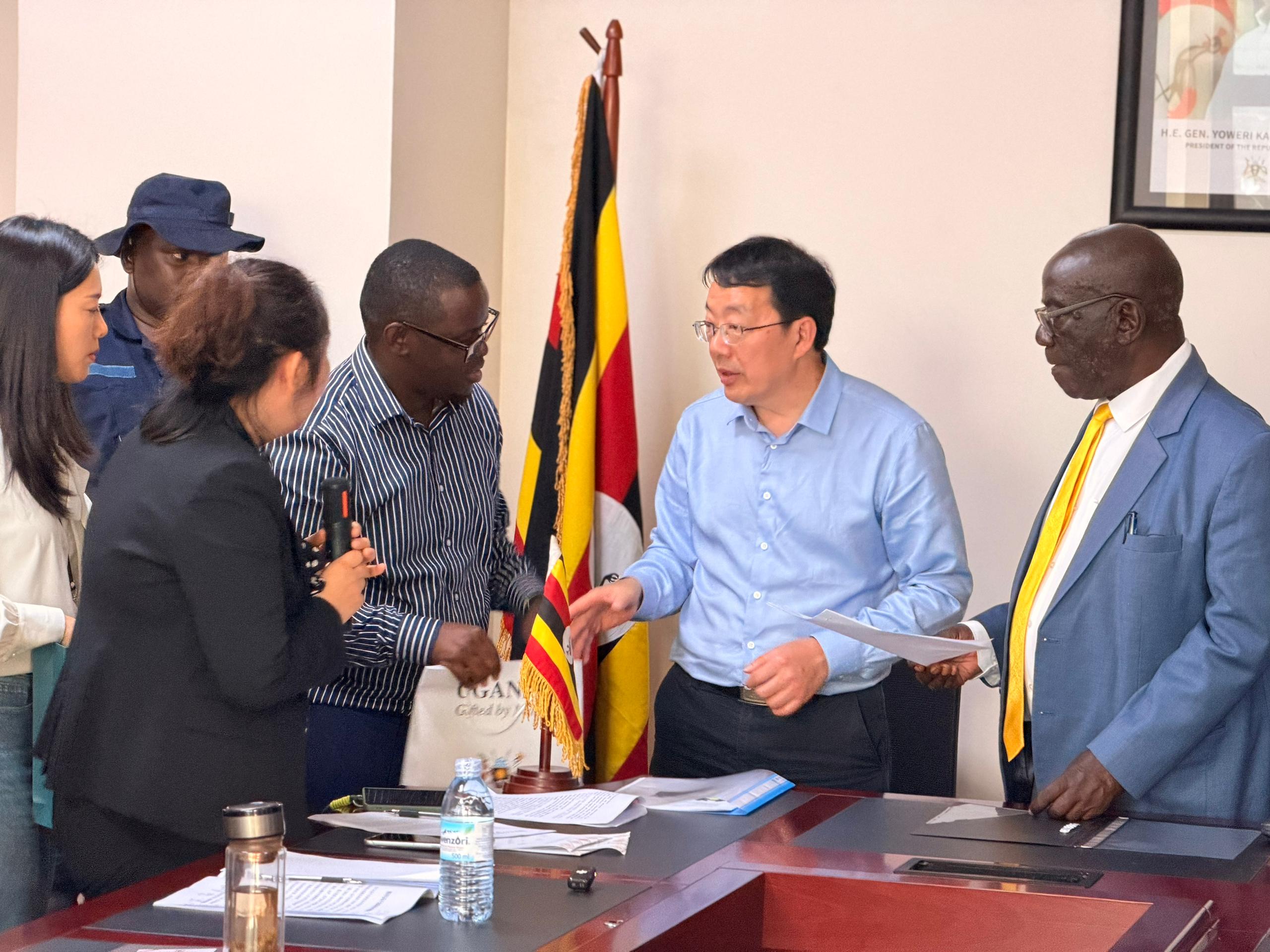
Former Ugandan Vice President Edward Kiwanuka Ssekandi welcomed a Chinese delegation to his Kampala office on April 25, 2026, praising their commitment to revive stalled development initiatives in the Greater Masaka region. The meeting, held at his official residence known as the Kampala Kingdom office, focused on rekindling economic cooperation between Uganda and China, particularly in agriculture, industrialization, and infrastructure.
Ssekandi, who continues to serve as Presidential Special Envoy on Political Affairs, emphasized that the renewed engagement builds on longstanding ties between Uganda and the People’s Republic of China. He described the relationship as founded on mutual respect, trust, and a shared vision for development, noting that earlier delays were largely attributable to the global disruptions caused by the COVID-19 pandemic.
The six-member delegation was led by Wu Xiuqiang, Deputy Director General of the Sichuan Provincial Department of Agriculture and Rural Affairs and Chairman of the China-Africa Friendship Association. Other members included Yao Chengwen, Fengi Yuanyi, Chen Liang, Li Hongquan, and Zhang Zingizhi, all affiliated with the Division of Exchange and Cooperation under the same Sichuan provincial department.
During the discussions, Ssekandi outlined plans to revive the Greater Masaka Consortium and Development Initiatives, a multi-sectoral strategy aimed at transforming the region into an industrial and agricultural hub. He specified that the initiative would focus on industrialization, modern agriculture, and infrastructure development, leveraging existing assets such as the Masaka Industrial Park.
He elaborated that the renewed cooperation would include development of the industrial park, glass manufacturing, solar energy projects, road network improvements, rice farming expansion, food processing facilities, fishing industry support, and agro-processing factories. Ssekandi added that these efforts are expected to generate employment for youth, broaden agricultural markets, and enhance vocational training opportunities across Greater Masaka.
Oscar Mutebi, Ssekandi’s personal assistant, echoed these sentiments, stating that the engagement reflects a long-term vision to reposition Greater Masaka as a dynamic economic hub driven by international partnerships. Mutebi emphasized that the goal is to revive the Greater Masaka Development Initiative and restore economic vibrancy to the region.
Wu Xiuqiang, speaking on behalf of the Chinese delegation, affirmed their readiness to deepen cooperation and support the reactivation of dormant development frameworks. He stated that the delegation is committed to revitalizing the Greater Masaka Consortium and strengthening collaboration in agriculture and industrial development.
The Greater Masaka Development agenda draws from earlier government efforts, including the establishment of the Masaka Industrial Park on 960 acres in Bukakata Sub-county. The park was commissioned in 2015 as part of Uganda’s national industrialization drive and developed through a partnership with Chinese infrastructure firms. Officials have noted that the park is intended to leverage the region’s strengths in agriculture, fisheries, energy, and transport connectivity to stimulate large-scale economic transformation.
Ssekandi’s office confirmed that the renewed engagement signals a fresh push to attract foreign investment into regional industrial clusters, with Greater Masaka positioned as a key economic corridor within Uganda’s long-term development strategy. The initiative aligns with broader national goals to decentralize industrial growth and reduce reliance on Kampala-centric economic activity.
Background on the Masaka Industrial Park
The Masaka Industrial Park, located in Bukakata Sub-county of Masaka District, spans approximately 960 acres and was officially launched in 2015. Developed under a public-private partnership model involving Ugandan authorities and Chinese investors, the park was designed to host industries in agro-processing, textiles, construction materials, and light manufacturing. Its development was part of Uganda’s broader strategy to establish regional industrial parks outside the capital to promote balanced economic growth.
Officials have highlighted the park’s strategic location near Lake Victoria and along key transport corridors connecting Uganda to neighboring countries such as Tanzania, Rwanda, and the Democratic Republic of the Congo. The site benefits from access to hydroelectric power and water resources, which are critical for energy-intensive industries. Over the years, the park has attracted interest from investors in sectors including packaging, fertilizer blending, and building materials, though full occupancy has been gradual due to earlier delays in infrastructure completion and market readiness.
China-Uganda Economic Cooperation
Uganda and China have maintained diplomatic relations since 1962, with economic cooperation expanding significantly over the past two decades. Chinese investment in Uganda has focused on infrastructure projects such as roads, bridges, and energy installations, as well as ventures in mining, telecommunications, and real estate. The two countries have also collaborated under frameworks such as the Forum on China-Africa Cooperation (FOCAC), which Uganda has participated in since its inception.

In recent years, Uganda has sought to deepen ties with Chinese investors in value-added agriculture and industrial manufacturing, aiming to move beyond raw material exports toward processed goods. Initiatives like the Greater Masaka Consortium reflect this shift, emphasizing local job creation, technology transfer, and sustainable development. Ssekandi’s role as a senior presidential envoy underscores the government’s commitment to advancing these partnerships at the highest level.
Greater Masaka Region: Economic Potential and Challenges
The Greater Masaka region, encompassing Masaka, Kalungu, Bukomansimbi, and Lwengo districts, is known for its fertile soils, favorable climate, and proximity to major water bodies including Lake Victoria. Agriculture remains the backbone of the local economy, with coffee, bananas, tea, and livestock farming being dominant activities. The region also supports significant fisheries and has potential for solar energy generation due to high sunlight exposure.

Despite these advantages, the area has faced challenges related to limited industrialization, inadequate road networks in rural areas, and post-harvest losses in agricultural production. Efforts to address these gaps have included government-led irrigation schemes, rural electrification programs, and support for farmer cooperatives. The revival of the Greater Masaka Consortium aims to integrate such efforts into a cohesive strategy for economic transformation.
Local leaders and development experts have noted that success will depend on sustained investment, transparent governance, and effective collaboration between national authorities, local governments, and private sector partners. They have also stressed the importance of ensuring that benefits are equitably distributed, particularly for youth and women who constitute a large portion of the region’s population.
As of April 2026, Ugandan officials have indicated that monitoring mechanisms will be established to track progress on investment commitments, job creation, and infrastructure milestones tied to the renewed initiative. Regular review meetings between Ugandan and Chinese representatives are expected to be scheduled to ensure accountability and adaptive management.
The renewed dialogue between Ssekandi and the Sichuan delegation marks a notable step in Uganda’s efforts to revitalize regional development through international cooperation. With the Masaka Industrial Park serving as a foundational asset, stakeholders hope that the revived consortium will unlock novel opportunities for inclusive and sustainable growth in Greater Masaka.
For updates on Uganda’s industrial development policies and China-Africa cooperation initiatives, readers can refer to official publications from the Uganda Investment Authority and the Ministry of Foreign Affairs.
We welcome your thoughts on this development. Share your perspective in the comments below or join the conversation on social media.