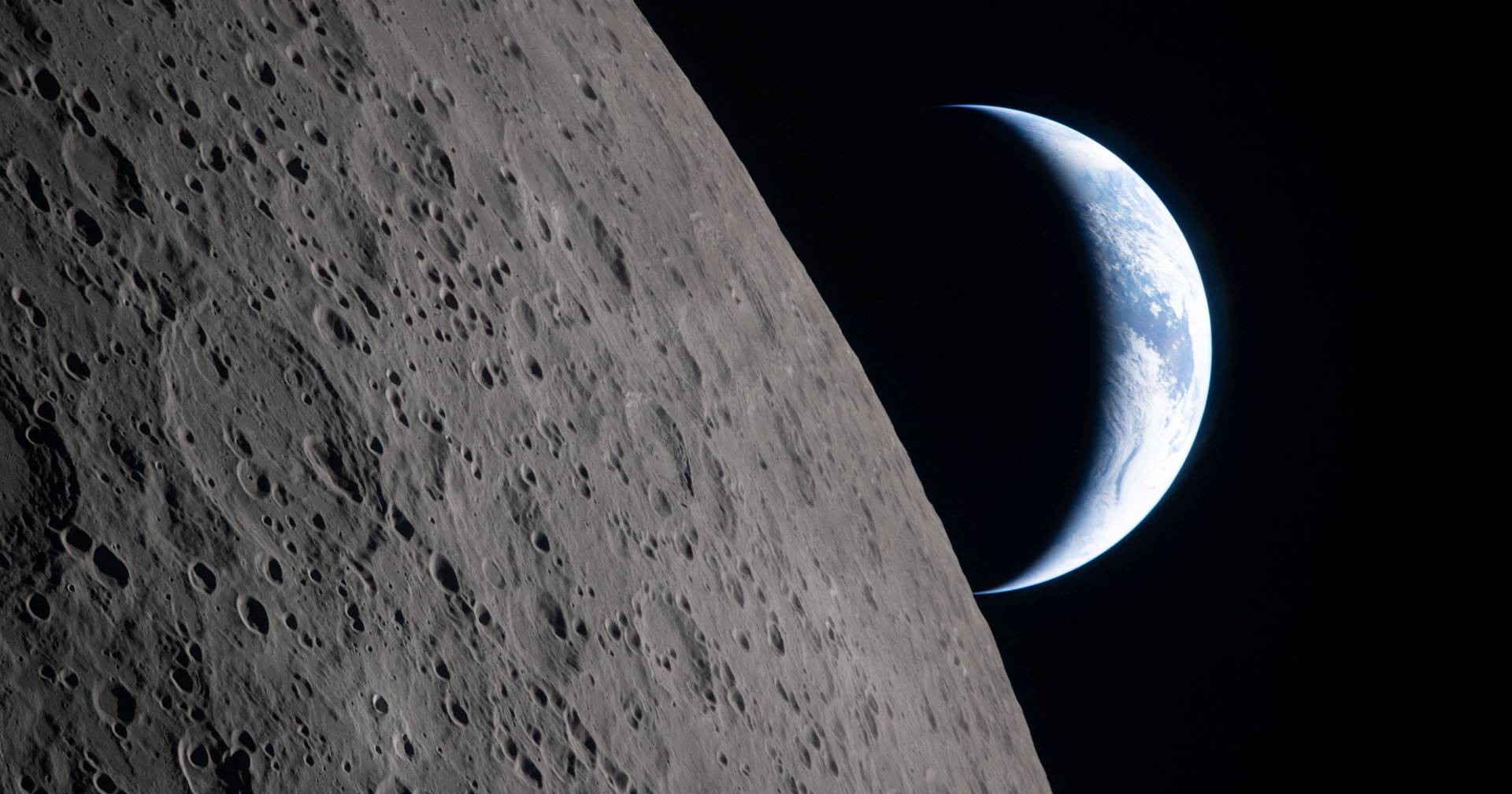
As of today, Wednesday, April 8, 2026, the world is watching the skies with a sense of nostalgia and futuristic ambition. The crew of Artemis II is currently navigating the long journey back to Earth, having just completed a historic loop around the Moon. While the technical achievements of the mission are staggering, It’s the imagery being beamed back to mission control that has captured the global imagination.
These Artemis II lunar flyby photos offer more than just scientific data; they provide a profound perspective on our place in the cosmos. From the stark, cratered vistas of the lunar far side to the fragile blue marble of Earth suspended in the void, the images serve as a visual bridge between the Apollo era and a new age of deep space exploration.
The mission, which launched on April 1, 2026, represents the first time humans have ventured beyond low Earth orbit since the Apollo 17 mission in December 1972 Artemis II Wikipedia. Aboard the Orion spacecraft, named Integrity by its crew, four astronauts are testing the critical systems required to eventually sustain human life on the lunar surface and, eventually, on Mars.
Capturing the Void: The Visuals of the Far Side
One of the most anticipated aspects of the mission has been the imagery of the Moon’s far side. Because the Moon is tidally locked to Earth, the far side remains forever hidden from our terrestrial telescopes. The Artemis II crew has now eclipsed previous records for the farthest human spaceflight, allowing them to capture high-resolution views of this mysterious region NASA Artemis II Mission.
The crew’s trajectory was designed as a 10-day free-return mission, bringing the Integrity spacecraft within approximately 6,545 kilometers (4,067 miles) of the lunar far side at its closest approach Artemis II Wikipedia. This proximity has allowed for a suite of photos that highlight the rugged, highland-heavy terrain of the lunar backside, providing essential reconnaissance for future landing sites.
Beyond the Moon, the crew has shared breathtaking “Earthset” photos—the opposite of the famous “Earthrise”—capturing our home planet as it disappears or reappears over the lunar horizon. These images underscore the isolation of deep space and the precision of the Space Launch System (SLS) rocket that propelled them into the void.
The Architecture of a Return: Orion and SLS
The success of these visuals depends entirely on the synergy between the Space Launch System (SLS) and the Orion spacecraft. The SLS, NASA’s heavy-lift rocket, provided the massive thrust necessary to escape Earth’s gravity and inject the crew into a trans-lunar trajectory NASA Spaceflight.
Orion CM-003, the command module, was specifically developed to sustain the crew during the rigors of deep space. Unlike the Apollo missions, Artemis II did not enter lunar orbit. Instead, it performed a high-speed flyby, testing the spacecraft’s ability to handle extreme velocities and radiation environments far from the protection of Earth’s magnetic field NASA Artemis II Mission.
The mission’s technical milestones are being hit with precision. On Flight Day 6, the crew wrapped up the historic lunar flyby, and by Flight Day 7, they successfully completed the first return correction burn to ensure their trajectory is aligned for a safe reentry NASA Artemis II Mission.
The Human Element: A Diverse Crew for a New Era
The images being sent home are the result of the work of four highly skilled astronauts: Reid Wiseman, Victor Glover, Christina Koch, and Jeremy Hansen Artemis II Wikipedia. This crew represents a significant shift in the demographics of space exploration, featuring the first woman and the first person of color to venture toward the Moon.

The psychological and physical toll of such a journey is immense. To preserve the public engaged and the crew connected, NASA has facilitated long-distance calls from the spacecraft. On Flight Day 7, the crew made a historic call back to Earth, sharing their experiences of the lunar flyby while orbiting thousands of miles away from any other human being NASA Artemis II Mission.
Their journey is not merely about the destination, but about proving that the deep space systems—including life support, navigation, and communication—can function flawlessly for a crew of four over a 10-day period NASA Artemis II Mission.
Artemis II Mission Timeline and Key Milestones
| Event | Date/Time | Detail |
|---|---|---|
| Launch | April 1, 2026, 6:35 PM EDT | Liftoff from Kennedy Space Center LC-39B NASA Spaceflight |
| Lunar Flyby | April 6, 2026 | Crew wraps historic lunar flyby NASA Artemis II Mission |
| Return Burn | April 7, 2026 | First return correction burn completed NASA Artemis II Mission |
| Planned Landing | April 11, 2026, 00:21 UTC | Splashdown in the Pacific Ocean Artemis II Wikipedia |
What This Means for the Future of Exploration
The Artemis II mission is a critical stepping stone. By successfully executing a crewed flyby, NASA has validated the Orion spacecraft’s capability to return humans safely from the vicinity of the Moon. This paves the way for Artemis III, which aims to land humans on the lunar surface for the first time in over half a century.
The “Integrity” mission proves that the infrastructure for long-term lunar habitation—and eventually a transition to Mars—is viable. The data gathered from the radiation environment and the performance of the SLS rocket will inform every mission that follows. For the global community, the photos of the Moon’s far side are a reminder that there are still frontiers to explore and mysteries to solve within our own celestial neighborhood.
As the crew prepares for their descent, the focus shifts to the recovery operation. The USS John P. Murtha is currently positioned in the Pacific Ocean, awaiting the arrival of the Orion capsule on April 11 Artemis II Wikipedia.
The next confirmed checkpoint for the mission is the landing and recovery of the crew, scheduled for April 11, 2026. We will continue to provide updates as the Orion spacecraft makes its final approach to Earth.
Do you think the Artemis missions will lead to a permanent human presence on the Moon? Share your thoughts in the comments below or share this story on social media.